
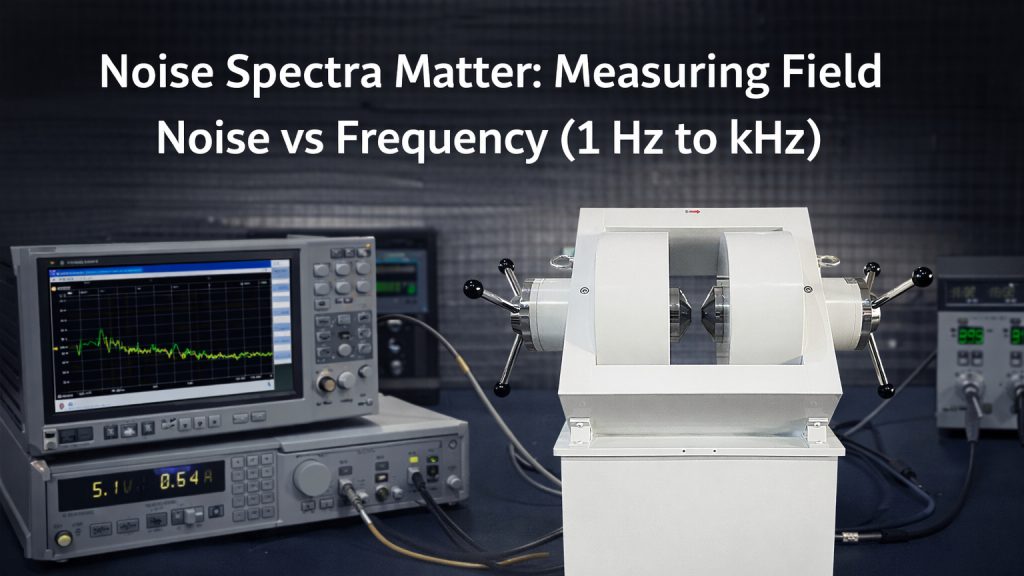
In precision magnetic experiments, field stability is often specified using a simple value such as peak-to-peak noise.
However, for many real research applications, this single number is not sufficient.
Serious experimental work often requires understanding how magnetic field noise is distributed across frequency. Instead of asking only for a peak fluctuation, researchers examine the magnetic field noise spectrum.
This article explains why noise spectra matter and how magnetic field noise is measured across frequencies ranging from 1 Hz to several kilohertz.
Why Peak-to-Peak Noise Is Not Enough
A peak-to-peak specification only describes the maximum variation within a measurement window.
Two magnet systems may both show ±0.1 mT fluctuations, but their spectral characteristics can be very different.
For example:
- one system may contain low-frequency drift
- another may contain switching noise from power electronics
These two systems will behave very differently in sensitive experiments.
Understanding the noise spectrum provides much more insight into system performance.
Magnetic Field Noise Sources
Magnetic field noise in electromagnet systems can originate from several sources.
Common contributors include:
Power Supply Ripple
Current ripple in the excitation power supply directly affects the magnetic field.
Even small ripple levels may produce measurable field fluctuations.
Environmental Magnetic Noise
External magnetic disturbances may come from:
- nearby electrical equipment
- building power lines
- moving ferromagnetic objects
These effects are particularly visible at low frequencies.
Thermal Drift
Temperature changes can cause slow variations in coil resistance and magnetic circuit behavior.
These effects usually appear in the sub-Hz to low-Hz frequency range.
What a Noise Spectrum Shows
A magnetic field noise spectrum describes how field fluctuations vary as a function of frequency.
Instead of a single value, the spectrum shows:
- dominant noise frequencies
- broadband noise levels
- system resonances
Noise spectra are often plotted as power spectral density (PSD) versus frequency.
Background on spectral analysis and FFT methods can be found here:
https://en.wikipedia.org/wiki/Fast_Fourier_transform
Spectral analysis allows researchers to identify the physical sources of noise.
Measuring Magnetic Field Noise
Field noise measurements require a carefully designed measurement chain.
Typical components include:
Magnetic Field Sensor
Common options include:
- Hall probes
- fluxgate magnetometers
- search coils
The sensor must have sufficient bandwidth and sensitivity.
Data Acquisition System
The signal is sampled and digitized using a high-resolution data acquisition system.
Sampling rate determines the measurable frequency range.
FFT Analysis
The recorded time-domain signal is transformed into the frequency domain using FFT (Fast Fourier Transform).
This produces the magnetic field noise spectrum.
Measurement Bandwidth and Frequency Range
Noise measurements typically cover a wide frequency range.
Common regions include:
Low Frequency (1 Hz – 10 Hz)
Dominated by:
- thermal drift
- environmental magnetic disturbances
Mid Frequency (10 Hz – 1 kHz)
Often influenced by:
- power supply ripple
- mechanical vibrations
Higher Frequency (kHz Range)
Noise sources may include:
- switching electronics
- electromagnetic interference
Understanding the frequency distribution helps engineers reduce noise effectively.
Reducing Magnetic Field Noise
Several strategies can improve magnetic field stability.
Low-Noise Current Sources
High-precision current sources reduce ripple and electrical noise.
Magnetic Shielding
Magnetic shielding enclosures can reduce environmental magnetic disturbances.
Background information on magnetic shielding can be found here:
https://en.wikipedia.org/wiki/Magnetic_shielding
Proper Grounding and Power Filtering
Power line noise can couple into magnet systems through grounding or supply connections.
Filtering and grounding design play an important role in noise control.
System-Level Considerations
Magnetic field noise is rarely caused by a single component.
Instead, it is influenced by the entire system:
- current source design
- coil geometry
- laboratory environment
- sensor bandwidth
Cryomagtech provides electromagnet and Helmholtz coil systems designed for stable magnetic field generation and compatibility with low-noise experimental setups.
👉 Product Link Placeholder – Low Noise Electromagnet and Helmholtz Coil Systems
System-level design helps researchers achieve stable magnetic environments for precision experiments.
Key Takeaways
- Peak-to-peak noise alone does not fully describe field stability
- Noise spectra reveal how fluctuations vary across frequency
- FFT analysis converts time signals into frequency-domain noise data
- Power supply ripple and environmental fields are common noise sources
- System design and shielding help reduce magnetic field noise
Understanding magnetic field noise spectra helps researchers design more stable and reliable experiments.