
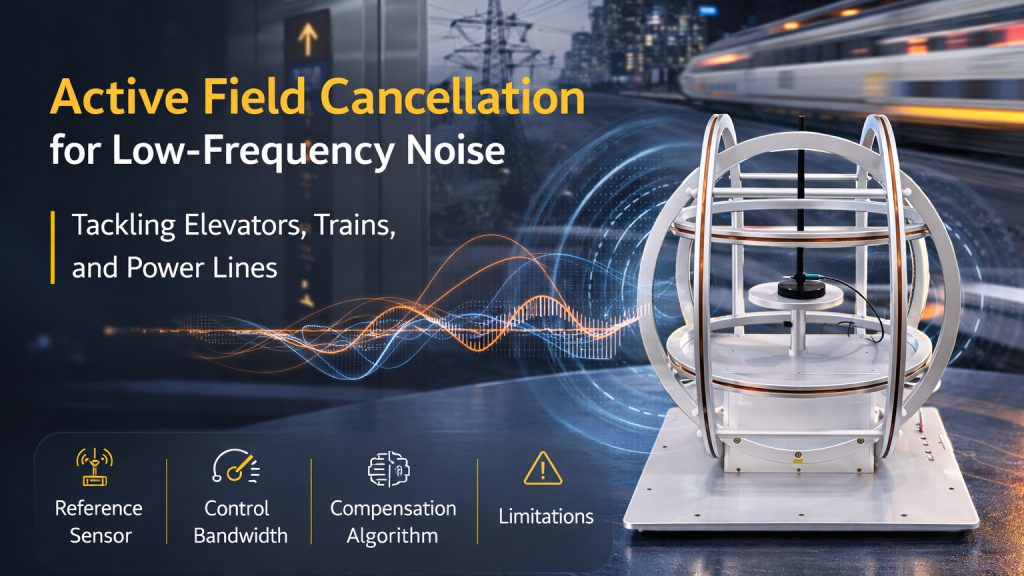
Many modern laboratories are located in dense urban environments.
Even when a magnet system itself is highly stable, external magnetic disturbances can dominate the noise floor of an experiment. Typical sources include:
- elevators and moving metal structures
- nearby railway or subway systems
- AC power lines and electrical infrastructure
These disturbances often appear in the low-frequency range (sub-Hz to tens of Hz) and can significantly affect sensitive measurements.
Active magnetic field cancellation systems are designed to suppress these disturbances in real time.
Why Low-Frequency Magnetic Noise Is Difficult
Low-frequency magnetic fields behave very differently from high-frequency electromagnetic interference.
At low frequencies:
- passive shielding becomes less effective
- disturbances propagate over large distances
- environmental sources cannot easily be eliminated
For example, extremely low-frequency magnetic fields generated by power infrastructure or transportation systems are a common source of interference in high-precision instruments.
Because these fields vary slowly, they can distort measurements over long time scales.
The Principle of Active Field Cancellation
Active cancellation systems use a closed-loop feedback approach.
The system typically contains three main components:
- Magnetic field sensors
- Compensation coils
- Control electronics
The operating principle is straightforward.
A sensor measures the environmental magnetic field. The system then generates an opposing magnetic field using coils placed around the experimental volume.
When the opposing field is correctly phased and scaled, the disturbance is reduced.
This process runs continuously in real time.
Why Three-Axis Compensation Is Often Required
Environmental magnetic disturbances rarely occur in a single direction.
Instead, disturbances vary along the X, Y, and Z axes.
Many active cancellation systems therefore use three orthogonal coil sets that generate compensating fields in each direction.
A typical architecture includes:
- a fluxgate or Hall sensor measuring the ambient field
- three orthogonal compensation coils
- a control system that adjusts coil current in each axis
The feedback controller generates anti-phase fields to suppress the disturbance.
This approach allows cancellation within a defined volume.
Reference Sensors and Measurement Placement
The location of the reference sensor is critical.
If the sensor is too close to the compensation coil, feedback may become unstable.
If it is too far from the experimental region, the measured disturbance may not represent the actual field at the experiment.
Typical strategies include:
- placing the sensor near the experiment center
- using multiple sensors for improved spatial accuracy
- calibrating sensor response during installation
These steps ensure the compensation system responds correctly to environmental noise.
Control Bandwidth and Compensation Limits
Active field cancellation systems have a finite control bandwidth.
This means they can only compensate disturbances within a certain frequency range.
Typical performance ranges include:
- DC to a few tens of Hz
- sometimes up to several hundred Hz
Higher-frequency noise often requires other mitigation methods such as:
- shielding
- cable filtering
- instrument isolation
Active cancellation is therefore most effective for slow environmental disturbances.
Compensation Algorithms
The control system must determine how strongly the compensation coils should respond to the measured disturbance.
Common approaches include:
- feedback control loops
- adaptive filtering algorithms
- feed-forward correction
Advanced systems may use algorithms such as filtered-x least mean squares (FxLMS) to suppress environmental magnetic noise.
These algorithms continuously adjust the compensation signal as environmental conditions change.
Combining Active and Passive Methods
Active field cancellation is often combined with passive magnetic shielding.
Passive shielding reduces background field levels, while active compensation removes remaining fluctuations.
Multi-layer shielding structures using high-permeability materials can attenuate low-frequency fields by redirecting magnetic flux.
Together, these approaches can significantly improve the magnetic environment in a laboratory.
Applications in Sensitive Instrumentation
Active magnetic compensation is commonly used in systems that require extremely stable magnetic environments.
Examples include:
- electron microscopes
- electron beam lithography tools
- magnetometry experiments
- quantum sensing systems
These instruments are often sensitive to very small magnetic fluctuations.
Active compensation systems help maintain stable conditions even in noisy environments.
System-Level Design Considerations
Successful field cancellation systems must consider:
- sensor sensitivity and bandwidth
- compensation coil geometry
- controller stability
- laboratory layout
Cryomagtech supports laboratories designing electromagnet and Helmholtz coil systems that can integrate with three-axis active field compensation and background field control strategies.
👉 Product Link Placeholder – Three-Axis Helmholtz and Field Compensation Systems
Integrating cancellation coils with experimental magnet systems allows researchers to maintain stable magnetic conditions even in challenging urban environments.
Key Takeaways
- Urban laboratories often experience low-frequency magnetic disturbances
- Active field cancellation measures environmental noise and generates opposing fields
- Three-axis coil systems compensate disturbances in all directions
- Feedback controllers and adaptive algorithms adjust the compensation in real time
- Combining active cancellation with passive shielding provides the best performance
Active compensation systems allow precision experiments to operate reliably even when environmental magnetic noise cannot be avoided.