
Precision Magnetic Field Generation with Standard Configurations, Water-Cooled High-Field Builds, and Engineered Vector / Multipole Solutions

Create a controllable magnetic field exactly where your experiment needs it—between the pole faces, with the gap, access, stability, and integration options defined around your test setup.
Cryomagtech designs and supplies laboratory electromagnets for materials science, physics, semiconductor and sensor testing—covering adjustable gap electromagnets, horizontal field / vertical field configurations, water-cooled electromagnets for high duty cycle, plus vector and multipole electromagnets when the field direction (not just magnitude) is the experiment.
👉Get a Quote Now – 24h Response Guaranteed
Why Electromagnets
What an electromagnet does in a lab
A laboratory electromagnet is a magnetic field generator that produces a controllable field in an air gap using a coil + magnetic yoke/poles. Change the current, and the field changes; change the gap and pole geometry, and the achievable field, uniformity, and usable sample space change with it.
If your experiment needs:
- Repeatable field sweeps (including crossing through zero)
- Stable field for long measurement windows
- Defined access for optics, probes, sample holders, or rotation
- A path to integrate power supply + gaussmeter + cooling + control
…an electromagnet is usually the most direct and engineering-friendly approach.
Why labs choose electromagnets instead of “any magnet”
Permanent magnets are compact, but not ideal when you need smooth programmable sweeps, polarity reversal, or controlled ramp rates. Coil-only solutions can be excellent for certain uniform-field needs—but many experiments require stronger local fields in a defined pole gap and a structure that integrates cleanly with a test platform.
Electromagnets are the pragmatic “research workhorse” for Hall effect, magnetoresistance, magnetization / hysteresis, magnetic annealing, MOKE, and general magnetic materials research—especially when the setup must evolve over time.
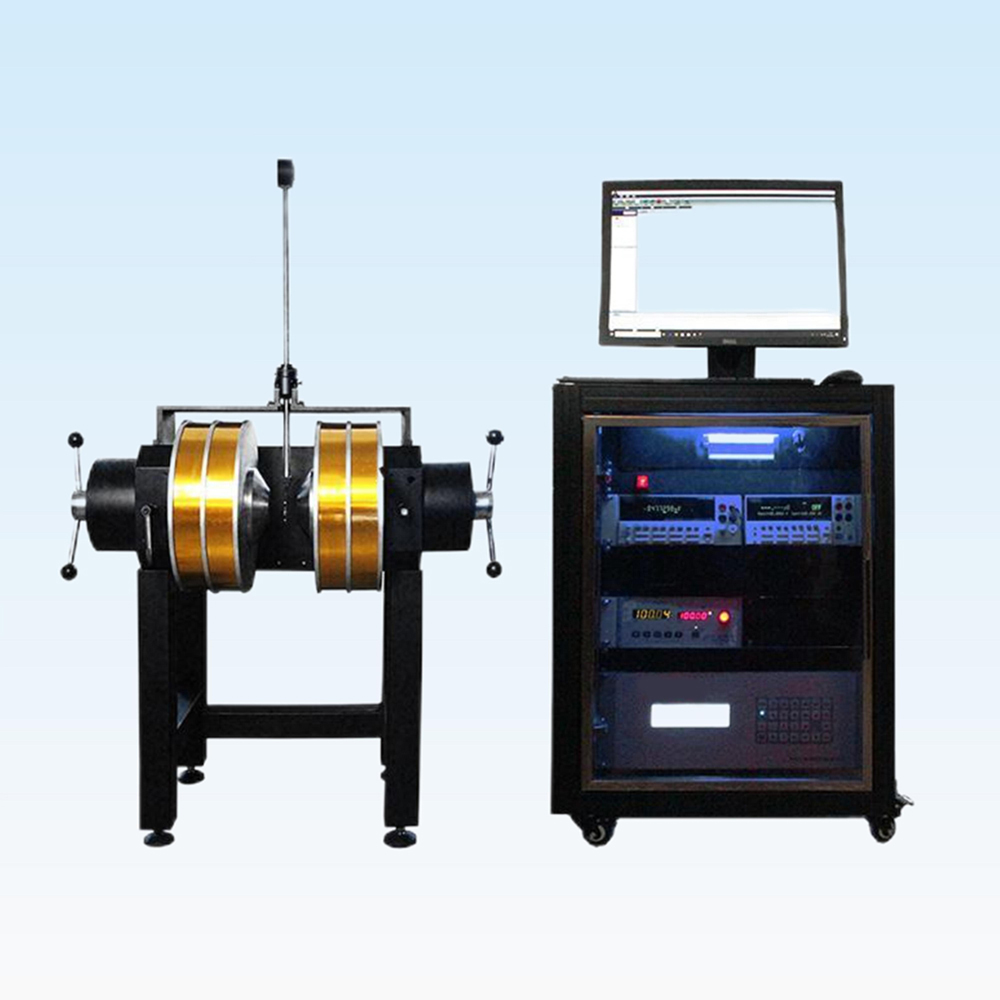
Standard Electromagnet Configurations
This section is written for overseas labs: choose by field direction + access + duty cycle, not by internal series codes.
Standard laboratory dipole electromagnets
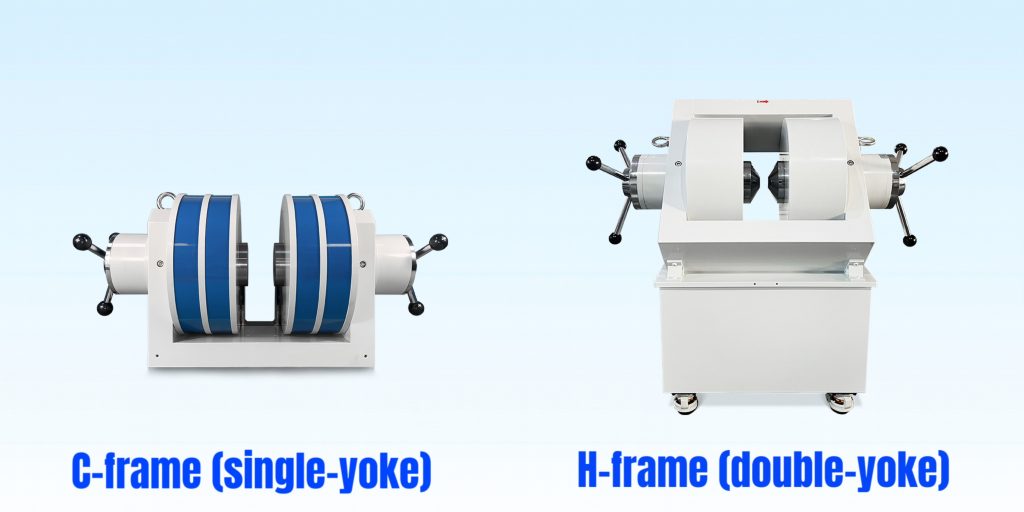
Most laboratory setups start here: a dipole electromagnet producing a field between two poles. Typical mechanical families include:
C-frame (single-yoke) designs
Best when you need open access and easy integration on benches, probe stations, or compact experiment rigs.
H-frame (double-yoke) designs
Used when higher structural rigidity or larger magnetic circuits are needed—often preferred for higher forces, larger poles, and heavier integration.
What you can standardize
- Mechanical family (C-frame vs H-frame)
- Gap adjustment method (bi-directional vs single-direction)
- Pole materials and common pole shapes
- Mounting orientation and basic interfaces
- Common accessories (probe holder, base, safety covers)
What is typically design-dependent
- Achievable field at your required gap
- Field uniformity region vs sample size
- Thermal stability at your duty cycle
- Stray field constraints near sensitive instruments
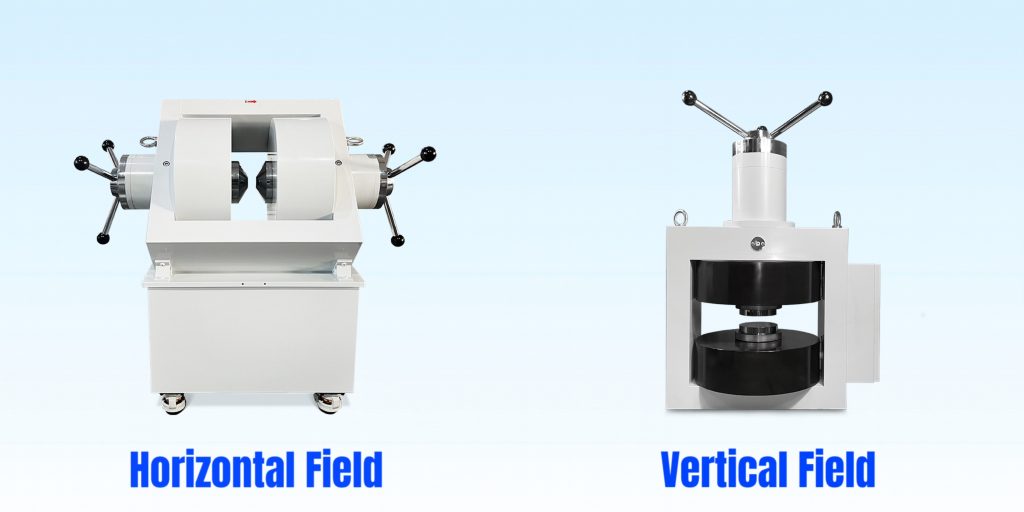
Horizontal field vs vertical field configurations
Field direction is not a detail—it changes how you place the sample, build your fixture, and route probes/optics.
Horizontal field electromagnets
- Field is typically across a horizontal gap line
- Often preferred for many transport / Hall setups with probe access from above/side
- Easy to integrate with a bench test setup or probe station
Vertical field electromagnets
- Field direction is vertical (sample often placed on a lower pole face or fixture)
- Can simplify sample loading and supports heavier sample holders
- Frequently used when sample mounting convenience matters or when a vertical geometry matches the measurement method
Adjustable gap, pole options, and open access
Adjustable gap electromagnets
A variable gap magnet (adjustable-gap electromagnet) lets you trade off:
- More gap / more access ↔ typically lower achievable field at a given coil power
- Smaller gap ↔ typically higher field and better efficiency, but reduced sample space
Two common adjustment concepts:
- Bi-directional adjustment: both poles move—helps keep the field center aligned for some setups
- Single-direction adjustment: one pole moves—simplifies mechanics in some vertical configurations
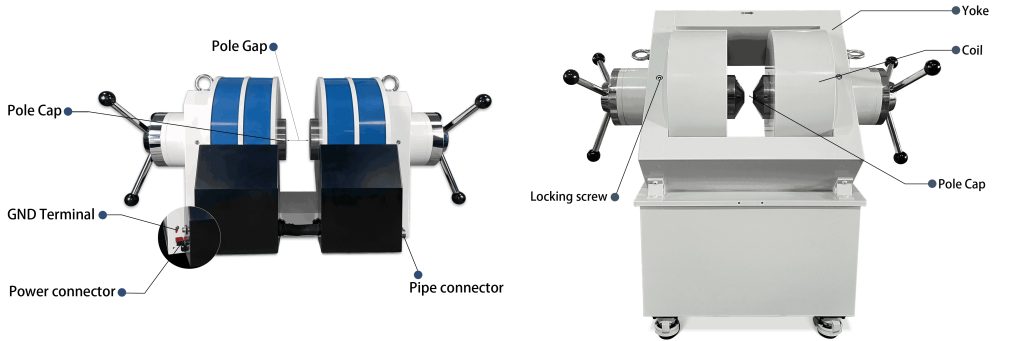
Interchangeable pole caps
Pole faces are where the experiment meets the magnet. Interchangeable pole caps help you adapt to:
- Different sample sizes
- Better uniformity for a specific volume
- Improved access for probes or optics
- Special pole faces for gradient fields or focused regions
Options commonly discussed during selection:
- Flat pole faces (general purpose)
- Tapered / conical pole caps (field optimization for smaller regions)
- Optical-access pole caps (through-holes or windows—trade-offs apply)
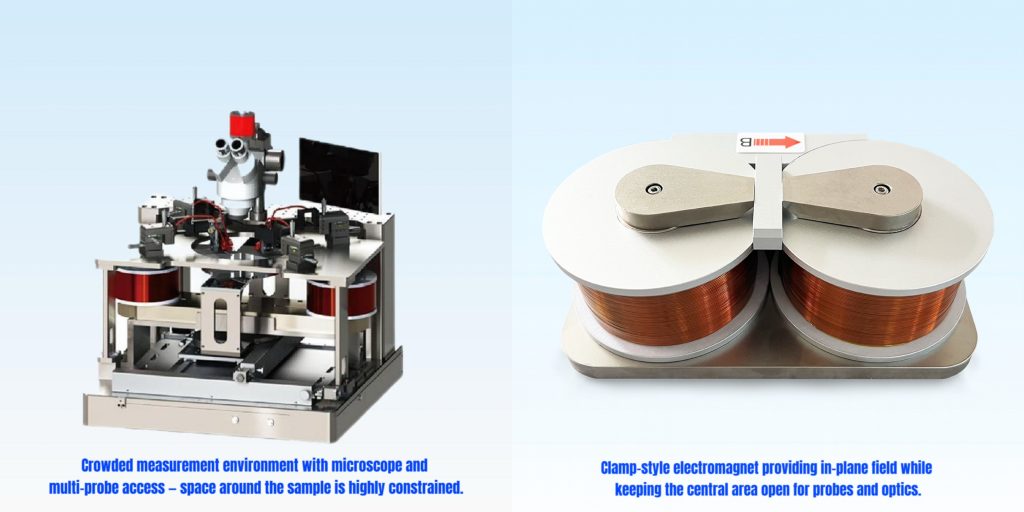
Open-access / clamp-style configurations
When your experiment is crowded (microscope objectives, probe manipulators, optical stages), an open-access geometry becomes critical.
Clamp / open-access electromagnets are designed for:
- In-plane (horizontal/in-plane) field near the sample surface
- Tight working envelopes (microscope, probe station, MOKE optics)
- “Get the field in without blocking everything” setups
These are often engineered solutions, because access constraints vary dramatically between labs.
Water-Cooled and High-Field Electromagnets
When water cooling becomes the right engineering choice
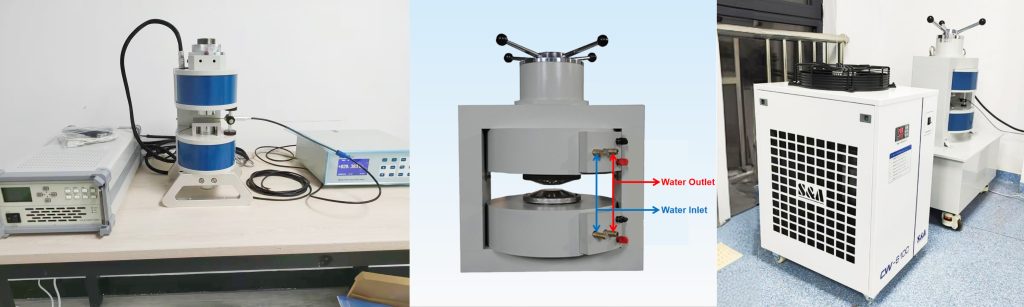
A water-cooled electromagnet is not “just a stronger magnet”—it’s a thermal and duty-cycle decision.
Water cooling is typically considered when you need:
- Higher continuous current (or long hold times at elevated current)
- Better thermal stability (reduced drift from coil heating)
- High duty-cycle field sweeps
- Larger poles / larger magnetic circuits that would otherwise overheat
It also changes system complexity: you will usually plan for a chiller loop, hoses, flow/temperature monitoring, and safety interlocks.
High-field expectations and capability boundaries
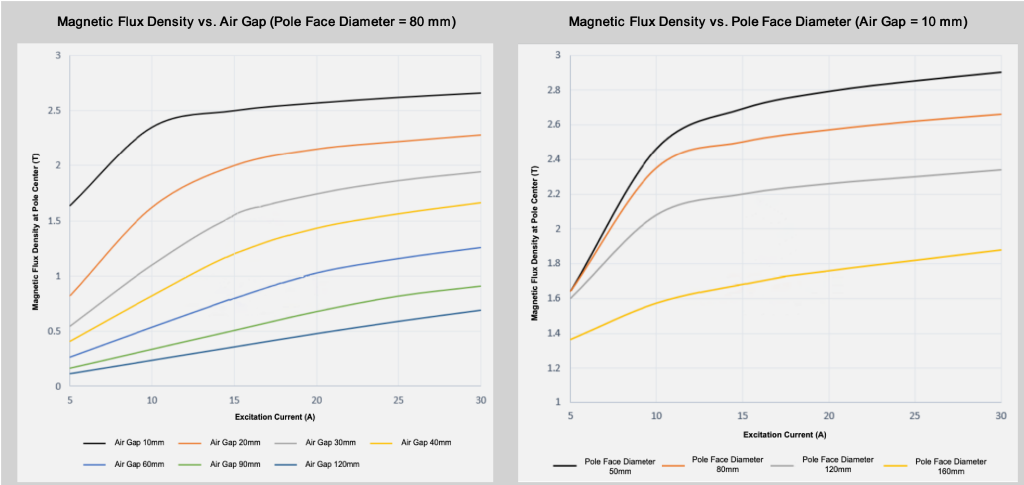
In lab electromagnets, field is not a standalone number. It is strongly influenced by:
- Pole geometry and pole face size
- Air gap / available sample space
- Core material behavior and saturation
- Cooling method and allowable duty cycle
- Power supply current and stability requirements
If you ask for high field + large gap + high uniformity + continuous operation, expect a real engineering trade-off: size, power, cooling, cost, and lead time all move together.
Table
Typical selection guide for standard vs high-duty builds
Table: Electromagnet Configuration Selection Guide (Typical, Not a Datasheet)
| Configuration Type | Field Direction | Cooling Method | Gap Style | Access Style | Typical Use Case | Customization Level |
|---|---|---|---|---|---|---|
| Standard adjustable-gap dipole | Horizontal | Natural / forced air (depending on duty cycle) | Bi-directional or single-direction | General open access | Hall effect, magnetoresistance, magnetization sweeps | Low–Medium |
| High-rigidity dipole | Horizontal | Air or water-cooled | Adjustable or fixed | Bench / instrument integration | High repeatability, heavier fixtures | Medium |
| Vertical-field dipole | Vertical | Air or water-cooled | Often single-direction adjustable | Convenient sample loading | Larger samples, vertical mounting preference | Medium |
| Fixed-gap high-stability dipole | Horizontal | Often water-cooled for long runs | Fixed | Instrument-focused | High stability / repeatability experiments | Medium |
| Water-cooled high-duty electromagnet | Horizontal or vertical | Water-cooled | Adjustable | Depends on integration | Long-duration holds, high duty-cycle sweeps | Medium–High |
| Clamp / open-access electromagnet | Often in-plane | Air or water (case dependent) | Typically small–medium working gap | Microscope/probe access | MOKE, probe station, optics-constrained setups | High |
| Vector / multi-axis electromagnet | 2D / 3D vector | Often water-cooled | Defined by geometry | Optics/probe integration | Directional control, vector sweeps | High |
| Multipole electromagnet | Multipole field distribution | Case dependent | Defined by design | Application-specific | Multipole magnetization, gradient/complex fields | High |
Vector, Multipole, and Special Configurations
Vector electromagnets
A vector electromagnet is designed to control field direction, not only magnitude. Common approaches include:
- 2D in-plane vector field generation (two orthogonal field components)
- 3D vector field by adding a third axis (often with a dedicated coil/solenoid axis)
- Control architecture that supports coordinated multi-axis sweeps
These systems are typically engineered solutions because they rely on:
- Coordinated coil geometry
- Multi-channel (often bipolar) power supplies
- Thermal management and cross-axis coupling considerations
- Field mapping / calibration strategies for your usable volume
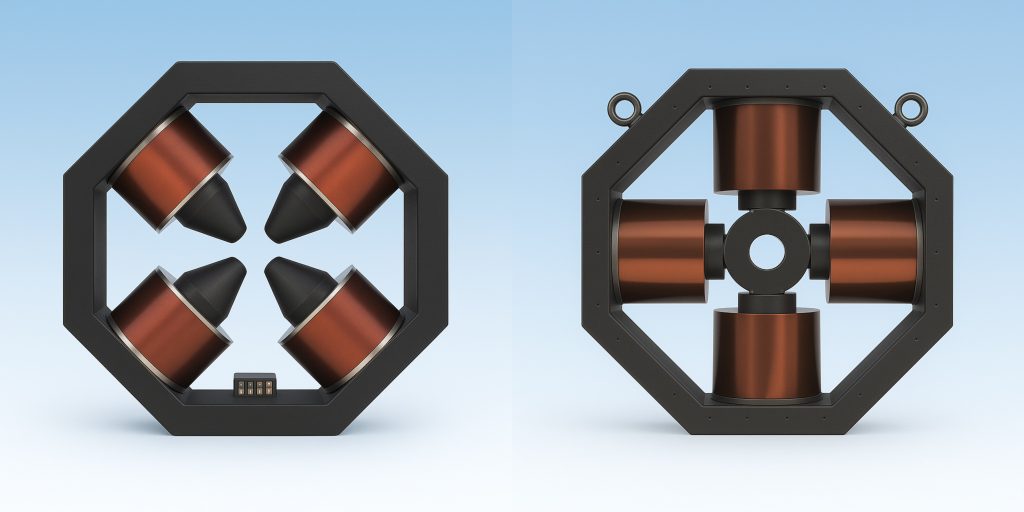
2D systems control in-plane fields,
while 3D systems enable full spatial field control.
Multipole electromagnets
A multipole electromagnet uses multiple poles to create a more complex spatial field distribution (e.g., quadrupole, octupole, and beyond). These are typically selected for:
- Multipole magnetization tasks (e.g., ring magnet magnetization)
- Gradient field requirements
- Application-specific field shaping where a two-pole dipole is not the right tool
Multipole builds are normally custom engineered. Field distribution targets (not just “Tesla”) matter—simulation and acceptance criteria should be defined early.

showing scalable coil architectures for advanced field control and experimental flexibility.
Special configurations
Some requirements are best treated as engineered configurations rather than “standard products”:
- Rotating-field or rotation-stage electromagnets (mechanical rotation of magnet or sample)
- AC electromagnets (to generate alternating fields—core design and eddy-current control matter)
- Special-shaped electromagnets for tight spaces or nonstandard fixtures
- Enhanced optical access (holes/windows) where optics must pass through the pole region
- Probe-station interfaces and microscope compatibility
When any of the above is your primary constraint, we recommend starting with your mechanical envelope and experiment workflow—then designing the magnetic solution around it.

Standard Range, Custom Solutions, and How to Get an Accurate Quote
Standard product range
Cryomagtech supports a standard range built around the most common laboratory needs:
- Dipole laboratory electromagnets with adjustable gap
- Horizontal-field and vertical-field configurations
- Interchangeable poles for common sample sizes
- Stable integration-ready mechanical design (bases, probe holders, mounting features)
Best fit for “standard”:
- Clear sample size and moderate access needs
- Typical lab duty cycles (intermittent sweeps, short holds)
- Conventional Hall / magnetoresistance / magnetization workflows
- No unusual optical path requirements
If you’re not sure, don’t worry—many projects start as “standard + options”.
👉Get a Quote Now – 24h Response Guaranteed
Custom engineered solutions
Custom does not mean “mystery project.” It means the magnet is designed to match constraints like:
- Large sample space, unusual gap geometry, or unique fixtures
- High-duty continuous operation with tight drift constraints
- Optical access (MOKE) or microscope/probe-station compatibility
- Vector (2D/3D) or multipole field requirements
- Embedded sensors, safety interlocks, and control software coordination
Best fit for “custom engineered”:
- Multi-axis / vector / multipole requests
- Tight space constraints (especially optics + probes + rotation in the same zone)
- Any requirement that forces a nonstandard magnetic circuit shape
What actually determines feasibility, cost, and lead time
If you want an accurate quote—and a system that works the first time—these are the variables we evaluate:
Core technical drivers
- Target field: peak vs continuous; DC vs AC; sweep requirements
- Required gap / sample space: include sample holder, thermal stage, cryostat tail, microscope objective clearance
- Pole geometry: pole face size, shape, interchangeable caps
- Uniformity needs: “uniform over what volume?” is the real question
- Duty cycle: minutes per sweep, continuous hold time, repetition rate
- Thermal strategy: air-cooled vs water-cooled, ambient constraints
- Control strategy: open-loop current control vs closed-loop field control (using gaussmeter feedback)
Integration drivers
- Power supply channel count (single-axis vs multi-axis)
- Bipolar operation for clean sweeps through zero
- Sensors and safety interlocks (temperature, flow, emergency stop)
- Cable routing, grounding, EMI considerations
System options and integration options
A lab electromagnet is rarely used alone. Typical system-building options include:
Power supply
- Stable DC output for fixed-field or slow sweeps
- Bipolar capability for polarity reversal and smooth crossing through zero
- Multi-channel output for vector/multipole systems
Field measurement
- Gaussmeter / teslameter integration
- Probe holders and measurement fixtures
- Field mapping strategy (for validation of usable volume)
Cooling
- Water-cooled coils
- Chiller integration (flow, pressure, inlet temperature planning)
- Hose routing, quick-connects, leak protection concepts
Mechanical & experiment accessories
- Rotation stage (manual or motorized)
- Fixed base or mobile base (depending on lab layout)
- Optical access features (as design-dependent options)
Control
- PC-based control for automated sweeps
- Data logging and basic safety logic integration
- Coordination between power supply and measurement instrument
Typical applications
Cryomagtech electromagnets are commonly used for:
Hall effect & magnetotransport
- Semiconductor Hall measurements
- Magnetoresistance experiments
- Probe-station-based magnetic characterization
MOKE and magneto-optical experiments
- In-plane or out-of-plane field control for optical Kerr studies
- Optical access considerations: pole caps, holes, and clearance planning
Magnetic materials research
- Magnetization and hysteresis measurements (field sweeps, loop capture)
- Magnetic annealing / field-assisted processes (duty cycle matters)
- Orientation and coercivity-related experimental procedures
Sensor testing
- Magnetic sensor characterization under controlled fields
- Repeatable field points for calibration and response mapping
Custom magnetic test setups
- When your sample environment is special (temperature stages, vacuum chambers, fixtures), we design around the real geometry.
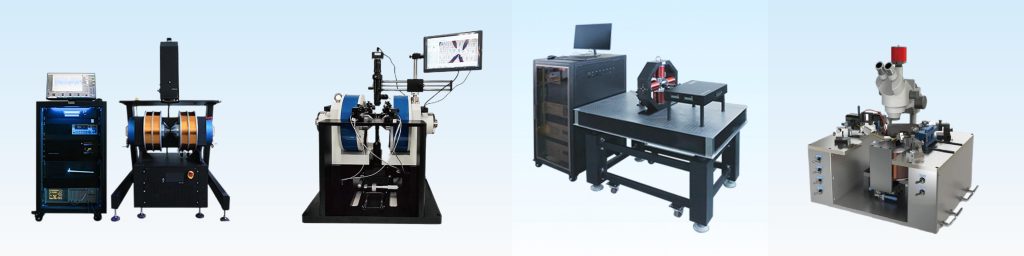
Why work with Cryomagtech
You’re not buying a metal frame—you’re buying field performance in your setup.
What overseas labs typically value (and what we build around):
- Engineering clarity: we define what is standard, what is optional, and what must be engineered
- Realistic boundaries: field, gap, uniformity, and duty cycle are evaluated together—not promised separately
- Integration mindset: power supply, gaussmeter, cooling, and fixtures are handled as a system
- Lab-first usability: access, mounting, and experiment workflow matter as much as coil power
- Documentation orientation: we can align acceptance criteria, testing method, and handover expectations early
FAQ
What is the difference between a laboratory electromagnet and a general industrial electromagnet?
Laboratory electromagnets are optimized for controlled magnetic field generation, stability, access, and integration with measurement setups. Industrial electromagnets are often optimized for holding, lifting, or actuation. If your goal is a precise field in a defined sample space, you want a laboratory electromagnet.
What determines the achievable magnetic field?
Field strength depends on gap size, pole geometry, core material behavior, coil current, and cooling/duty cycle. Asking for “high field” without stating the gap and sample space is like asking for “high resolution” without stating the sensor size.
Can I get high field at a large gap?
Sometimes yes, but the system usually grows quickly in size, power, and cooling complexity. For large gaps, feasibility is evaluated case by case based on duty cycle and uniformity needs.
Do you offer horizontal field and vertical field electromagnets?
Yes. The right choice depends on sample loading, fixture geometry, probe/optical access, and how your experiment is built.
Do you offer adjustable gap electromagnets?
Yes. Adjustable gap (variable gap) is common for laboratory use because it helps match different samples and fixtures. The final gap range and mechanics are selected around your required working space.
Are clamp / open-access electromagnets standard products?
They are often semi-standard to custom, because microscope/probe/optics constraints differ widely. If you share your working envelope and access needs, we can recommend a practical path.
Do you provide vector (2D/3D) electromagnets?
Yes, as engineered solutions. Multi-axis systems usually require multi-channel power supply planning, thermal design, and field calibration strategy.
Can you supply a complete electromagnet system?
Yes. Common systems include the electromagnet plus power supply, field measurement (gaussmeter), cooling (chiller), and basic control integration—defined to match the experiment workflow.
What information do you need for a quotation?
At minimum: target field (DC/AC, peak/continuous), required gap & sample space, field direction, duty cycle, and any integration constraints (optics/probes/rotation/temperature stage).