
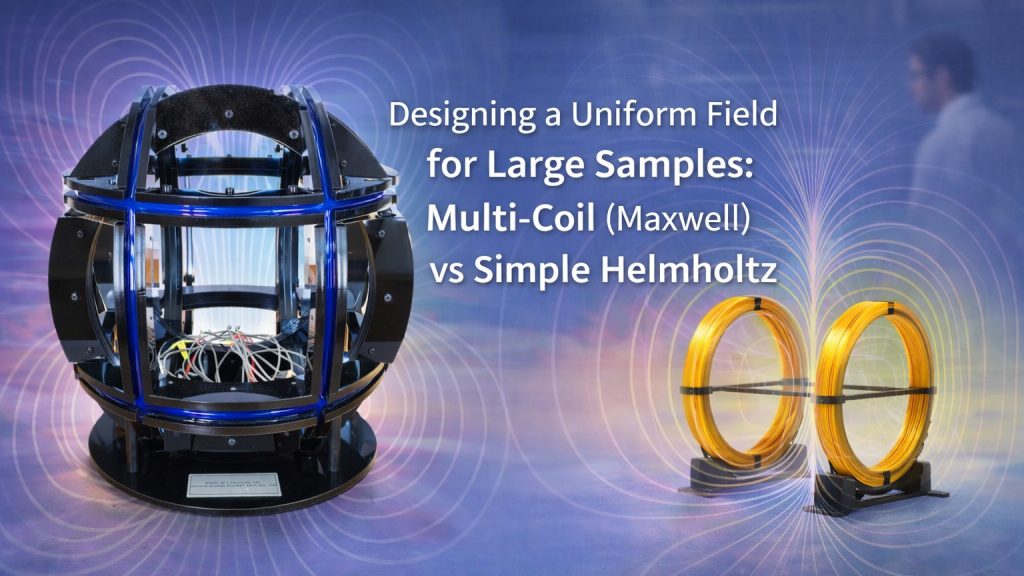
Uniform magnetic fields are essential in many laboratory experiments, including magnetic material characterization, sensor calibration, and magnetotransport measurements.
For small samples, a Helmholtz coil pair often provides sufficient uniformity in the central region. However, when experiments involve larger samples or larger measurement volumes, the uniform field region produced by a simple Helmholtz configuration may no longer be adequate.
In these cases, researchers often consider more complex multi-coil configurations such as Maxwell coils or custom multi-coil systems.
This article explains how Helmholtz and Maxwell coil configurations differ and how to choose the right approach for large-sample magnetic field uniformity.
1. The Helmholtz Coil: A Classic Solution for Uniform Fields
The Helmholtz coil configuration consists of two identical circular coils separated by a distance equal to their radius.
This geometry produces a highly uniform magnetic field in the central region between the coils.
Reference overview:
https://en.wikipedia.org/wiki/Helmholtz_coil
Key advantages include:
- Simple geometry
- Relatively easy construction
- Good field uniformity near the center
Because of these properties, Helmholtz coils are widely used in:
- sensor calibration
- basic magnetic experiments
- laboratory demonstrations
However, the uniform region is limited in size.
2. The Limitation: Uniform Region Size
In a Helmholtz coil system, field uniformity decreases rapidly as one moves away from the center.
For many advanced experiments, researchers require:
- larger samples
- optical access
- complex probe assemblies
These requirements increase the physical size of the experimental region.
When the sample volume becomes comparable to the coil radius, the field gradient across the sample can no longer be ignored.
This is often the point where researchers start looking for improved coil configurations.
3. Maxwell Coil Systems: Expanding the Uniform Region
A Maxwell coil system uses three coils instead of two.
The outer coils are positioned symmetrically around the central coil and carry current in the same direction.
Reference overview:
https://en.wikipedia.org/wiki/Maxwell_coil
This configuration cancels higher-order field derivatives, producing a larger region of uniform magnetic field compared with a simple Helmholtz pair.
Advantages include:
- larger uniform field volume
- improved gradient suppression
- better field homogeneity for extended samples
These features are particularly useful in experiments requiring:
- spatially distributed samples
- uniform excitation across large volumes
- precision magnetic calibration
4. Engineering Trade-Offs: Uniformity vs Complexity
While Maxwell and multi-coil systems improve uniformity, they introduce additional engineering challenges.
These include:
- more complex coil geometry
- increased power requirements
- more demanding alignment
- higher construction cost
In practice, researchers must balance:
- desired uniform field volume
- system complexity
- available power supply capability
Multi-coil systems often require more precise current control to maintain field symmetry.
5. Field Uniformity and Coil Geometry Optimization
Uniformity is typically evaluated using magnetic field derivatives.
In simplified terms, coil configurations are designed to cancel higher-order terms in the field expansion around the center.
Helmholtz coils cancel the second derivative of the magnetic field.
Maxwell coils cancel additional derivatives, improving uniformity over a larger volume.
For large sample experiments, careful geometric optimization is often necessary.
Magnetic field simulations are frequently used to evaluate coil performance before construction.
6. Power Supply and System Stability
Uniform magnetic field generation depends not only on coil geometry but also on current stability.
Important factors include:
- precision current control
- low noise excitation power supplies
- stable ramp behavior
Field stability directly influences measurement repeatability in experiments such as:
- magnetoresistance
- Hall effect measurements
- magnetic hysteresis characterization
Stable current sources ensure that the theoretically uniform field remains stable during actual experiments.
7. When Custom Multi-Coil Systems Make Sense
Researchers may consider multi-coil or Maxwell configurations when experiments require:
- large uniform field volumes
- large sample assemblies
- optical or mechanical access in the central region
- high precision field homogeneity
These systems are particularly common in advanced material characterization and sensor calibration platforms.
Cryomagtech supports laboratories designing custom electromagnet and multi-coil Helmholtz systems optimized for uniform magnetic field applications.
👉 Product Link Placeholder – Custom Helmholtz and Multi-Coil Magnetic Field Systems
Custom coil geometries allow researchers to balance field uniformity, system complexity, and experimental accessibility.
Key Takeaways
- Helmholtz coils provide excellent uniformity in a limited central region
- Large samples often require larger uniform field volumes
- Maxwell and multi-coil systems expand the uniform region
- Improved uniformity comes with increased system complexity
- Coil geometry and current stability both influence field quality
Choosing the right coil configuration ensures that the magnetic field remains uniform across the entire experimental region.