

Magnet systems are designed to generate controlled magnetic fields in a specific region.
However, magnetic fields do not stop at the pole gap or coil center. They extend into the surrounding space as stray fields, which can interfere with nearby instruments.
In research laboratories, unmanaged stray fields may cause:
- Image distortion in electron microscopes
- Drift in analytical balances
- Instability in magnetic sensors
- Data corruption in precision measurements
Understanding how stray fields propagate—and how to control them—is essential when installing electromagnets or Helmholtz coil systems.
1. What Is a Stray Magnetic Field?
A stray field is the magnetic field outside the intended working region of a magnet system.
Even when the main field is concentrated between pole pieces or inside coil geometry, field lines must close through surrounding space.
Reference overview:
https://en.wikipedia.org/wiki/Magnetic_field
In practice, this means:
- A 1-Tesla magnet may still produce measurable fields meters away
- Low-level fields can affect sensitive instruments long before they become obvious
Stray fields are especially relevant in laboratories with multiple precision instruments operating simultaneously.
2. Why Sensitive Instruments Are Vulnerable
Different instruments respond differently to external magnetic fields.
Electron Microscopes (SEM / TEM)
Electron trajectories are extremely sensitive to magnetic perturbations.
Even fields on the order of tens of microtesla can distort beam alignment.
Precision Balances
Electronic balances use electromagnetic force compensation.
External magnetic fields can introduce measurement drift or unstable readings.
Magnetic Sensors
Devices such as:
- Fluxgate sensors
- Hall probes
- Magnetometers
may detect stray fields as environmental noise, reducing measurement accuracy.
Electronic Storage and Sensors
Older magnetic storage media and certain sensor systems can experience interference when exposed to fluctuating magnetic fields.
Stray field management is therefore not just a magnet design problem—it is a laboratory infrastructure problem.
3. Estimating Stray Field Levels
A rough estimation approach considers magnetic dipole decay.
Magnetic field strength decreases approximately with distance:
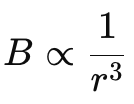
Where r is distance from the magnetic source.
Although this is a simplification, it illustrates an important principle:
Increasing distance is often the most effective stray-field mitigation strategy.
Exact stray field distribution depends on:
- Magnet geometry
- Core material
- Pole design
- Shielding structures
For large electromagnets, simulation tools or field mapping measurements are often used.
4. Practical Distance Guidelines
Many laboratories adopt informal distance rules.
Typical examples include:
- ≥1–2 meters from sensitive analytical instruments
- ≥3–5 meters from electron microscopy systems
However, these are only rough guidelines.
Actual safe distance depends on:
- Magnet field strength
- Magnet geometry
- Instrument sensitivity
In practice, measuring the field distribution with a probe provides the most reliable guidance.
5. Magnetic Shielding Options
When distance alone is insufficient, shielding may be required.
Passive Magnetic Shielding
Materials with high magnetic permeability (such as mu-metal) can redirect magnetic flux.
Benefits:
- Reduces field leakage
- Protects nearby equipment
Limitations:
- Saturation at high fields
- Installation complexity
Magnetic Circuit Optimization
Electromagnet design itself can reduce stray fields by:
- Optimizing pole geometry
- Improving magnetic circuit closure
- Using return paths to contain flux
Well-designed electromagnets naturally confine magnetic fields more effectively than open magnetic structures.
6. Laboratory Layout Planning
Stray field management should be considered during laboratory planning.
Key layout considerations include:
- Positioning magnet systems away from sensitive instruments
- Orienting magnetic poles to minimize interference direction
- Maintaining cable routing that avoids induced noise
Many laboratories benefit from mapping the magnetic environment before installing new equipment.
7. Measuring Stray Fields
Field probes can be used to measure spatial field distribution.
Common tools include:
- Hall probes for moderate field levels
- Fluxgate sensors for low-field detection
Field mapping allows researchers to:
- Identify interference zones
- Validate shielding effectiveness
- Define safe equipment placement
8. System-Level Design Matters
Stray field management begins with magnet system design.
Factors that influence stray fields include:
- Coil geometry
- Magnetic circuit design
- Core materials
- Pole configuration
Cryomagtech magnet systems—including electromagnets and Helmholtz coil platforms—are designed with attention to magnetic field distribution and installation environments.
Careful system design helps ensure that the magnetic field remains where it is needed—and nowhere else.
Key Takeaways
- Stray magnetic fields extend beyond the intended magnet region
- Sensitive instruments such as SEMs and balances can be affected by low-level fields
- Increasing distance is often the simplest mitigation strategy
- Shielding and magnet design can reduce field leakage
- Field mapping helps verify safe laboratory layouts
In magnet laboratories, controlling the intended field is only half the challenge.
Managing the unintended field is just as important.