
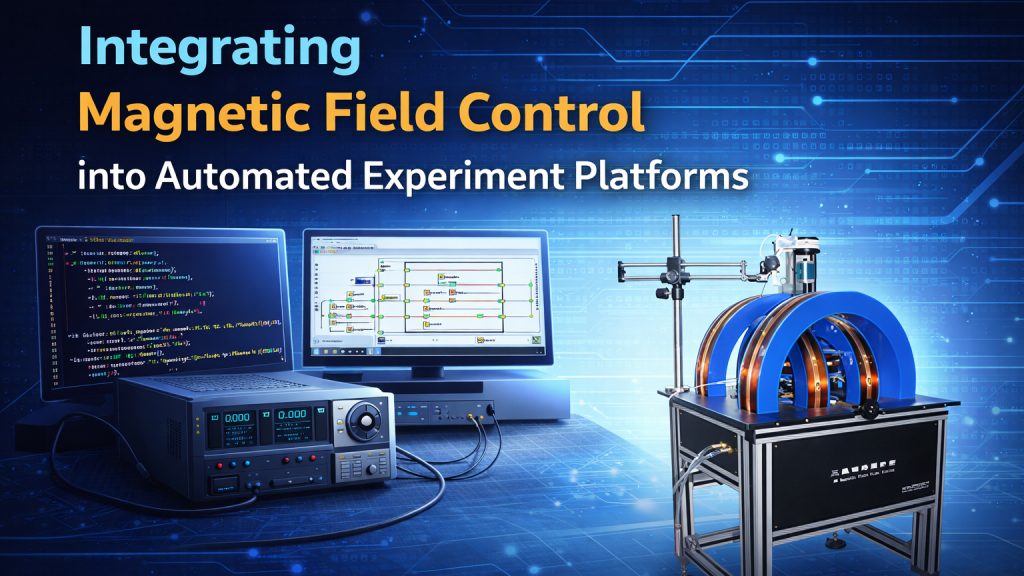
Modern laboratories increasingly rely on automated experiment platforms. Instead of manually adjusting instruments, researchers now orchestrate entire measurement sequences through software frameworks such as Python scripts, LabVIEW workflows, or custom automation environments.
In these setups, magnetic field control is no longer an isolated device function. It becomes a programmable subsystem within a larger experimental architecture.
This article explains how magnetic field control can be integrated into automated experiment platforms, and what design considerations ensure reliable, reproducible operation.
1. Why Magnetic Field Control Must Be Automation-Ready
Traditional laboratory workflows often involved manual control:
- Adjust current on the power supply
- Observe the magnetic field
- Trigger measurement equipment
Automation platforms change this workflow entirely.
Typical automated measurement loops now include:
- Set magnetic field
- Wait for stabilization
- Acquire measurement data
- Sweep field
- Repeat across parameter space
If the magnet system cannot be programmatically controlled, it becomes the bottleneck in an otherwise automated pipeline.
Automation compatibility therefore requires:
- Programmable excitation power supply
- Stable ramp control
- Reliable communication interfaces
- Software-level command integration
2. Software Platforms Used in Automated Experiments
Several software environments dominate laboratory automation.
Python-Based Automation
Python has become extremely popular in research laboratories because it provides:
- Instrument control libraries
- Data analysis tools
- Experiment orchestration frameworks
Libraries such as PyVISA allow communication with laboratory instruments via standard interfaces.
Reference:
https://en.wikipedia.org/wiki/Virtual_instrument_software_architecture
LabVIEW Platforms
LabVIEW remains widely used in engineering laboratories for instrument automation.
Advantages include:
- Graphical workflow design
- Native instrument drivers
- Strong integration with DAQ systems
LabVIEW-based automation platforms often control:
- Magnet power supplies
- Measurement instruments
- Environmental control systems
3. Communication Interfaces for Magnet Systems
To integrate magnetic field control into automated environments, the excitation power supply must support standard communication protocols.
Common interfaces include:
- USB
- Ethernet
- RS-232
- GPIB
Each interface supports remote commands such as:
- Set current
- Ramp field
- Query output status
- Trigger measurement synchronization
In automated experiments, communication reliability is as important as electrical stability.
4. Programmatic Field Sweeps and Experiment Sequences
In automated magnetic measurements, field sweeps are typically embedded into experiment scripts.
Example sequence:
- Initialize magnet driver
- Ramp to starting field
- Wait for stabilization
- Perform measurement
- Increment field step
- Repeat until full sweep completed
This approach enables experiments such as:
- Hall effect measurements
- Magnetoresistance mapping
- Spin transport studies
- Automated hysteresis characterization
Automation ensures consistent ramp timing and eliminates operator variability.
5. Synchronizing Field Control with Measurement Hardware
Automation becomes more powerful when the magnetic field control system synchronizes with other instruments.
Examples include:
- Lock-in amplifiers
- Source-measure units
- Cryogenic temperature controllers
- Data acquisition systems
Synchronization methods include:
- Software triggers
- Hardware trigger lines
- Time-based sequencing
When properly configured, the magnetic field becomes a programmable parameter within the measurement environment.
6. Stability Considerations in Automated Magnetic Experiments
Automated experiments often run unattended for hours or days.
This introduces new engineering requirements:
- Stable current regulation
- Controlled ramp rates
- Thermal stability
- Reliable communication recovery
If a power supply loses communication or enters protection mode during automation, the entire experiment sequence may fail.
For long-duration experiments, system reliability becomes just as important as electrical performance.
7. Field Control in Large Parameter Sweeps
Automation platforms frequently explore large parameter spaces:
- Magnetic field
- Temperature
- Voltage bias
- Frequency
Magnetic field therefore becomes one axis in a multidimensional experiment.
This allows researchers to perform:
- Automated phase diagram mapping
- Parameter sweeps across magnetic field and temperature
- High-throughput material characterization
Automation dramatically increases experimental efficiency while improving reproducibility.
8. System-Level Integration: Magnet + Driver + Software
Successful automated magnetic experiments require integration of several components:
- Magnet system (electromagnet or Helmholtz coil)
- Programmable excitation power supply
- Communication interface
- Automation software
Cryomagtech excitation power supplies are designed for integration into automated laboratory platforms, supporting programmable control and stable operation in long-duration experiments.
👉 Product Link Placeholder – Programmable Excitation Power Supplies for Automated Magnet Systems
When magnetic field control becomes part of an automated workflow, instrument design must prioritize both electrical stability and software compatibility.
Key Takeaways
- Automated experiments require programmable magnetic field control
- Python and LabVIEW are common automation environments
- Communication protocols enable remote magnet control
- Field sweeps can be integrated directly into experiment scripts
- System reliability is essential for long-duration automated measurements
In modern laboratories, magnetic field control is no longer a manual adjustment.
It is a programmable parameter within a fully automated experimental system.