
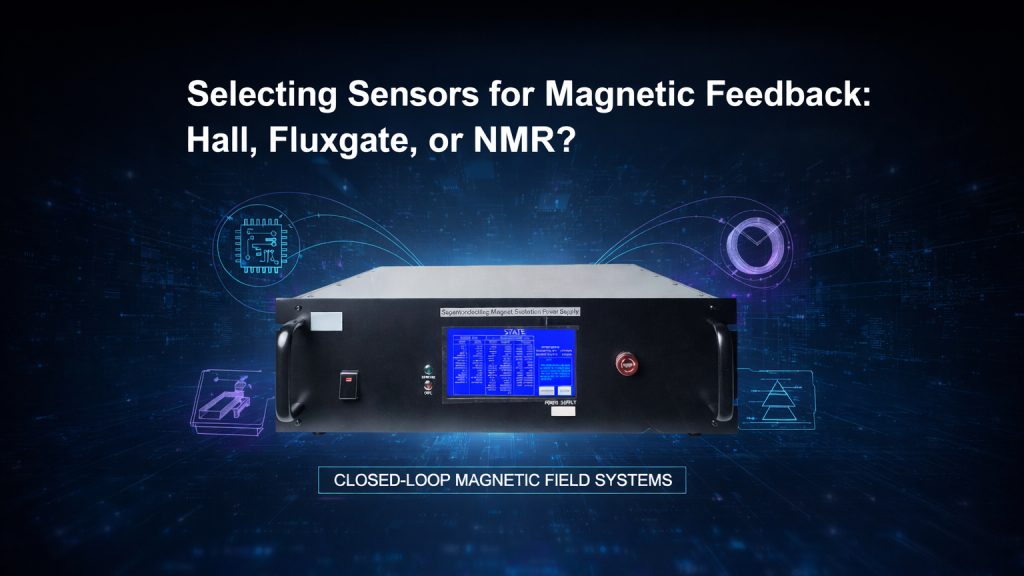
When designing a closed-loop magnetic field control system, the most critical decision is often not the power supply.
It is the sensor.
If your goal is to stabilize magnetic field B, not just current, sensor choice defines:
- Accuracy
- Noise floor
- Drift performance
- Control bandwidth
- System complexity
This article compares Hall sensors, fluxgate sensors, and NMR probes in practical field feedback applications — without unnecessary hype.
1. Why Sensor Selection Matters in Closed-Loop Field Control
In current-controlled systems, feedback comes from current measurement.
In field-controlled systems, feedback comes from the magnetic field itself.
Closed-loop architecture:
Setpoint B → Controller → Driver → Magnet → Field
↑ ↓
Field Sensor ←–––––––––––––––––––––––––––
The sensor becomes part of the control loop. Its:
- Noise
- Latency
- Drift
- Bandwidth
directly affect overall field stability.
Poor sensor selection can make a theoretically stable driver unstable in practice.
2. Hall Sensors: Practical and Versatile
Hall sensors are widely used due to:
- Compact size
- Broad field range
- Fast response
- Relatively low cost
They measure magnetic flux density via the Hall effect:
- Wikipedia – Hall effect
https://en.wikipedia.org/wiki/Hall_effect
Strengths
- Suitable for DC and AC fields
- Good bandwidth
- Easy integration into sample region
Limitations
- Temperature drift
- Moderate long-term stability
- Calibration required for precision work
Typical applications:
- Laboratory electromagnets
- Helmholtz coil systems
- General-purpose field stabilization
For most closed-loop systems below ppm-level stability requirements, Hall sensors are sufficient.
3. Fluxgate Sensors: High Sensitivity at Low Fields
Fluxgate sensors operate based on nonlinear magnetic core excitation.
They offer:
- Very high sensitivity at low fields
- Excellent resolution in µT to mT range
- Good DC stability
Reference overview:
- Wikipedia – Fluxgate magnetometer
https://en.wikipedia.org/wiki/Fluxgate_magnetometer
Strengths
- Superior resolution at low fields
- Better drift performance than Hall sensors
- Suitable for environmental compensation
Limitations
- Limited bandwidth compared to Hall
- More complex electronics
- Saturation at high fields
Fluxgate sensors are commonly used in:
- Low-field magnetic shielding systems
- Environmental field cancellation
- Sub-mT stabilization applications
4. NMR Probes: Absolute Accuracy Standard
Nuclear Magnetic Resonance (NMR) probes measure magnetic field based on fundamental resonance frequency.
They provide:
- Extremely high absolute accuracy
- Traceable field measurement
- Long-term stability
Reference:
- Wikipedia – Nuclear magnetic resonance
https://en.wikipedia.org/wiki/Nuclear_magnetic_resonance
Strengths
- ppm-level or better accuracy
- Minimal long-term drift
- Ideal for high-field calibration
Limitations
- Requires homogeneous field region
- Limited dynamic bandwidth
- More complex and costly
NMR probes are typically used in:
- High-field superconducting magnet systems
- Reference calibration systems
- NMR and MRI-grade environments
They are rarely used for fast dynamic feedback loops due to bandwidth constraints.
5. Bandwidth vs Noise: Control System Trade-Off
In closed-loop field control:
Higher sensor bandwidth:
- Faster correction
- Better dynamic response
But:
- Increases noise injection into control loop
Lower bandwidth:
- Smoother control
- Reduced noise
But:
- Slower drift correction
Hall sensors generally provide higher bandwidth.
Fluxgate sensors prioritize low-noise resolution.
NMR probes prioritize absolute accuracy over speed.
The correct choice depends on:
- Required stability (ppm, 100 ppm, 0.1%)
- Field range (mT vs Tesla)
- Sweep speed requirements
- Environmental noise conditions
6. Matching Sensor Type to Magnet System
Helmholtz Coils
Often used for uniform, moderate fields.
Hall sensors are typically sufficient.
Fluxgate may be used for low-field compensation.
Iron-Core Electromagnets
Core hysteresis and drift make field sensing valuable.
Hall sensors or fluxgate sensors commonly used.
Superconducting Magnets
High-field, high-stability systems.
NMR probes often used as calibration references.
Hall sensors used for dynamic feedback in some systems.
Sensor selection must align with:
- Excitation power supply bandwidth
- Compliance voltage
- Control software capability
- Thermal drift behavior
7. System-Level Integration Matters More Than Sensor Type
Sensor choice alone does not guarantee stability.
Effective closed-loop magnetic systems require integration of:
- High precision excitation power supply
- Magnet system (coil or electromagnet)
- Sensor placement strategy
- Control algorithm tuning
- Noise filtering
Cryomagtech supports integration of excitation power supplies with field feedback architectures, including:
- High precision current drivers
- Superconducting magnet power supplies
- Support for Hall or fluxgate sensor integration
- System-level feedback configuration
👉 Product Link Placeholder – Closed-Loop Magnetic Field Control Systems & Excitation Power Supplies
The best sensor cannot compensate for a poorly matched driver.
8. Key Takeaways
- Hall sensors: versatile and practical
- Fluxgate sensors: superior low-field resolution
- NMR probes: highest absolute accuracy
- Bandwidth and noise trade-offs define loop stability
- Sensor must match magnet type and experiment goal
If your experiment depends on magnetic field stability,
sensor selection is not a detail.
It is a system-level design decision.