
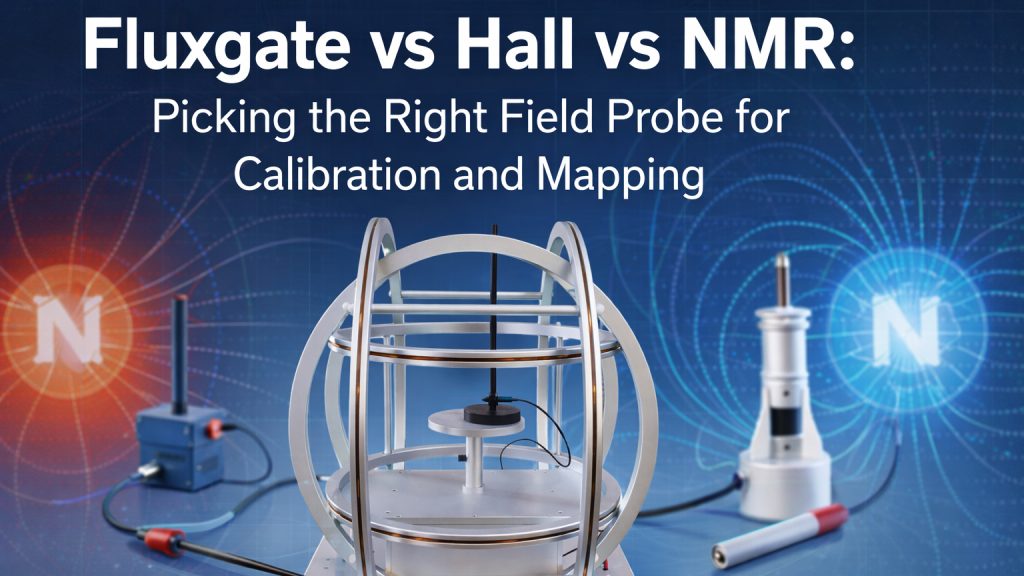
In magnetic field calibration and mapping, the question is not simply:
“Which probe measures magnetic field?”
It is:
Which probe provides the right combination of range, noise, linearity, temperature stability, and traceable accuracy for your application?
Fluxgate, Hall, and NMR probes each serve different engineering roles. Selecting the wrong one may not cause immediate failure — but it will limit your calibration accuracy, mapping resolution, and long-term data credibility.
This article compares the three technologies from a practical engineering perspective.
1. Why Field Probe Selection Defines Calibration Quality
Field mapping and calibration require more than basic field indication.
You must consider:
- Measurement range
- Noise floor
- Temperature coefficient
- Linearity
- Absolute accuracy
- Traceability
These parameters directly affect:
- Uniformity verification in Helmholtz coils
- Gap-field mapping in electromagnets
- Drift compensation
- Compliance documentation
For background on magnetic field measurement principles:
- Wikipedia – Magnetometer
https://en.wikipedia.org/wiki/Magnetometer
Different probe technologies optimize different parameters.
2. Hall Probes: Wide Range and Practical Flexibility
Hall probes are widely used in field mapping due to:
- Compact sensor head
- Broad field range (mT to Tesla level)
- High bandwidth
- Simple integration
Operating principle:
- Wikipedia – Hall effect
https://en.wikipedia.org/wiki/Hall_effect
Key Characteristics
| Parameter | Hall Probe |
|---|---|
| Range | Wide |
| Noise | Moderate |
| Temperature Drift | Moderate |
| Linearity | Good (calibration dependent) |
| Absolute Accuracy | Moderate |
| Traceability | Requires calibration certificate |
Typical Applications
- Electromagnet gap mapping
- Helmholtz coil uniformity verification
- Medium-field laboratory measurements
Hall probes are ideal when:
- Field range is broad
- Mapping speed is important
- Absolute ppm-level accuracy is not critical
3. Fluxgate Probes: Low-Field Precision Specialists
Fluxgate magnetometers use nonlinear magnetic core excitation to detect field variation.
Reference:
- Wikipedia – Fluxgate magnetometer
https://en.wikipedia.org/wiki/Fluxgate_magnetometer
Key Characteristics
| Parameter | Fluxgate |
|---|---|
| Range | Low to moderate |
| Noise | Very low (µT range) |
| Temperature Drift | Low |
| Linearity | Excellent at low fields |
| Absolute Accuracy | Good |
| Traceability | Calibration required |
Typical Applications
- Low-field mapping
- Magnetic shielding verification
- Environmental field monitoring
- Sub-mT stabilization systems
Fluxgate probes excel when resolution and noise floor are more critical than high-field capability.
4. NMR Probes: Absolute Reference Standard
Nuclear Magnetic Resonance probes measure field strength via resonance frequency tied to physical constants.
Reference:
- Wikipedia – Nuclear magnetic resonance
https://en.wikipedia.org/wiki/Nuclear_magnetic_resonance
Key Characteristics
| Parameter | NMR Probe |
|---|---|
| Range | High-field, homogeneous regions |
| Noise | Extremely low |
| Temperature Drift | Minimal |
| Linearity | Intrinsic (frequency-based) |
| Absolute Accuracy | Very high (ppm-level) |
| Traceability | Directly traceable |
Typical Applications
- Superconducting magnet calibration
- Reference standard verification
- MRI and NMR system validation
Limitations:
- Requires homogeneous field region
- Limited bandwidth
- Higher system complexity
NMR probes are not general-purpose mapping tools — they are reference-grade instruments.
5. Noise, Temperature Drift, and Linearity: Practical Comparison
Noise Floor
- Fluxgate: Best at low field
- Hall: Moderate
- NMR: Excellent (frequency-based)
Temperature Stability
- Hall: Requires compensation
- Fluxgate: Better intrinsic stability
- NMR: Minimal temperature dependence
Linearity
- Hall: Good with calibration
- Fluxgate: Strong in low-field regime
- NMR: Fundamentally linear
When mapping uniformity in Helmholtz coils or electromagnets, noise and drift directly affect spatial resolution.
6. Absolute Accuracy and Traceability
Calibration work requires traceability.
- Hall probes require periodic calibration certificates.
- Fluxgate systems require calibration against known standards.
- NMR probes inherently reference physical constants and are used as transfer standards.
Absolute accuracy is essential when:
- Publishing precision magnetic measurements
- Certifying magnet uniformity
- Meeting ISO or audit requirements
If calibration documentation matters, probe selection must align with compliance strategy.
7. Matching Probe to Magnet System
Helmholtz Coil Mapping
- Hall probes for general mapping
- Fluxgate for low-field uniformity
- NMR for reference verification
Electromagnet Gap Calibration
- Hall probes for spatial mapping
- Fluxgate for drift monitoring
Superconducting Magnet Systems
- NMR for absolute field reference
- Hall for dynamic monitoring
Probe choice must align with:
- Field range
- Required resolution
- Calibration documentation
- Budget constraints
8. Engineering-Level Integration: Beyond the Probe
Calibration and mapping are system-level tasks requiring:
- Stable excitation power supply
- Thermal management
- Mechanical positioning control
- Data acquisition and logging
Cryomagtech supports magnet systems with field mapping and calibration integration, including:
- Helmholtz coil systems
- Electromagnet systems
- Field probe compatibility
- System-level stability optimization
👉 Product Link Placeholder – Field Mapping & Calibration Solutions for Magnet Systems
Field probe selection defines measurement capability,
but system integration defines measurement reliability.
9. Key Takeaways
- Hall probes: versatile and wide range
- Fluxgate probes: superior low-field resolution
- NMR probes: highest absolute accuracy and traceability
- Noise, temperature drift, and linearity determine mapping quality
- Probe selection must align with calibration and compliance goals
Field calibration is not about measuring something.
It is about measuring it correctly — and defensibly.