
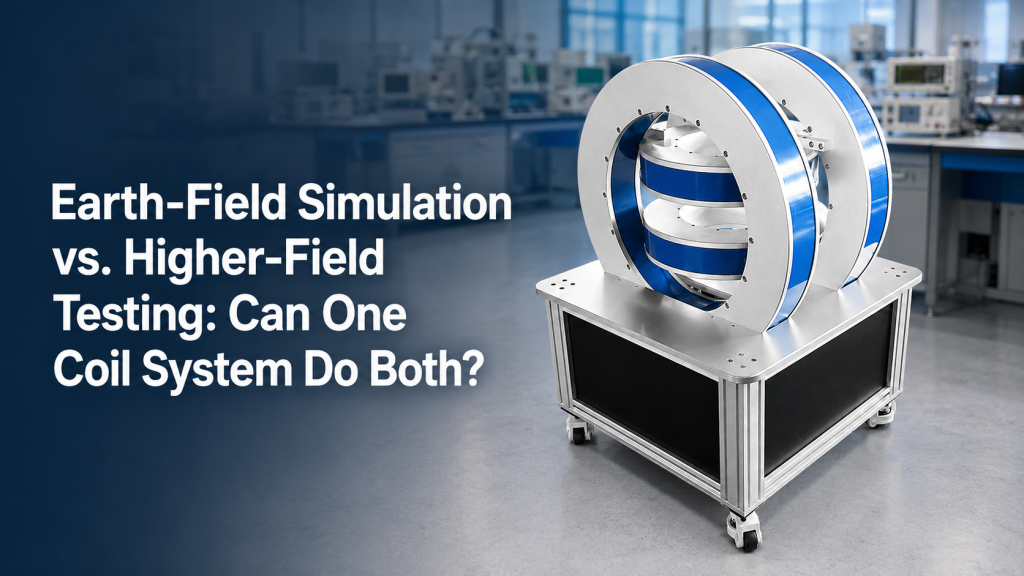
Many laboratories ask a practical question when selecting a Helmholtz coil system:
“Can we use one coil system for both Earth-field simulation and higher-field magnetic testing?”
The short answer is: sometimes yes, but only within a carefully defined field range, uniformity requirement, driver capacity, and thermal duty cycle.
Earth-field simulation usually works in the microtesla range. Higher-field testing may require millitesla or even stronger magnetic fields. A single Helmholtz coil system can sometimes cover both tasks, but the design must avoid one common mistake: optimizing only for maximum field while ignoring low-field resolution, linearity, noise, and control stability.
This article explains when one coil system can do both, when it cannot, and what specifications should be confirmed before requesting a quotation.
1. What Does Earth-Field Simulation Really Mean?
Earth-field simulation means reproducing or compensating for the local geomagnetic field inside a controlled test volume.
The Earth’s magnetic field at the surface is typically around 25–65 µT, or 0.25–0.65 gauss, depending on location. NOAA’s World Magnetic Model is widely used for navigation, attitude, and heading reference systems, and NOAA also provides geomagnetic calculators for estimating local field components.
For laboratory testing, Earth-field simulation may involve:
- Generating a known DC magnetic field vector
- Cancelling the local geomagnetic field
- Simulating magnetic heading changes
- Testing compasses, magnetometers, IMUs, or attitude sensors
- Creating controlled low-field environments for biological, navigation, or sensor experiments
In this range, the most important specifications are often not maximum field strength. They are:
- Low-field resolution
- Current stability
- Magnetic noise
- Field uniformity
- Accurate three-axis vector control
- Calibration and repeatability
2. What Counts as Higher-Field Testing?
Higher-field testing usually moves beyond the Earth-field range into the millitesla level.
For example:
- ±1 mT
- ±3 mT
- ±10 mT
- ±50 mT
- 100 mT or higher in some compact systems
At these levels, the system starts to behave differently from a pure Earth-field simulator.
The key concerns become:
- Coil heating
- Driver voltage and current capacity
- Continuous duty cycle
- Field uniformity over the required test volume
- Mechanical size and access
- Power supply response and safety protection
A system designed only for Earth-field simulation may not have enough current, cooling, or driver voltage for higher-field operation. A system designed only for higher-field output may not provide the low-noise and fine-resolution control needed for precise Earth-field simulation.
That is where the engineering trade-off begins.
3. Why Helmholtz Coils Are Commonly Used for Both Tasks
A Helmholtz coil is widely used because it can generate a relatively uniform magnetic field in a central test region. In a classic Helmholtz pair, two matching coils are positioned symmetrically, and the geometry is chosen to improve field uniformity around the center. Helmholtz coils are also commonly used to cancel external fields such as the Earth’s magnetic field.
Why This Matters for Testing
For sensor testing, it is not enough to generate a magnetic field somewhere inside the coil.
The field must be controlled where the device under test is actually located.
That is why users should define:
- Required field range
- Uniform region size
- DUT dimensions
- Test orientation
- Number of axes
- DC or AC operation
- Required software control
- Whether the system must cancel, simulate, or sweep the field
A Helmholtz coil system can be very flexible, but only when the coil and driver are designed together.
4. Can One Coil System Cover Microtesla and Millitesla Fields?
Yes, in many cases one system can cover both Earth-field simulation and moderate higher-field testing.
For example, a three-axis Helmholtz coil system may be designed to support:
- Low-field control around ±100 µT for Earth-field simulation
- Medium-field testing around ±1 mT to ±10 mT
- Higher test points if coil size, current, and cooling allow
But there is no free lunch.
The wider the field range, the more carefully the driver and control system must be selected.
The Main Challenge: Dynamic Range
A system that must control both 50 µT and 10 mT needs a field range ratio of 200:1.
If the higher-field target is 50 mT, the ratio becomes 1000:1.
This creates several design challenges:
- Can the power supply control very small currents smoothly?
- Is the current resolution fine enough for microtesla-level adjustment?
- Is electrical noise low enough for Earth-field simulation?
- Can the same coil tolerate continuous high-current operation?
- Does the field remain linear across the full operating range?
If these points are ignored, the system may reach the maximum field on paper but perform poorly at the low-field end.
5. Field Linearity: Why “More Field” Is Not Always Better
For a Helmholtz coil, magnetic field is approximately proportional to current when the coil is operated within its normal linear range.
That sounds simple:
More current = more magnetic field.
But real systems have limits.
At Low Field
The main concerns are:
- Current resolution
- Current noise
- Offset drift
- Environmental magnetic interference
- Power supply stability
For Earth-field simulation, even small errors may matter.
A few microtesla of drift can be significant when the target field is only tens of microtesla.
At Higher Field
The main concerns shift to:
- Coil temperature rise
- Copper resistance change
- Driver voltage headroom
- Long-term thermal stability
- Field drift during continuous operation
As current increases, heat increases strongly. If the coil warms up during testing, resistance changes, and the field output may drift unless the driver and control strategy are stable enough.
This is why higher field capability alone does not prove the system is suitable for precision Earth-field simulation.
6. Driver Headroom: The Specification Many Buyers Underestimate
A Helmholtz coil is only half of the system.
The driver is just as important.
For a combined Earth-field simulation and higher-field testing system, the driver should be evaluated by:
- Maximum current
- Current resolution
- Current stability
- Output voltage
- Noise level
- Bipolar output capability
- Communication interface
- Software control
- Protection functions
- Continuous operation rating
Why Voltage Headroom Matters
At DC or slow field changes, current capacity may look sufficient.
But when the user needs faster ramping, waveform output, or AC magnetic fields, coil inductance becomes important. The driver may need more voltage to force current changes quickly.
A system that can generate a DC field may not automatically support fast dynamic testing.
This is especially important for:
- Sensor response testing
- Magnetic heading simulation
- IMU calibration
- AC susceptibility-style experiments
- Time-varying magnetic exposure studies
7. Uniformity: One Coil Size Cannot Serve Every Sample Volume
Earth-field simulation often requires a relatively large, clean, uniform region.
Higher-field testing may accept a smaller region if the goal is only to expose a compact sensor or sample.
This creates another trade-off.
Larger Coils
Larger coils usually provide:
- Better access
- Larger uniform region
- Easier integration with fixtures or optical setups
But they may require:
- More current
- More power
- Larger drivers
- More cooling
- Higher system cost
Smaller Coils
Smaller coils usually provide:
- Higher field efficiency
- Lower current requirement
- More compact footprint
- Lower cost for the same field level
But they may have:
- Smaller uniform volume
- Less room for test fixtures
- More mechanical limitations
For this reason, the correct question is not only:
“How many millitesla can the coil generate?”
The better question is:
“How many millitesla can it generate over the required uniform volume, for the required duty cycle, with the required control resolution?”
8. When One Coil System Is a Good Choice
One coil system is often reasonable when the user needs:
- Earth-field simulation plus moderate higher-field testing
- DC or low-frequency operation
- A clearly defined DUT size
- A known uniformity requirement
- Three-axis vector field control
- Software-controlled current and field output
- Moderate continuous operation time
Typical examples include:
- Magnetometer calibration
- Compass and heading sensor testing
- IMU magnetic response evaluation
- Navigation device testing
- Low-field physics experiments
- Controlled magnetic exposure tests
In these cases, a well-designed Helmholtz coil and driver combination can reduce equipment cost, save lab space, and simplify operation.
9. When Two Separate Systems May Be Better
One system may not be the best choice when the requirements are too far apart.
For example:
- Ultra-low-noise Earth-field simulation
- Very high-field continuous testing
- Large uniform volume plus high field
- Fast AC or pulsed magnetic field operation
- Strict thermal stability over long test cycles
- Very different sample sizes for different experiments
In such cases, forcing one system to do everything can create a compromised design.
The result may be:
- Too expensive
- Too large
- Too noisy at low field
- Too hot at high field
- Too slow for dynamic tests
- Not uniform enough over the real sample volume
Sometimes the smarter solution is a two-system strategy:
- A low-field precision coil system for Earth-field simulation
- A separate higher-field coil or electromagnet system for stronger magnetic testing
This is not a failure of design. It is honest engineering.
10. Practical Specification Checklist Before Requesting a Quotation
Before asking whether one coil system can do both, users should define the following information.
Magnetic Field Requirements
- Earth-field simulation range, such as ±100 µT
- Higher-field target, such as ±3 mT, ±10 mT, or ±50 mT
- DC, AC, sweep, or waveform operation
- One-axis, two-axis, or three-axis control
Test Volume
- DUT size
- Required uniform region
- Required field uniformity
- Fixture or optical access needs
- Available installation space
Driver and Control
- Current resolution
- Stability requirement
- Bipolar operation
- PC/software control
- Communication interface
- Ramp rate or frequency requirement
Operation Conditions
- Continuous or intermittent operation
- Maximum test duration
- Cooling preference
- Ambient temperature
- Safety or interlock requirements
These details help determine whether a single Helmholtz coil system is practical or whether a split-system approach is safer.
11. How Cryomagtech Helps Define the Right Coil and Driver Combination
Cryomagtech supplies Helmholtz coil systems and matching magnetic field drivers for low-field simulation, three-axis vector field control, and moderate higher-field testing.
For projects that need both Earth-field simulation and higher-field testing, we help evaluate:
- Required field range
- Uniform volume
- Driver current and voltage margin
- Low-field resolution
- Coil heating and duty cycle
- Software control requirements
- Mechanical access for sensors, samples, or optical setups
👉 Product link placeholder: Cryomagtech Helmholtz Coil Systems and Magnetic Field Drivers
Instead of simply increasing the maximum field rating, the better approach is to design a balanced coil and driver system that matches the real test conditions.
References
- NOAA / NCEI – World Magnetic Model
https://www.ncei.noaa.gov/products/world-magnetic-model - NOAA / NCEI – Geomagnetism Frequently Asked Questions
https://www.ncei.noaa.gov/products/geomagnetism-frequently-asked-questions - Wikipedia – Helmholtz Coil
https://en.wikipedia.org/wiki/Helmholtz_coil
Key Takeaways
- Earth-field simulation usually requires microtesla-level precision, not high maximum field.
- Higher-field testing requires enough current, voltage, thermal capacity, and duty-cycle margin.
- A single Helmholtz coil system can sometimes cover both tasks, but only if the coil and driver are designed together.
- The wider the field range, the more important current resolution, noise, linearity, and thermal stability become.
- For some demanding applications, two separate systems may be more reliable than one compromised system.
A good coil system is not the one with the biggest field number.
It is the one that produces the right field, in the right volume, with the right stability, for the real experiment.