
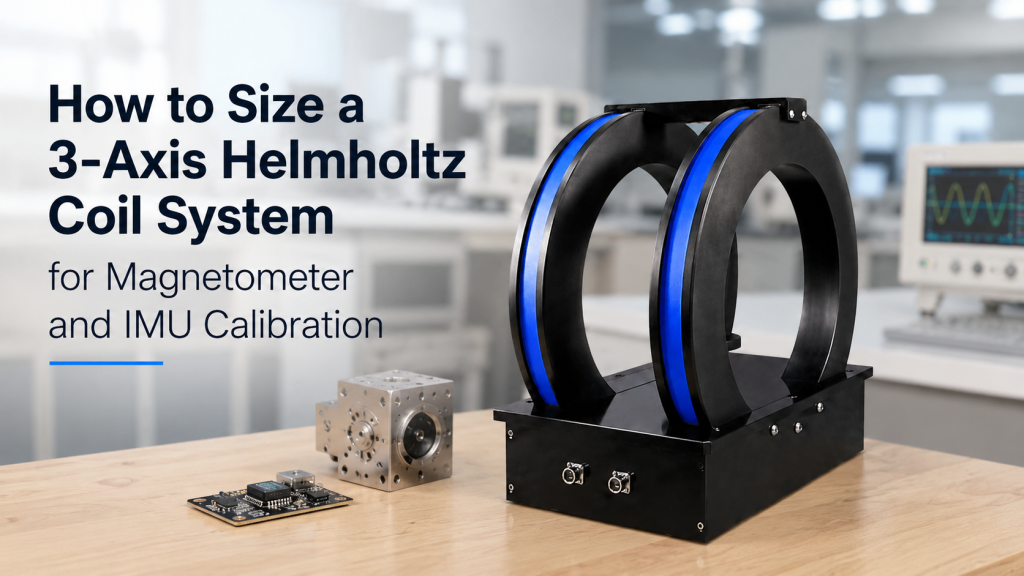
Choosing the right 3-axis Helmholtz coil system is not only about the maximum magnetic field.
For magnetometer, compass, AHRS, and IMU calibration, the real sizing questions are usually much more practical:
- How large is the DUT?
- How much fixture space is required?
- What is the required uniform field region?
- What target magnetic field range is needed?
- Does the system need manual control, software control, or automated calibration sequences?
- Is the calibration task for R&D, QA testing, or production-level repeatability?
This article explains how to size a 3-axis Helmholtz coil system before requesting a quotation, especially for laboratories working with magnetometers, IMUs, navigation modules, and magnetic sensor assemblies.
1. Why 3-Axis Helmholtz Coils Are Used for Sensor Calibration
A Helmholtz coil pair is a classic configuration for generating a controlled magnetic field near the center of the coil geometry. In a standard Helmholtz arrangement, two identical coaxial coils carry current in the same direction, and the geometry is selected to improve field uniformity around the midpoint. NIST historical literature also discusses coil arrangements for producing uniform magnetic fields, showing the long-standing measurement importance of this type of field-generation structure.
A 3-axis Helmholtz coil system combines three orthogonal coil pairs to generate controlled magnetic fields along the X, Y, and Z directions.
This makes it useful for:
- Magnetometer calibration
- Electronic compass testing
- IMU and AHRS calibration
- Magnetic sensor offset testing
- Magnetic sensitivity and linearity testing
- Earth-field simulation
- Low-field vector magnetic field generation
- Background magnetic field compensation
For calibration work, the key requirement is not simply “maximum field.” The coil must generate a stable, predictable, and sufficiently uniform field over the actual volume occupied by the device under test.
2. Start with the DUT Size
The first sizing parameter is the DUT size.
DUT means “device under test.” In magnetometer and IMU calibration, the DUT may be:
- A chip-level sensor board
- A packaged IMU module
- A compass module
- A PCB assembly
- A full navigation unit
- A magnetic sensor array
- A fixture holding multiple sensors
Many users only provide the sensor size, but this is usually not enough.
For coil sizing, the important volume is:
DUT size + cable clearance + mounting fixture + positioning allowance + possible rotation space
For example, a 30 mm sensor board may require 80–120 mm of usable internal space once the fixture, connector, cable bend radius, and alignment holder are included.
If the coil system is sized only for the bare sensor, the final calibration setup may become mechanically inconvenient or even unusable.
3. Define the Required Uniform Field Region
The uniform field region is the volume where the magnetic field remains within a specified tolerance.
Common examples include:
- 20 mm cube
- 50 mm cube
- 100 mm cube
- 150 mm cube
- Custom rectangular fixture volume
For magnetometer and IMU calibration, the uniform field region should cover not only the active sensing element, but also the possible positioning error during calibration.
A practical rule is:
The uniform field region should be larger than the DUT and its positioning uncertainty, not merely equal to the sensor package size.
Typical examples:
Small Sensor PCB
A small sensor PCB may only require a 20–50 mm cube uniform region if the DUT can be accurately centered.
Compact IMU Module
A compact IMU module with fixture and cable clearance may require a 50–100 mm cube uniform region.
Navigation Assembly or Multi-Sensor Fixture
A larger navigation module, multi-sensor board, or assembled fixture may require a 100 mm cube or larger uniform region.
If the DUT is not centered accurately, a small uniform region can introduce calibration error even when the coil itself is well designed.
4. Match the Field Range to the Calibration Purpose
Different calibration tasks require different magnetic field ranges.
For low-field magnetometer and IMU calibration, many systems work around Earth-field-level magnetic fields or several times that range. Magnetometer calibration methods often rely on controlled, homogeneous magnetic field conditions to estimate sensor offset, sensitivity, and axis alignment errors.
Low-Field Calibration
Typical range:
- ±100 µT to ±1 mT
Suitable for:
- Compass calibration
- Magnetometer offset correction
- IMU and AHRS calibration
- Earth-field simulation
- Low-field magnetic sensor testing
For many IMU and magnetometer applications, this is often the most relevant range.
Medium-Field Sensor Testing
Typical range:
- ±1 mT to ±10 mT
Suitable for:
- Stronger sensor response testing
- Linearity checks
- Extended operating range evaluation
- Laboratory R&D testing
This range may require higher current, larger power supplies, and more careful thermal design.
Higher-Field Laboratory Testing
Typical range:
- 10 mT and above
Suitable for:
- Special magnetic sensor evaluation
- Magnetic component testing
- Laboratory magnetic field experiments
At this level, coil geometry, current capacity, heat dissipation, power supply selection, and safety review become much more important.
For many magnetometer and IMU calibration projects, very high magnetic field is unnecessary. Field accuracy, repeatability, uniformity, and controllability often matter more than maximum field strength.
5. Do Not Oversize the Field Without Reason
A common mistake is asking for the highest possible field “just in case.”
This can create several problems:
- Larger coil structure
- Larger power supplies
- More heat generation
- Higher cost
- More difficult temperature control
- More complex safety requirements
- Reduced practicality for benchtop calibration
For calibration projects, the better question is:
What magnetic field range is actually needed to calibrate the sensor response?
If the application is compass, AHRS, or IMU calibration, a moderate low-field design may be more practical than an oversized high-field system.
Overspecification can make the system more expensive without improving calibration quality.
6. Check Fixture Space Before Coil Diameter
A 3-axis Helmholtz coil system must provide enough central working space for the real calibration workflow.
The internal space may need to accommodate:
- DUT fixture
- Non-magnetic holder
- Cable routing
- Rotation stage
- Reference magnetometer
- Optical alignment path
- Manual access
- Mounting base
- Protective enclosure
The coil should not only fit the DUT. It should fit the full calibration operation.
For example, if the user needs to rotate the DUT manually inside the coil, the structure must allow hand access or a suitable non-magnetic rotation mechanism.
If the DUT requires active cable connection during calibration, cable routing must be considered before finalizing the coil frame.
7. Consider X/Y/Z Axis Orthogonality
In a 3-axis system, each coil axis should generate a field aligned with its intended direction.
In practice, calibration quality can be affected by:
- Mechanical alignment error
- Coil winding tolerance
- Cross-axis coupling
- Fixture misalignment
- Sensor axis misalignment
- Local magnetic disturbance
- Reference probe positioning error
This matters because magnetometer and IMU calibration is not only about generating a magnetic field. It is also about understanding how the sensor’s internal axes respond to known external field vectors.
Research on triaxial magnetometer calibration shows that sensitivity and orthogonality errors are important calibration targets, and triaxial Helmholtz coil systems can be used as part of precise calibration procedures.
Therefore, a good 3-axis Helmholtz coil system should be considered as a complete calibration platform, not just three coil pairs assembled together.
8. Decide Whether Manual or Software Control Is Needed
Control method strongly affects the final configuration.
Manual Control May Be Enough When:
- The user only needs a few fixed field values
- Calibration is performed occasionally
- The operator adjusts current manually
- The budget is limited
- Data logging is not required
Software Control Is Preferred When:
- Calibration sequences must be repeated
- X/Y/Z fields need to change automatically
- Multiple DUTs must be tested
- Polarity reversal is required
- Data logging is needed
- A reference magnetometer is used
- The system is part of QA or production testing
For IMU and magnetometer calibration, software control is often valuable because calibration routines may require multiple vector field points, repeatable current settings, field reversal, background compensation, and test record export.
9. Power Supply Selection Matters as Much as Coil Size
A 3-axis Helmholtz coil system usually requires one controlled current source per axis.
Important power supply specifications include:
- Current range
- Current resolution
- Current stability
- Output noise and ripple
- Bipolar or unipolar output
- Response time
- Software interface
- Protection functions
- Long-term operating stability
For low-field calibration, current precision may matter more than maximum current.
For example, if the target field is only ±500 µT, the system must control small current changes accurately. A high-current but low-resolution power supply may not be the best choice.
In calibration systems, “bigger power supply” does not automatically mean “better calibration.”
10. Account for Background Magnetic Field
The Earth’s magnetic field and surrounding magnetic materials can affect calibration results.
Possible interference sources include:
- Steel tables
- Building structures
- Motors
- Power cables
- Speakers
- Magnetic tools
- Nearby instruments
- Ferromagnetic screws or fixtures
Depending on the calibration requirement, the system may need:
- Background field measurement
- Zero-field compensation
- Reference magnetometer feedback
- Non-magnetic fixtures
- Controlled lab placement
- Magnetic cleanliness around the test area
Some recent work on magnetometer-array calibration uses three-dimensional Helmholtz coil systems as part of an in-situ calibration setup, combining field generation, measurement, and control units.
This is especially important when the calibration target is not just a single sensor, but a sensor array or a complete measurement system.
11. Practical Sizing Checklist Before Requesting a Quote
Before requesting a quotation for a 3-axis Helmholtz coil system, prepare the following information.
DUT and Fixture Information
- DUT dimensions
- Fixture dimensions
- Cable clearance
- Mounting method
- Required access space
- Whether rotation is needed
- Whether a reference sensor will be placed inside
Uniform Field Requirement
- Required uniform volume
- Acceptable uniformity tolerance
- DUT positioning accuracy
- Whether the uniform region should be spherical, cubic, or customized
Magnetic Field Requirement
- Target field range on X/Y/Z axes
- DC only or AC requirement
- Field stability requirement
- Field resolution requirement
- Need for Earth-field compensation
- Need for polarity reversal
Control Requirement
- Manual control or software control
- Required communication interface
- Need for automated sequences
- Need for data logging
- Need for closed-loop feedback
Installation Requirement
- Benchtop or floor-standing structure
- Available lab space
- Power supply limitations
- Cooling preference
- Safety enclosure requirement
- Local voltage and plug standard
This information helps avoid three common procurement problems:
- Buying a coil that is too small for the real fixture
- Paying for unnecessary field strength
- Discovering after delivery that the calibration workflow cannot be performed conveniently
12. How Cryomagtech Helps Size 3-Axis Helmholtz Coil Systems
Cryomagtech supports customized 3-axis Helmholtz coil systems for magnetometer, IMU, compass, AHRS, and magnetic sensor calibration applications.
We help evaluate:
- DUT and fixture size
- Required uniform field region
- Target X/Y/Z field range
- Coil geometry
- Current source configuration
- Manual or software control
- Calibration workflow requirements
- Optional fixture and positioning design
For calibration projects, our goal is not simply to make the coil larger or stronger.
The real goal is to match the coil system to the DUT, fixture, uniform field region, target field range, and calibration workflow.
References
- NIST – Coil arrangements for producing a uniform magnetic field
Reference link: - Precise calibration method for triaxial magnetometers using a triaxial Helmholtz coil system
Reference link: - On Calibration of Three-axis Magnetometer
Reference link:
Key Takeaways
- A 3-axis Helmholtz coil system should be sized around the DUT, fixture, and required uniform field region.
- For magnetometer and IMU calibration, field accuracy and repeatability often matter more than maximum field strength.
- The usable uniform region must be larger than the bare sensor package.
- Fixture space, cable routing, and rotation requirements should be checked before finalizing coil dimensions.
- Software control is valuable for repeatable calibration sequences.
- Background magnetic field and non-magnetic fixture design should be considered before procurement.
Choosing the right 3-axis Helmholtz coil system prevents calibration errors, mechanical interference, unnecessary cost, and redesign after purchase.