
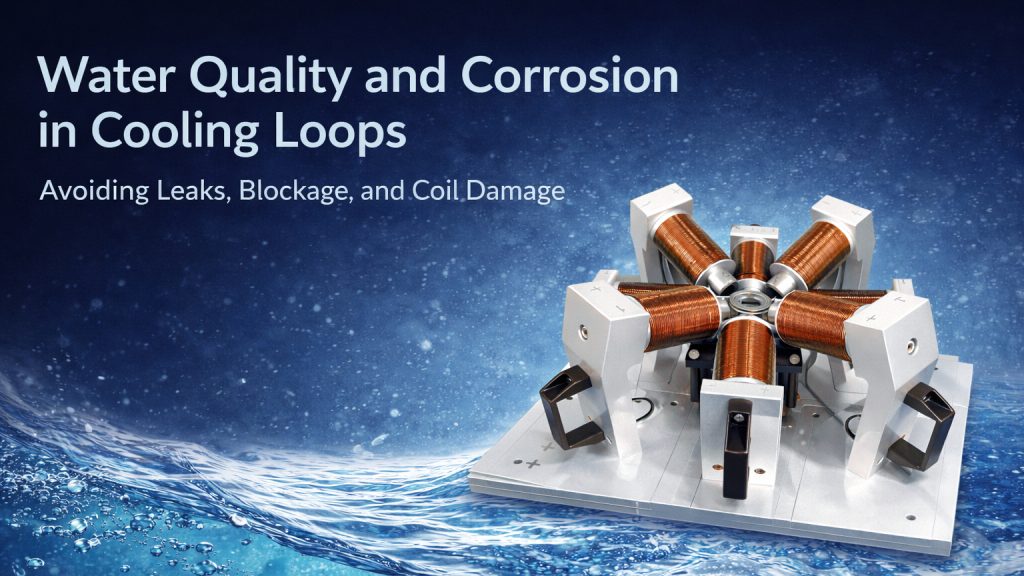
In water-cooled electromagnet systems, performance is often evaluated by:
- Field strength
- Stability
- Duty cycle
But long-term reliability depends on something far less visible:
👉 the quality of the cooling water
Improper water management can lead to:
- Internal corrosion
- Flow blockage
- Reduced cooling efficiency
- Irreversible coil damage
This is not an immediate failure.
It is a slow degradation that eventually becomes expensive.
1. Why Water Quality Matters in Cooling Loops
Cooling water is in direct contact with:
- Copper conductors
- Internal channels
- Connectors and fittings
Over time, water chemistry affects:
- Material integrity
- Heat transfer performance
- System lifetime
According to Wikipedia:
https://en.wikipedia.org/wiki/Corrosion
Corrosion is a chemical process that gradually degrades materials, especially metals exposed to electrolytes such as water.
2. Electrical Conductivity: The Hidden Risk
Water is not just a coolant—it can also become a conductor.
High Conductivity Water
- Contains dissolved ions
- Increases risk of electrochemical reactions
- Accelerates corrosion
Low Conductivity Water
- Reduces electrolysis
- Minimizes internal damage
Practical Guideline
👉 Use deionized (DI) or treated water with controlled conductivity levels
However:
- Too pure water can also be aggressive (material leaching)
- Stability requires controlled balance—not extremes
3. Corrosion Mechanisms Inside Cooling Systems
Corrosion is not uniform. It occurs at specific points:
Common Locations
- Joints and connectors
- Changes in material (galvanic corrosion)
- Areas with stagnant flow
Types of Corrosion
- Uniform corrosion
- Galvanic corrosion
- Pitting corrosion
Why It’s Dangerous
- Internal channels are not visible
- Damage accumulates unnoticed
- Failure appears suddenly
4. Blockage: The Silent Performance Killer
Cooling efficiency depends on flow.
What Causes Blockage
- Mineral deposits
- Corrosion particles
- Biological growth (in untreated systems)
Effects
- Reduced flow rate
- Local overheating
- Uneven temperature distribution
👉 This leads to thermal hotspots inside coils
Which can:
- Degrade insulation
- Reduce coil lifetime
- Affect magnetic field stability
5. Material Compatibility: The Overlooked Factor
Cooling loops often involve multiple materials:
- Copper (coils)
- Brass or stainless fittings
- Rubber or polymer hoses
Risk
Different materials create galvanic couples.
This accelerates corrosion when:
- Water conductivity is high
- Protective measures are absent
Best Practice
- Use compatible materials
- Avoid unnecessary metal mixing
- Apply corrosion inhibitors when appropriate
6. Filtration and Water Treatment
A proper cooling system is not just a loop—it is a controlled environment.
Essential Components
- Inline filters
- Particle traps
- Water treatment systems
Function
- Remove debris
- Maintain water quality
- Prevent accumulation of contaminants
Common Mistake
- Running systems without filtration
Result:
👉 Slow buildup of particles → eventual blockage
7. Maintenance Cycles: Where Most Systems Fail
Most failures are not due to design, but lack of maintenance.
Recommended Practices
- Regular conductivity monitoring
- Periodic water replacement
- Filter inspection and replacement
- Visual inspection of fittings
Typical Reality
- Systems run “until something goes wrong”
- Maintenance is reactive, not preventive
8. Early Warning Signs You Should Not Ignore
Before failure, systems usually show subtle signs:
- Increasing operating temperature
- Reduced flow rate
- Unstable field under load
- Visible discoloration in water
👉 These are not minor issues
They are early indicators of system degradation
9. How Cryomagtech Designs Reliable Cooling Systems
At Cryomagtech, water-cooled systems are designed with long-term reliability in mind.
We consider:
- Cooling channel design
- Material compatibility
- Recommended water specifications
- Integration with filtration and maintenance practices
👉 Product link placeholder: Cryomagtech Water-Cooled Electromagnet Systems & Maintenance Guidelines
Instead of focusing only on initial performance,
we help ensure:
- Stable long-term operation
- Reduced maintenance risk
- Lower total cost of ownership
References
- Wikipedia – Corrosion
https://en.wikipedia.org/wiki/Corrosion - IEEE – Cooling and reliability in electrical systems
https://ieeexplore.ieee.org/
Key Takeaways
- Water quality directly affects cooling system reliability
- High conductivity accelerates corrosion
- Blockage reduces cooling efficiency and creates hotspots
- Material compatibility is critical for long-term stability
- Filtration and treatment prevent internal contamination
- Preventive maintenance is essential
A water-cooled system does not fail suddenly.
👉 It degrades slowly—until it doesn’t work anymore.