
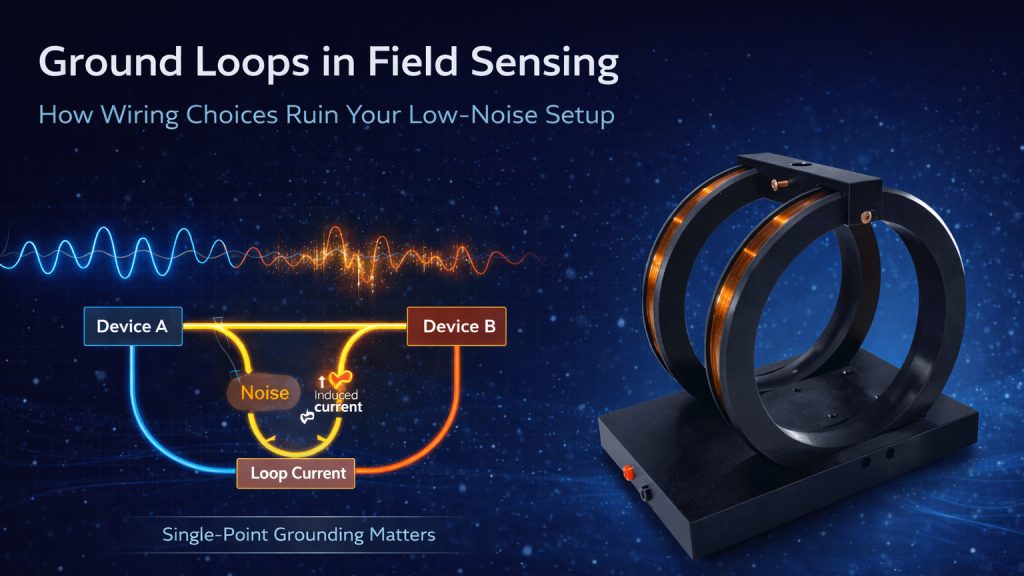
When field measurements become unstable, noisy, or drifting, the usual suspects are:
- Sensors
- Power supplies
- External interference
But in many cases, the real cause is much simpler—and more frustrating:
👉 the wiring itself
Ground loops are one of the most common and least understood sources of noise in magnetic field sensing systems.
If not properly addressed, they can completely undermine otherwise high-quality instrumentation.
1. What Is a Ground Loop
A ground loop occurs when multiple ground paths exist between different parts of a system.
This creates:
- Unintended current flow through ground conductors
- Voltage differences between “ground” points
According to Wikipedia:
https://en.wikipedia.org/wiki/Ground_loop_(electricity)
Ground loops can introduce noise and interference into sensitive measurement systems, especially where low-level signals are involved.
2. Why Ground Loops Are Critical in Field Sensing
Magnetic field sensors often operate at:
- Low signal levels
- High sensitivity
- Narrow noise margins
In this environment:
👉 Even microvolt-level disturbances matter
Typical Symptoms
- Fluctuating readings
- Low-frequency drift
- 50/60 Hz noise pickup
- Inconsistent measurement results
These issues are often misdiagnosed as:
- Sensor instability
- Environmental magnetic noise
3. How Ground Loops Form in Real Systems
Ground loops are rarely intentional.
They arise from:
- Multiple grounded instruments
- Shield connections at both ends
- Shared power lines with different ground potentials
- Improper cable routing
Common Scenario
- Sensor grounded at measurement device
- Also grounded at control system
- Connected through shielded cable
👉 This creates a loop where current can circulate.
4. Single-Point Grounding: The First Fix
The most effective strategy is:
👉 single-point grounding (star grounding)
How It Works
- All grounds reference a single physical point
- No closed ground paths are formed
Benefits
- Eliminates circulating ground currents
- Reduces noise coupling
- Stabilizes reference potential
Typical Mistake
- “Everything grounded everywhere”
- Which feels safe—but creates loops
5. Shielding: Helpful or Harmful?
Shielded cables are widely used—but often misused.
Correct Shielding Practice
- Connect shield to ground at one end only
- Typically at the signal receiver side
Incorrect Practice
- Grounding both ends of the shield
Result:
👉 The shield itself becomes part of a ground loop
6. Differential Measurement: Rejecting Noise Instead of Fighting It
Differential measurement techniques can significantly reduce ground loop effects.
How It Works
- Measures voltage difference between two signal lines
- Rejects common-mode noise
Advantages
- Robust against ground potential differences
- Improved signal integrity
Limitations
- Requires proper instrumentation
- Does not eliminate loops—only mitigates their effects
7. Isolation: Breaking the Loop Completely
When grounding cannot be simplified, isolation is the solution.
Types of Isolation
- Signal isolation amplifiers
- Optical isolation
- Isolated data acquisition systems
What It Achieves
- Breaks electrical continuity between subsystems
- Eliminates loop current paths
According to IEEE EMC practices, isolation is one of the most effective ways to eliminate ground-related interference.
8. Wiring Layout: The Overlooked Factor
Even with correct grounding, layout matters.
Best Practices
- Separate signal cables from power cables
- Avoid long parallel runs
- Use twisted pair for differential signals
- Minimize loop area in wiring
Why It Matters
👉 Large loop areas act like antennas
They pick up:
- Electromagnetic interference (EMI)
- Power line noise
9. When Noise Is Not a Sensor Problem
A critical insight:
👉 Many “bad sensors” are actually good sensors in bad wiring environments
Before replacing:
- Hall probes
- Fluxgate sensors
- Measurement electronics
You should evaluate:
- Grounding scheme
- Cable shielding
- Signal routing
10. How Cryomagtech Supports Low-Noise Field Measurement
At Cryomagtech, field sensing is treated as a system integration problem.
We consider:
- Grounding architecture
- Shielding strategy
- Sensor interface design
- Noise-sensitive measurement environments
👉 Product link placeholder: Cryomagtech Field Measurement & Integrated Control Solutions
Instead of focusing only on sensors,
we design complete systems that ensure:
- Low-noise measurement conditions
- Stable and repeatable readings
- Reduced troubleshooting during setup
References
- Wikipedia – Ground Loop
https://en.wikipedia.org/wiki/Ground_loop_(electricity) - IEEE – Grounding and shielding in measurement systems
https://ieeexplore.ieee.org/
Key Takeaways
- Ground loops are a major source of measurement noise
- Multiple ground paths create unintended current flow
- Single-point grounding reduces loop formation
- Shielding must be applied correctly to avoid worsening noise
- Differential measurement improves noise rejection
- Isolation can eliminate ground loops entirely
If your field measurements are unstable,
the problem may not be your sensor—
👉 it may be your wiring.