
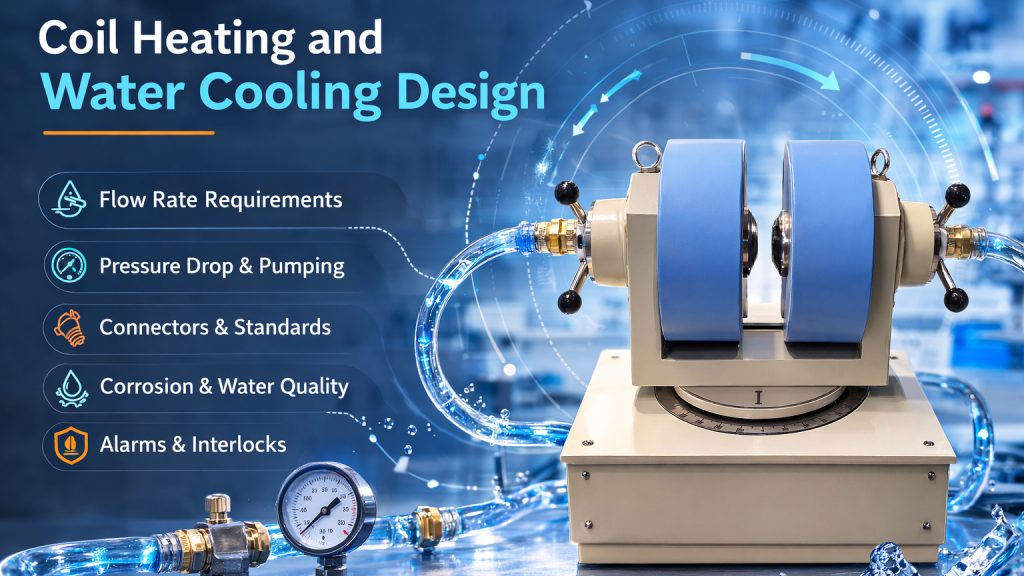
High-field electromagnets and large coil systems often rely on water cooling to manage thermal load.
When electrical current flows through a coil, resistive heating follows the familiar relation:
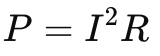
As current increases, heat generation rises rapidly. Without adequate cooling, coil temperature can increase to levels that degrade insulation, shift resistance, or damage the magnet system.
Water-cooled coil designs allow much higher current densities and continuous operation compared with air-cooled systems.
However, proper water cooling design requires careful attention to flow rate, pressure drop, plumbing standards, and failure protection.
1. Why Coil Heating Becomes a Serious Problem
Even moderate laboratory electromagnets can generate significant heat.
For example:
- High current excitation
- Continuous operation
- Long automated experiments
All increase the thermal load on the coil windings.
If heat removal is insufficient, several problems can occur:
- Coil resistance increases with temperature
- Required drive voltage increases
- Magnetic field stability degrades
Basic background on Joule heating can be found here:
https://en.wikipedia.org/wiki/Joule_heating
For high-field systems, passive cooling alone is rarely sufficient.
2. Water Cooling in Electromagnet Systems
Water cooling works by circulating coolant through channels embedded in the coil conductor or surrounding structure.
In many high-power electromagnets, hollow copper conductors are used so that water flows directly through the conductor itself.
Advantages include:
- efficient heat removal
- stable operating temperature
- ability to sustain high current densities
Water cooling allows magnet systems to operate continuously without excessive thermal drift.
3. Flow Rate Requirements
Cooling effectiveness depends strongly on the coolant flow rate.
Higher flow rates improve heat transfer but also increase system complexity.
Typical design considerations include:
- coil thermal load
- coolant temperature rise
- allowable pressure drop
The required flow rate is often estimated based on energy balance:
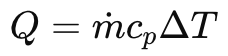
Where:
- m˙ = mass flow rate
- cp = heat capacity of water
- ΔT = temperature rise
Proper flow design ensures the coil remains within safe operating temperature limits.
4. Pressure Drop in Cooling Channels
Cooling channels in coils introduce hydraulic resistance.
Pressure drop depends on:
- channel diameter
- channel length
- flow velocity
- surface roughness
High pressure drop can cause:
- insufficient flow
- pump overload
- unstable cooling conditions
In coil cooling design, engineers must balance:
- sufficient flow for heat removal
- acceptable pressure requirements for the pump system
Understanding pressure losses in pipe systems is essential for reliable cooling design.
5. Connector Standards and Plumbing Reliability
Water connections are a common point of failure in laboratory magnet systems.
Typical design considerations include:
- standardized hose fittings
- leak-resistant connectors
- mechanical strain relief
Laboratory installations should also include:
- flexible tubing to prevent stress
- clear flow direction labeling
- accessible inspection points
Reliable plumbing design significantly reduces maintenance risks.
6. Water Quality and Corrosion Risks
Cooling water quality directly affects system reliability.
Poor water quality may lead to:
- corrosion in copper conductors
- mineral deposits in channels
- reduced flow efficiency
Recommended practices include:
- using filtered or deionized water
- monitoring conductivity levels
- avoiding aggressive chemical contamination
Water quality control extends the lifetime of the cooling system.
7. Failure Modes in Water-Cooled Magnet Systems
Although water cooling is effective, several failure modes must be considered.
Common risks include:
Blocked Cooling Channels
Particles or mineral deposits may restrict flow.
This can cause localized overheating.
Pump Failure
Loss of coolant circulation may quickly raise coil temperature.
Leaks
Improper fittings or mechanical damage may cause water leakage.
Reduced Flow
Flow reduction can occur due to partial blockages or pump degradation.
Each of these failure modes requires detection and protection mechanisms.
8. Monitoring and Interlock Protection
Reliable systems incorporate monitoring and safety interlocks.
Common protection strategies include:
- flow sensors
- temperature monitoring
- pressure monitoring
- automatic power shutdown if cooling fails
These interlocks prevent coil overheating and protect both the magnet and power supply.
In advanced installations, cooling status can also be integrated into automated experiment control systems.
9. System-Level Cooling Design
Effective cooling design requires coordination between:
- coil geometry
- water flow channels
- pump capacity
- plumbing layout
- safety monitoring
Cryomagtech supports water-cooled electromagnet and coil systems designed for stable operation and reliable thermal management.
👉 Product Link Placeholder – Water-Cooled Electromagnet and Coil Systems
Proper cooling design ensures that the magnet system remains stable even during long-duration experiments.
Key Takeaways
- Coil heating increases rapidly with current due to resistive losses
- Water cooling enables higher current densities and continuous operation
- Proper flow rate and pressure management are critical
- Water quality affects corrosion and long-term reliability
- Monitoring and interlocks protect against cooling failure
In high-power magnet systems, thermal management is not just a design detail.
It is a fundamental requirement for safe and stable operation.