
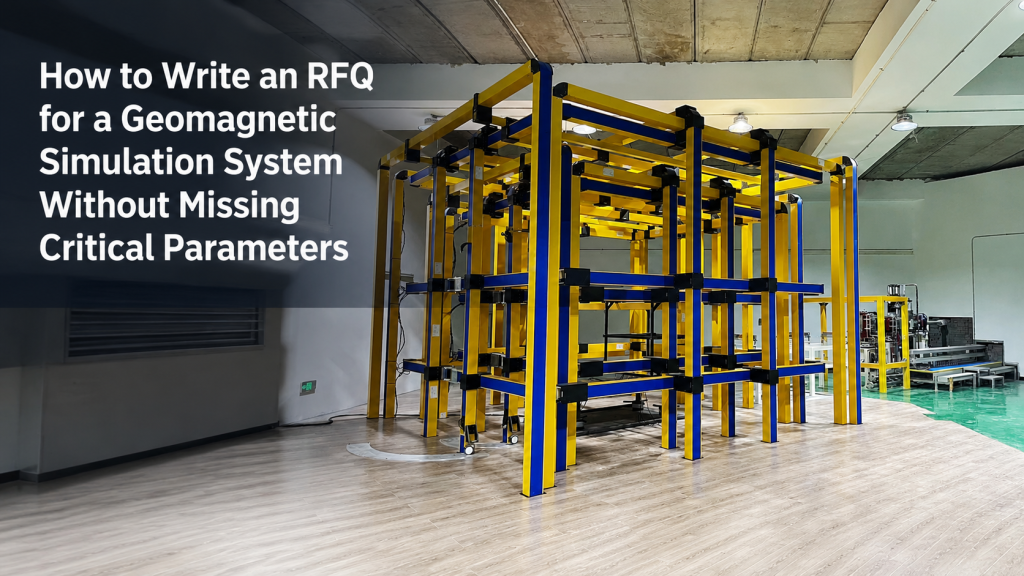
A good RFQ for a geomagnetic simulation system does more than ask for “a Helmholtz coil quotation.”
It tells the supplier what magnetic field needs to be generated, how accurately it must be controlled, what test volume is required, how many axes are needed, and how the system will be used in real experiments.
For magnetometer, compass, IMU, navigation, and sensor calibration projects, missing one critical parameter can lead to the wrong coil size, wrong driver capacity, wrong software scope, or a quotation that looks attractive but cannot support the real test.
This article explains how to write a clear RFQ for a geomagnetic simulation system, especially when selecting 1-axis, 2-axis, or 3-axis Helmholtz coil systems.
1. Start with the Real Application, Not the Coil Name
Many RFQs begin like this:
“We need a Helmholtz coil system. Please quote.”
That is not enough.
A Helmholtz coil is a tool for generating a controlled magnetic field, but the correct system depends on the application.
Typical Applications
A geomagnetic simulation system may be used for:
- Magnetometer calibration
- Compass testing
- IMU and AHRS validation
- Navigation sensor development
- Earth-field compensation
- Heading simulation
- Magnetic interference testing
- Low-field scientific experiments
- Production sensor calibration
Each application has different priorities.
For example, a compass test may care more about field direction and angular accuracy. A magnetometer calibration project may care more about field magnitude, linearity, and noise. A production test system may care more about repeatability and software automation.
So the first RFQ requirement should be:
“What is the system used for?”
2. Define the Required Magnetic Field Range
Geomagnetic simulation usually works near the Earth’s magnetic field level.
The Earth’s magnetic field is commonly in the range of tens of microtesla, depending on location. NOAA’s World Magnetic Model provides software and online calculators for computing the main components of the geomagnetic field and their annual changes.
Reference link: https://www.ncei.noaa.gov/products/world-magnetic-model
A clear RFQ should specify the required magnetic field range.
Example Field Range Descriptions
Good RFQ examples:
- ±100 µT per axis
- ±200 µT per axis
- ±500 µT per axis
- 0–1 mT for single-axis testing
- ±2 mT for sensor response testing
- Earth-field cancellation plus programmable vector field generation
Poor RFQ example:
“We need to simulate magnetic field.”
This is too vague.
Why Field Range Matters
Field range affects:
- Coil size
- Coil turns
- Required current
- Driver output current
- Driver voltage
- Heat generation
- Resolution at low field
- System cost
A system designed for ±100 µT is very different from a system designed for ±10 mT, even if both are called Helmholtz coil systems.
3. Specify 1-Axis, 2-Axis, or 3-Axis Field Control
Geomagnetic simulation often requires vector control, not only field magnitude.
A 1-axis system generates a field along one direction.
A 2-axis system controls two perpendicular directions.
A 3-axis system can generate a full vector magnetic field.
When 1-Axis Is Enough
A 1-axis Helmholtz coil may be suitable for:
- Basic sensor response testing
- Single-axis magnetometer calibration
- Simple field exposure experiments
- Educational laboratory demonstrations
When 2-Axis Is Useful
A 2-axis system may be suitable for:
- Horizontal plane heading simulation
- Compass testing in a limited orientation range
- Two-axis magnetic response testing
- Applications where the vertical component is not critical
When 3-Axis Is Needed
A 3-axis Helmholtz coil system is usually preferred for:
- Full geomagnetic vector simulation
- IMU and AHRS testing
- Magnetometer calibration
- Compass heading and tilt-related testing
- Earth-field cancellation and replacement
- Automated magnetic vector sequences
Helmholtz coils are widely used to produce a region of nearly uniform magnetic field and can also be used to cancel external fields such as the Earth’s magnetic field.
Reference link: https://en.wikipedia.org/wiki/Helmholtz_coil
4. Describe the Test Volume and DUT Size
One of the most important RFQ parameters is the required uniform field region.
The supplier needs to know where the device under test will sit, how large it is, and how much of the space must meet the uniformity requirement.
Include These Details
Your RFQ should include:
- DUT size
- Sensor package size
- Fixture size
- Required uniform region
- Whether cables or connectors occupy space
- Whether multiple devices are tested at once
- Whether the DUT rotates inside the coil
Example
Better RFQ wording:
“The DUT is an IMU module approximately 40 × 40 × 20 mm. We need a uniform magnetic field over at least a 60 mm cube around the coil center.”
This is much better than:
“The sample is small.”
Why This Matters
A larger uniform region usually requires:
- Larger coils
- More space
- More power
- Higher cost
- More careful mechanical design
A small coil may produce enough magnetic field at the center but fail to provide the required uniformity over the actual DUT volume.
5. Define the Required Field Uniformity
Field uniformity describes how much the field changes inside the specified test volume.
For geomagnetic simulation, field uniformity may be specified as:
- ±0.1%
- ±0.5%
- ±1%
- ±2%
- ±5%
The right value depends on the application.
Practical Guidance
For early R&D testing, moderate uniformity may be acceptable.
For sensor calibration, compass validation, or production testing, uniformity should be defined more carefully.
A clear RFQ should say:
- Uniformity value
- Uniformity volume
- Whether the value applies to one axis or three axes
- Whether it applies after calibration or as a geometric design target
Example
Good RFQ example:
“Field uniformity: ±1% over a 100 mm cube around the center, for all three axes.”
Poor RFQ example:
“High uniformity required.”
“High uniformity” means different things to different suppliers. It is not a specification.
6. Clarify Field Accuracy, Resolution, and Stability
For geomagnetic simulation, maximum field strength is often less important than accuracy and stability.
A system may generate ±500 µT, but that does not automatically mean it can control the field precisely at 30 µT, 50 µT, or 65 µT.
Important Control Specifications
Your RFQ should define:
- Field setting resolution
- Current resolution
- Field accuracy
- Current stability
- Field stability over time
- Noise requirement
- Calibration method
- Whether a feedback sensor is required
Example Questions
Ask yourself:
- Do we need microtesla-level resolution?
- Do we need nanotesla-level stability?
- Is open-loop current control enough?
- Do we need closed-loop feedback with a magnetometer?
- How long must the field remain stable?
For sensor calibration projects, these details can be more important than the maximum field number.
7. Include Background Field Compensation Requirements
Geomagnetic simulation is often performed in the presence of the local Earth field and surrounding magnetic interference.
That means the system may need to:
- Cancel the local Earth field
- Add a programmed vector field
- Compensate for residual background field
- Reduce magnetic offsets caused by nearby structures
What to Include in the RFQ
A strong RFQ should mention:
- Whether background field cancellation is required
- Whether the local geomagnetic field is known
- Whether the test room has magnetic interference
- Whether field mapping is required before operation
- Whether compensation should be manual or automatic
Example
“System should support local Earth-field cancellation and programmable vector field generation. We can provide site coordinates, or the supplier may suggest a field measurement and compensation procedure.”
This tells the supplier that the system is not only generating a field in isolation. It must work in the real magnetic environment.
8. Define DC, Sweep, AC, or Dynamic Operation
Some geomagnetic simulation systems only need static DC fields.
Others need changing fields, sweeps, or rotating magnetic vectors.
These are very different driver requirements.
Common Operation Modes
Your RFQ should specify whether the system needs:
- Static DC field
- Step changes
- Linear field sweep
- Rotating vector field
- Sinusoidal waveform
- Custom waveform
- Frequency response testing
- Automated test sequences
Why This Matters
Dynamic operation affects:
- Driver bandwidth
- Output voltage
- Coil inductance
- Current response time
- Heat generation
- Software control
- Synchronization between axes
A driver that works well for static Earth-field simulation may not be suitable for fast waveform generation.
9. Specify Driver and Software Requirements
A Helmholtz coil system is not complete without a suitable driver.
For geomagnetic simulation, the driver should be selected together with the coil.
Driver Parameters to Include
A good RFQ should mention:
- Number of driver channels
- Bipolar output requirement
- Current range
- Current resolution
- Stability
- Voltage headroom
- Communication interface
- Protection functions
- Cooling requirements
- Rack-mount or desktop preference
Software Parameters to Include
The software scope should also be clear.
Possible requirements include:
- Manual current control
- Magnetic field unit input
- Vector field setting
- Coordinate transformation
- Field sequence programming
- Data logging
- API or command control
- Integration with LabVIEW, Python, or external software
- Calibration table support
If software is essential, say so clearly in the RFQ.
Do not assume it is included by default.
10. Mention Mechanical Access and Integration Constraints
Many RFQs forget mechanical details.
That is a mistake.
A geomagnetic simulation system must physically fit the device, fixture, cables, optical path, or test platform.
Mechanical Details to Include
Your RFQ should mention:
- Maximum available space
- Required coil opening
- Optical access
- Cable routing
- Fixture mounting
- Sensor rotation needs
- Non-magnetic material requirements
- Tabletop, frame-mounted, or rack-integrated installation
- Whether the system must fit around existing equipment
Example
“The coil system must allow side access for cables and enough central space for a non-magnetic rotation fixture.”
This one sentence can prevent a major design mismatch.
11. Clarify Duty Cycle and Operating Time
Even low-field systems should define operation time.
For higher-field geomagnetic testing, duty cycle becomes even more important.
Include These Details
Your RFQ should specify:
- Continuous or intermittent operation
- Maximum test duration
- Daily usage time
- Ambient temperature
- Cooling preference
- Whether fan noise is acceptable
- Whether water cooling is allowed
Example
“The system will be used for automated test cycles lasting 4–6 hours per day. Continuous operation at the specified field range is preferred.”
This helps the supplier choose the right coil wire, driver margin, and cooling strategy.
12. Provide Accuracy Priorities Instead of Asking for Everything
Many users ask for:
- High field
- Large volume
- High uniformity
- High accuracy
- Fast response
- Compact size
- Low cost
All at the same time.
That is usually unrealistic.
A better RFQ should define priorities.
Example Priority Statement
“Our first priority is stable Earth-field simulation around ±100 µT. A larger field range up to ±1 mT would be useful but is not mandatory if it significantly increases cost.”
This helps the supplier propose a realistic system instead of overdesigning the quotation.
13. RFQ Template for a Geomagnetic Simulation System
Below is a practical RFQ structure users can copy and adapt.
Project Background
We are looking for a geomagnetic simulation system for [application], such as magnetometer / compass / IMU / navigation sensor testing.
Required Field Control
- Axis configuration: 1-axis / 2-axis / 3-axis
- Field range per axis:
- DC or dynamic operation:
- Required field resolution:
- Required field stability:
- Required field accuracy:
Test Volume
- DUT size:
- Required uniform region:
- Required uniformity:
- Number of devices tested at once:
- Sensor position fixed or rotating:
Background Field Compensation
- Need to cancel local Earth field: Yes / No
- Need programmable vector field: Yes / No
- Local field measurement available: Yes / No
- Closed-loop feedback required: Yes / No / Not sure
Driver and Software
- Number of channels:
- Bipolar current output required: Yes / No
- Communication interface:
- Manual control or PC software:
- Field sequence programming:
- API integration requirement:
Mechanical Requirements
- Available installation space:
- Required central opening:
- Fixture or turntable:
- Optical or cable access:
- Non-magnetic material requirement:
- Existing equipment to integrate with:
Operating Conditions
- Continuous operation time:
- Duty cycle:
- Ambient temperature:
- Cooling preference:
- Noise limitation:
- Power supply standard:
Commercial Information
- Quantity:
- Target delivery date:
- Delivery country:
- Preferred trade term:
- Budget range, if available:
- Required documentation:
This structure gives suppliers enough information to provide a meaningful technical proposal and quotation.
14. How Cryomagtech Supports Geomagnetic Simulation RFQs
Cryomagtech provides 1-axis, 2-axis, and 3-axis Helmholtz coil systems with matched magnetic field drivers for geomagnetic simulation, Earth-field compensation, and sensor calibration applications.
We help users define:
- Field range
- Axis configuration
- Uniform region
- Driver current and voltage margin
- Low-field resolution
- Background field compensation strategy
- Software control requirements
- Mechanical access and fixture design
👉 Product link placeholder: Cryomagtech Geomagnetic Simulation and Helmholtz Coil Systems
A clear RFQ helps both sides move faster.
It reduces unnecessary assumptions, avoids under-designed systems, and makes the quotation more relevant to the real test.
References
- NOAA / NCEI – World Magnetic Model
https://www.ncei.noaa.gov/products/world-magnetic-model - NOAA / NCEI – Geomagnetic Calculators
https://www.ngdc.noaa.gov/geomag/calculators/magcalc.shtml - Wikipedia – Helmholtz Coil
https://en.wikipedia.org/wiki/Helmholtz_coil
Key Takeaways
- A good geomagnetic simulation RFQ should define application, field range, axis count, uniform volume, control accuracy, and software needs.
- 1-axis, 2-axis, and 3-axis Helmholtz coil systems serve different calibration and simulation tasks.
- Field range alone is not enough; low-field resolution, stability, and background compensation are critical.
- Mechanical access, fixtures, cables, and DUT size must be included in the RFQ.
- The best quotation comes from a complete specification, not from a short request for “a Helmholtz coil price.”
A well-written RFQ does not need to be long.
It needs to include the parameters that decide the system design.