
Many users want a coil system with two goals at the same time:
“We need a large open test space, but we also need strong, uniform magnetic field performance.”
This is a reasonable request, but it contains one of the most important hidden trade-offs in custom coil design.
For Helmholtz coil systems, open test space is never free. A larger opening, larger coil spacing, side access, optical access, or fixture clearance can affect field strength, uniformity, coil efficiency, power demand, driver capacity, and mechanical stability.
This article explains why open access and better field performance often compete with each other, and how users can define realistic coil requirements before requesting a custom design.
1. Why Open Test Space Matters
Open test space is important because the magnetic field is rarely the only requirement.
In real laboratory setups, users may need space for:
- Sensors
- Samples
- Fixtures
- Cables
- Optical paths
- Probes
- Cryostats
- Vacuum chambers
- Rotation stages
- Translation stages
- Temperature control modules
A coil system that produces the right field but blocks the experiment is not useful.
That is why many custom Helmholtz coil projects begin with mechanical access requirements, not only magnetic field requirements.
Common Open-Space Requests
Users often ask for:
- Larger center opening
- Wider coil spacing
- Side access
- Top access
- Optical windows
- Removable coil sections
- Non-magnetic sample holders
- Space for a turntable or fixture
- Compatibility with an existing test platform
These requirements are legitimate. But every opening changes the design balance.
2. What “Better Field Performance” Usually Means
When users ask for better field performance, they usually mean one or more of the following:
- Higher magnetic field strength
- Larger uniform region
- Better field uniformity
- Lower current consumption
- Better thermal stability
- Lower field drift
- Faster field response
- More stable three-axis vector control
These are also legitimate goals.
The conflict appears when the same system must provide both a very open structure and strong field performance.
In coil design, geometry is performance.
If the geometry changes to create more access, the magnetic field behavior changes as well.
3. Why Helmholtz Coil Geometry Is Sensitive
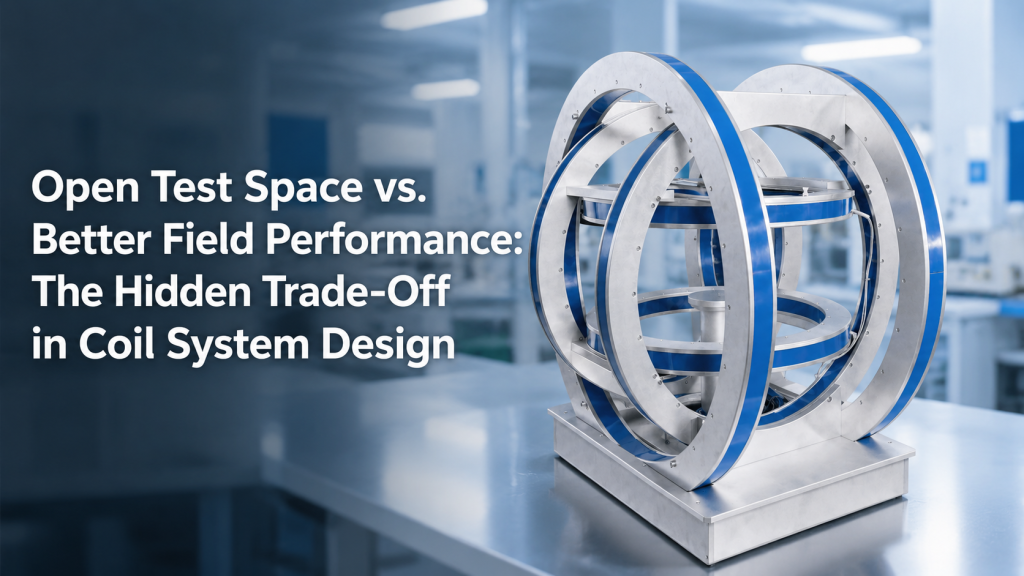
A classic Helmholtz coil pair consists of two matching coils placed coaxially with a spacing related to the coil radius. This arrangement is used to create a region of nearly uniform magnetic field near the center. Wikipedia describes a Helmholtz coil as a device that produces a region of nearly uniform magnetic field, and notes that the coil spacing is chosen to minimize nonuniformity near the center.
Reference link: https://en.wikipedia.org/wiki/Helmholtz_coil
This geometry is not arbitrary.
Changing it affects:
- Center field strength
- Uniformity volume
- Field direction
- Coil efficiency
- Required current
- Field gradient
- Mechanical envelope
That is why a custom coil system cannot be evaluated only by the external dimensions. The magnetic geometry matters.
4. Larger Opening Usually Means Lower Field Efficiency
A larger open test space usually requires larger coils or wider coil spacing.
Both can reduce field efficiency.
Field efficiency means how much magnetic field is generated per ampere of current.
When the coil becomes larger, the magnetic field at the center may require:
- More turns
- Higher current
- More copper
- Higher voltage
- Larger driver
- More heat management
- Stronger mechanical support
A compact coil can often generate a higher field more efficiently.
A large open coil may provide better access but needs more power to reach the same field.
This is one of the most common reasons why two coil systems with the same target field can have very different prices.
5. Wider Coil Spacing Can Reduce Uniformity
Users sometimes ask for more space between coil pairs so they can place a large fixture, optical setup, or chamber in the center.
This may be necessary, but it can affect field uniformity.
For a Helmholtz pair, the coil spacing is part of the uniformity condition. If the spacing is changed too much, the field distribution near the center may become less uniform.
What This Means in Practice
A wider spacing may provide:
- Better physical access
- More room for large DUTs
- Easier fixture installation
- More flexible cable routing
But it may also cause:
- Reduced uniformity
- Lower center field
- Higher field gradients
- More current demand
- More difficult calibration
The question is not simply whether the sample fits.
The real question is whether the required field uniformity still holds over the actual sample volume after the structure is opened.
6. Larger Uniform Region Requires Larger Coil Geometry
Some users want both a large open space and a large uniform region.
This is possible, but it usually increases system size and cost.
A larger uniform volume often requires:
- Larger coil diameter
- More optimized coil spacing
- Better structural symmetry
- More careful axis alignment
- Higher driver capacity
- More mechanical rigidity
- Sometimes multi-coil or compensation-coil designs
Research on uniform magnetic field systems often focuses on coil geometry because the shape, spacing, and arrangement of coils directly determine field uniformity. For example, a peer-reviewed study in Sensors discusses the design and evaluation of uniform magnetic field systems and compares coil geometries for generating controlled field regions.
Reference link: https://www.ncbi.nlm.nih.gov/pmc/articles/PMC8330130/
For custom systems, this means the uniform region should always be specified together with its size and location.
“High uniformity” alone is not enough.
7. Open Access Can Create Mechanical and Alignment Challenges
A coil system is not only an electrical device.
It is also a mechanical structure.
When more openings are added, the system may become more difficult to keep rigid, symmetric, and aligned.
Possible Mechanical Issues
Open structures can introduce:
- Reduced frame stiffness
- Coil displacement under load
- Axis misalignment
- Fixture vibration
- Assembly tolerance error
- Cable movement
- Difficulty maintaining three-axis orthogonality
- More complex calibration
For low-field systems, small alignment errors may already matter.
For three-axis Helmholtz coil systems, mechanical symmetry is especially important because each axis must generate a predictable field direction.
A design with excellent access but poor mechanical repeatability can become a calibration problem.
8. Optical Access and Side Access Are Not the Same Problem
Many users ask for “open access,” but different types of access have different design consequences.
Optical Access
Optical access may require:
- Clear line of sight through the coil center
- Space for lenses or objectives
- Avoiding obstruction by frames
- Non-reflective or non-magnetic fixtures
- Stable sample position
This may be manageable if the optical path is narrow and well defined.
Side Access
Side access may require:
- Larger side openings
- Offset fixtures
- Cable routing
- Probe insertion
- Mechanical support outside the coil center
This can be more difficult because side access may interfere with coil placement or frame symmetry.
Top Access
Top access may be needed for:
- Vertical probes
- Cryostats
- Sample loading
- Manipulators
- Vacuum chambers
This may affect coil stacking, frame height, and serviceability.
A good RFQ should not only say “open structure required.”
It should say which direction must be open and why.
9. Field Strength, Turns, Current, and Heat Are Connected
When open space increases, the coil may need more power to reach the same field.
The design variables are connected:
- More turns can increase field per ampere
- More turns also increase resistance and inductance
- Higher current increases heat
- Higher voltage may be needed for faster response
- Larger wire reduces resistance but increases coil size
- Better cooling adds complexity
This means the final design is always a balance among:
- Magnetic field strength
- Coil size
- Number of turns
- Current requirement
- Voltage requirement
- Temperature rise
- Duty cycle
- Driver cost
- Mechanical envelope
A user may ask for “more open space” and “same performance,” but the system may become larger, more expensive, or slower.
That is not a sales excuse. It is physics and engineering.
10. When Open Test Space Should Be the Priority
Open test space should be prioritized when the experiment cannot be performed without physical access.
This is common in:
- Optical measurement setups
- Probe-based testing
- Sensor rotation systems
- Cryogenic sample environments
- Vacuum chambers
- Large DUT testing
- Cable-heavy sensor modules
- Integration with existing instruments
In these cases, the coil must be designed around the experiment.
The right approach is to define:
- Minimum required access
- Exact DUT size
- Fixture dimensions
- Cable routing direction
- Optical path direction
- Required working distance
- Maximum allowed system footprint
Then the magnetic performance should be designed within those mechanical boundaries.
11. When Field Performance Should Be the Priority
Field performance should be prioritized when the measurement result depends strongly on magnetic quality.
This is common in:
- Magnetometer calibration
- Compass and IMU testing
- Uniform exposure experiments
- Low-noise magnetic measurement
- Three-axis vector field control
- Field mapping and sensor characterization
- Repeatable production calibration
In these cases, mechanical access should be limited to what is truly necessary.
Too much open space may reduce system quality without improving the real experiment.
A serious design question is:
“What access do we truly need, and what access is only convenient?”
Convenience can become expensive.
12. Practical Trade-Off Examples
Example 1: Large Opening, Low Field Target
A user needs a large center opening for a sensor fixture but only requires Earth-field simulation around ±100 µT.
This is usually feasible because the field target is low.
The main concerns are:
- Uniformity
- Axis alignment
- Driver resolution
- Background field compensation
- Mechanical stability
Example 2: Large Opening, High Field Target
A user needs a large chamber inside the coil and also wants tens of millitesla.
This is much harder.
The main concerns are:
- High current
- Coil heating
- Driver size
- Cooling
- Mechanical load
- Cost
- Lower field efficiency
The system may still be possible, but the user should expect a larger and more expensive design.
Example 3: Small Sample, High Uniformity
A user has a small sensor but asks for a very large uniform region.
This may be unnecessary.
If the real DUT is small and stays near the center, a smaller uniform region may reduce cost significantly.
Example 4: Optical Access with Moderate Field
A user needs optical access through the center and moderate field strength.
This can often be handled with a custom frame and carefully defined optical path, as long as the access direction and working distance are clear.
13. What Users Should Define Before Requesting a Custom Coil
A strong RFQ should include both magnetic and mechanical requirements.
Magnetic Requirements
- Field range
- Number of axes
- DC, AC, sweep, or vector control
- Required uniformity
- Uniform region size
- Field stability
- Field resolution
- Duty cycle
- Cooling preference
Mechanical Requirements
- Required open directions
- DUT size
- Fixture dimensions
- Optical path
- Probe access
- Cable routing
- Existing equipment dimensions
- Maximum footprint
- Mounting method
- Non-magnetic material requirements
Priority Statement
Users should also include a priority statement.
For example:
“Our first priority is optical access from both sides. Field strength can be moderate.”
Or:
“Our first priority is ±1% uniformity over a 100 mm cube. Mechanical access can be adjusted.”
This helps avoid unrealistic designs and unnecessary cost.
14. How Cryomagtech Supports Custom Helmholtz Coil Design
Cryomagtech provides custom Helmholtz coil systems for magnetic field generation, geomagnetic simulation, sensor testing, and research applications.
For projects with open-space requirements, we help evaluate:
- Coil size
- Field range
- Uniform region
- Axis configuration
- Driver capacity
- Cooling method
- Fixture space
- Optical or probe access
- Mechanical structure
- Field performance trade-offs
👉 Product link placeholder: Cryomagtech Custom Helmholtz Coil Systems
The best coil design is not always the most open design or the strongest design.
It is the design that gives the experiment enough access without sacrificing the magnetic performance that actually determines the result.
References
- Wikipedia – Helmholtz Coil
https://en.wikipedia.org/wiki/Helmholtz_coil - Sensors – Design, Simulation and Evaluation of Uniform Magnetic Field Systems
https://www.ncbi.nlm.nih.gov/pmc/articles/PMC8330130/
Key Takeaways
- Open test space and field performance often compete in custom coil system design.
- Larger openings may reduce field efficiency, uniformity, and mechanical stiffness.
- Better uniformity usually requires careful coil geometry and controlled spacing.
- Mechanical access should be defined by the real experiment, not by convenience alone.
- A successful Helmholtz coil design balances field strength, uniform region, driver capacity, structure, and access.
For custom coil projects, the most important question is not:
“How open can the system be?”
The better question is:
“How much open space do we truly need, while still protecting the magnetic field performance required by the experiment?”