
In precision magnetic experiments, users often focus on:
- current stability
- field uniformity
- sensor resolution
But there is another silent factor that can ruin your data:
👉 Mechanical vibration and microphonics
Even when your magnetic system is electrically stable, tiny vibrations can translate into measurable noise—especially in high-sensitivity setups.
1. What Are Microphonics in Magnetic Systems?
Microphonics refers to:
👉 mechanical vibrations being converted into electrical or measurement noise
In magnetic systems, this can happen when:
- coils move slightly under Lorentz forces
- structures resonate
- sensors shift relative to the field
According to Wikipedia, microphonics is a well-known phenomenon in precision instrumentation where mechanical motion affects signal integrity.
2. Why Vibration Directly Affects Magnetic Measurements
Magnetic measurements depend on:
- relative position between sample and field
- stability of field geometry
- sensor alignment
Even micrometer-level motion can cause:
- field fluctuation at the sample
- signal noise in sensors
- drift in measurement results
👉 In sensitive systems, mechanical instability often appears as “electrical noise”
3. Where Vibrations Actually Come From
Internal Sources
- coil expansion and contraction
- Lorentz force-induced movement
- cooling fans
External Sources
- building vibration
- nearby equipment
- foot traffic
Fluid-Induced Sources
- water cooling flow
- pump vibration
- turbulence
👉 Water-cooled systems are especially prone if not properly isolated
4. Structural Resonance: The Hidden Amplifier
Every mechanical structure has natural frequencies.
If excitation matches these frequencies:
👉 vibration amplitude increases dramatically
Typical Resonance Sources
- coil supports
- mounting frames
- optical tables
According to IEEE studies, structural resonance can amplify small disturbances into significant measurement errors.
5. Coil Movement: Small Displacement, Big Impact
Coils are not perfectly rigid.
Under current:
- electromagnetic forces act on conductors
- thermal expansion occurs
Result
- slight deformation
- positional shift
- time-dependent instability
👉 This directly affects field distribution
6. Mechanical Design Strategies That Actually Work
Rigid Structural Design
- Use high-stiffness materials
- Minimize unsupported spans
Damping Elements
- vibration-absorbing mounts
- composite materials
Decoupling Techniques
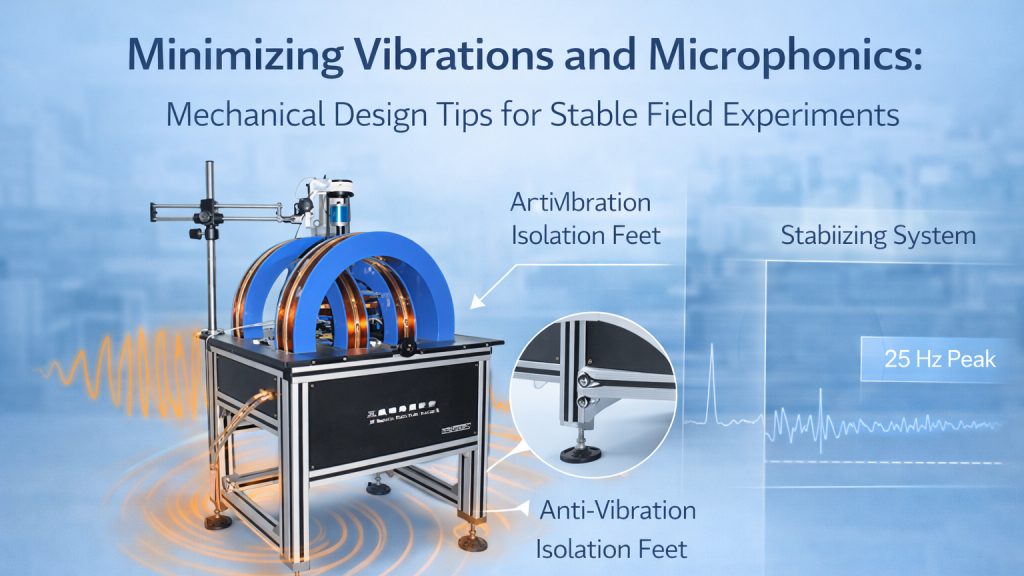
- isolate magnet from floor vibration
- separate cooling system mechanically
Mass Distribution
- heavier structures reduce vibration amplitude
- balanced design improves stability
7. Cooling System Design: Often Overlooked
Cooling is a major vibration source.
Air Cooling
- fan-induced vibration
- airflow disturbance
Water Cooling
- pump vibration
- pressure fluctuations
Best Practices
- remote chillers
- flexible hoses
- flow stabilization
8. Installation Matters More Than You Think
Even a well-designed system can fail if poorly installed.
Common Issues
- loose mounting
- uneven support surfaces
- rigid coupling to vibrating structures
Recommendations
- use vibration isolation platforms
- ensure proper leveling
- avoid direct coupling to heavy machinery
9. Diagnosing Vibration Problems
Symptoms
- fluctuating measurement readings
- noise correlated with time or activity
- inconsistent repeatability
Simple Tests
- tap test (light mechanical disturbance)
- monitor signal vs time
- turn off nearby equipment
👉 If readings change, vibration is likely the cause
10. How Cryomagtech Designs for Mechanical Stability
Cryomagtech systems consider vibration and microphonics from the beginning:
- rigid magnet structures
- optimized mounting interfaces
- guidance on installation and isolation
- compatibility with precision experimental setups
👉 Product link placeholder: Cryomagtech Stable Electromagnet Systems
Because stable measurements require more than just stable current—they require stable mechanics.
References
- Wikipedia – Microphonics and vibration effects
https://en.wikipedia.org/wiki/Microphonics - IEEE – Structural vibration and measurement stability
https://ieeexplore.ieee.org/
Key Takeaways
- Mechanical vibration can dominate measurement noise
- Microphonics converts vibration into signal instability
- Structural resonance amplifies small disturbances
- Cooling systems are major vibration sources
- Proper mechanical design improves stability
- Installation and isolation are critical for performance