
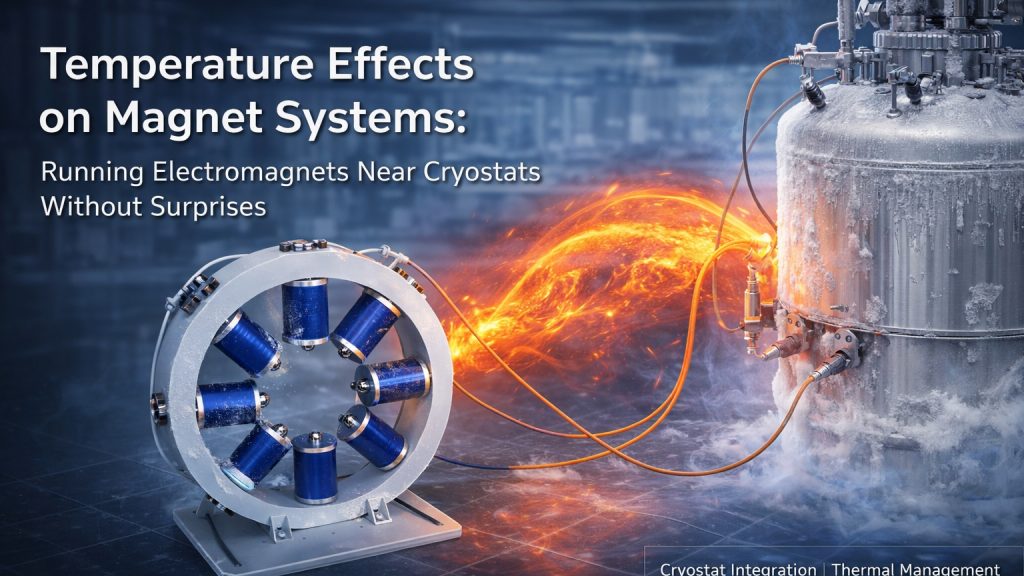
In many laboratory setups, electromagnets or Helmholtz coil systems are placed close to cryogenic systems (cryostats) to enable low-temperature magnetic measurements.
While this integration is common, it introduces a set of thermal and environmental challenges that can significantly affect system performance and measurement reliability.
This article explains key temperature-related effects when operating magnet systems near cryostats and how to avoid unexpected problems.
Why Cryostats Change Everything
A cryostat is a device designed to maintain extremely low temperatures, often using liquid helium or nitrogen.
In these environments:
- large temperature gradients exist (300 K → cryogenic levels)
- heat transfer occurs through conduction, convection, and radiation
This creates a complex thermal environment that affects nearby equipment—including magnet systems.
1. Heat Flow Between Magnet and Cryostat
When an electromagnet is placed near a cryostat, heat exchange occurs in multiple ways:
Conduction
Through mechanical supports and mounting structures
Convection
Through surrounding air
Radiation
Between warm magnet surfaces and cold cryostat surfaces
Even small heat leaks can affect cryogenic performance, because cryostats are designed to minimize thermal load as much as possible
2. Condensation and Frost Formation
One of the most visible issues is condensation.
When warm, humid air meets cold surfaces:
- water vapor condenses
- frost or ice forms
Condensation may appear on:
- cryostat surfaces
- nearby cables and connectors
- magnet components
This is not just cosmetic.
Condensation can:
- create electrical leakage paths
- damage insulation
- cause corrosion
In some cryogenic systems, frosting is a known indicator of thermal leakage or vacuum issues
3. Thermal Expansion and Mechanical Stress
Materials contract when cooled.
In cryogenic environments, temperature changes can reach hundreds of Kelvin, causing:
- differential expansion between materials
- mechanical stress in mounts and supports
- misalignment of the sample or sensors
Cryogenic systems routinely experience large dimensional changes due to temperature variation
If magnet structures and cryostat mounts are not mechanically decoupled, alignment errors may appear during operation.
4. Sensor Drift and Measurement Instability
Temperature affects measurement accuracy in several ways:
- Hall sensors drift with temperature
- resistance-based sensors change calibration
- electronics experience offset variations
Even if the magnetic field is stable, temperature fluctuations can create the illusion of field instability.
This is particularly problematic in:
- low-noise measurements
- long-duration experiments
- lock-in detection systems
5. Wiring and Thermal Conduction Paths
Cables are often overlooked, but they act as thermal bridges.
Problems include:
- heat conduction from room temperature into cryogenic regions
- temperature gradients along signal lines
- noise pickup due to thermal fluctuations
In cryogenic systems, wiring design must balance:
- electrical performance
- thermal isolation
Poor cable routing can degrade both thermal and measurement performance.
6. Magnetic Field Stability Under Thermal Load
Temperature changes affect electromagnet behavior:
- coil resistance increases with temperature
- current stability may change
- field output drifts over time
Even small temperature fluctuations can lead to measurable changes in magnetic field strength.
This effect becomes critical in:
- precision magnetometry
- hysteresis measurements
- low-field experiments
7. Practical Design Strategies
To avoid surprises when combining magnet systems with cryostats, several strategies can be applied.
1. Thermal Isolation
- minimize direct conductive paths
- use low thermal conductivity materials
- physically separate warm and cold components
2. Control Humidity and Condensation
- use dry air or nitrogen purge
- insulate cold surfaces
- avoid exposed cold metal
3. Mechanical Decoupling
- allow for thermal expansion
- avoid rigid connections between warm and cold systems
4. Sensor Placement Optimization
- keep sensors away from thermal gradients
- use temperature compensation where possible
5. Cable Management
- use low thermal conductivity wiring
- avoid unnecessary cable loops
- route cables carefully to reduce heat flow
8. System-Level Integration Matters
Combining magnet systems with cryostats is not just a placement problem.
It is a system integration problem, involving:
- thermal design
- mechanical stability
- electrical performance
- environmental control
Cryomagtech supports laboratories integrating electromagnet and Helmholtz coil systems with cryogenic setups, including guidance on thermal management and system stability.
👉 Product Link Placeholder – Electromagnet and Helmholtz Coil Systems for Cryogenic Integration
Proper integration ensures stable magnetic performance even in extreme temperature environments.
Key Takeaways
- Cryostats introduce strong thermal gradients into laboratory environments
- Heat transfer occurs through conduction, convection, and radiation
- Condensation and frost can damage electrical and mechanical components
- Thermal expansion can affect alignment and stability
- Sensor drift and wiring effects can distort measurements
- System-level design is essential for reliable operation
Running magnet systems near cryostats requires careful thermal and mechanical planning.