
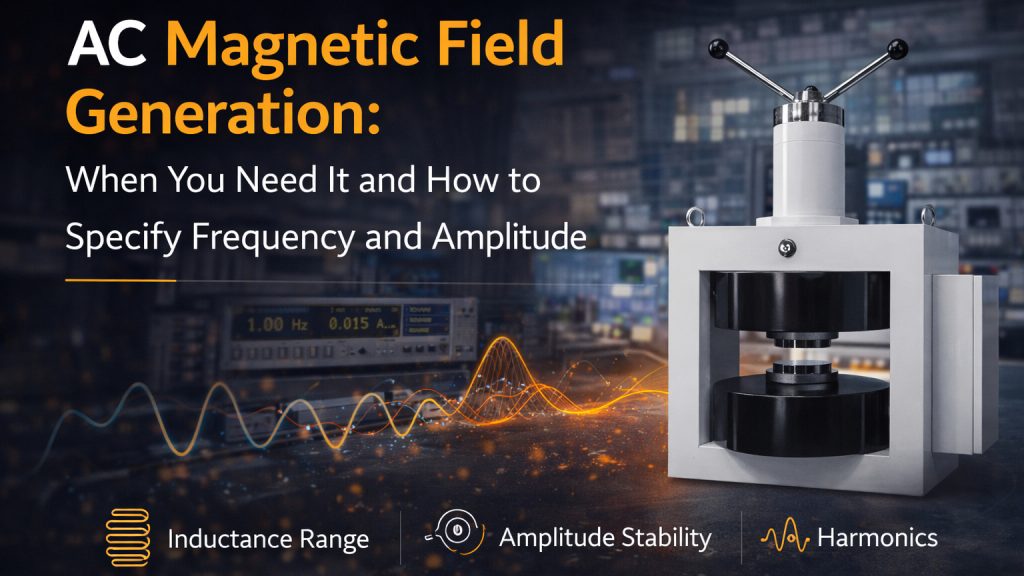
AC magnetic fields are widely used in modern laboratory experiments, including:
- magnetic susceptibility measurements
- inductive sensing and detection
- lock-in amplifier experiments
- sensor characterization
Unlike DC magnetic fields, AC magnetic fields introduce frequency-dependent behavior that significantly affects system design.
This article explains when AC magnetic fields are required and how to properly specify frequency and amplitude in real systems.
When Do You Actually Need an AC Magnetic Field?
AC magnetic fields are typically used when experiments depend on dynamic response rather than static field values.
Common scenarios include:
Magnetic Susceptibility Measurements
AC excitation allows separation of in-phase and out-of-phase components using lock-in techniques.
Inductive Sensing
Sensors detect changes in magnetic response as a function of frequency.
Lock-In Detection Systems
AC excitation improves signal-to-noise ratio by shifting measurements away from low-frequency noise.
Dynamic Material Response
Some materials exhibit frequency-dependent magnetic behavior.
In all these cases, the frequency domain becomes part of the measurement, not just the field amplitude.
The Core Reality: Coils Are Not Ideal
In theory, magnetic field is proportional to current:
B ∝ I
However, in AC systems, coils behave as inductive elements, meaning they resist changes in current.
The inductive reactance is:
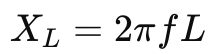
This means that as frequency increases, the coil becomes harder to drive.
Why Frequency Limits Exist
The maximum usable frequency in an AC magnetic field system is limited by several factors.
1. Inductance and Drive Voltage
At higher frequencies:
- inductive reactance increases
- required drive voltage increases
- current becomes harder to maintain
This directly limits achievable field amplitude.
2. Phase Shift Between Voltage and Current
In AC circuits, current lags voltage due to inductance.
This causes:
- phase mismatch between drive signal and magnetic field
- errors in lock-in measurements
3. Skin Effect and Losses
At higher frequencies, current tends to concentrate near the surface of conductors.
This increases resistance and energy loss.
Result:
- reduced efficiency
- heating
- amplitude instability
4. Parasitic Capacitance and Resonance
Coils are not purely inductive.
They also exhibit:
- parasitic capacitance
- self-resonance behavior
At certain frequencies, the system may:
- distort the waveform
- amplify or suppress signals unpredictably
Amplitude Control: Not Just “Set Current”
Specifying AC magnetic field amplitude requires more than defining current.
Important considerations include:
- frequency-dependent current capability
- power supply bandwidth
- thermal limits
For example:
A system capable of 100 mT at DC may only achieve:
- 50 mT at 100 Hz
- 10 mT at 1 kHz
This is not a failure. It is physics doing its job.
Harmonics and Waveform Purity
In AC magnetic field systems, waveform quality is critical.
Non-ideal factors may introduce:
- harmonic distortion
- waveform asymmetry
- frequency-dependent amplitude variation
These distortions can affect:
- lock-in detection accuracy
- harmonic analysis
- nonlinear material characterization
Therefore, specifying total harmonic distortion (THD) or waveform purity may be necessary in high-precision experiments.
How to Properly Specify an AC Magnetic Field
A meaningful specification should include both frequency and amplitude constraints.
1. Frequency Range
Example:
Frequency: 1 Hz – 1 kHz
2. Field Amplitude vs Frequency
Instead of a single value, specify a curve:
- 50 mT @ 10 Hz
- 20 mT @ 100 Hz
- 5 mT @ 1 kHz
3. Waveform Type
- sine wave
- square wave
- custom waveform
4. Stability and Noise
- amplitude stability
- phase stability
- noise spectrum requirements
5. Duty Cycle
Continuous vs pulsed operation affects thermal design.
System-Level Design: Coil + Driver Must Match
AC magnetic field performance depends on the combination of:
- coil inductance
- power supply bandwidth
- control electronics
- thermal management
You cannot evaluate them separately.
Cryomagtech provides electromagnet and Helmholtz coil systems designed for AC magnetic field applications, including matched driver configurations for frequency-dependent performance.
👉 Product Link Placeholder – AC Magnetic Field Helmholtz Coil and Electromagnet Systems
Matching coil design with driver capability ensures predictable AC field performance across frequency ranges.
Key Takeaways
- AC magnetic fields are essential for dynamic and frequency-domain measurements
- Coil inductance limits performance at higher frequencies
- Field amplitude decreases as frequency increases
- Phase shift and harmonic distortion affect measurement accuracy
- Proper specifications must include both frequency and amplitude
Understanding these constraints helps researchers design reliable AC magnetic field experiments.