
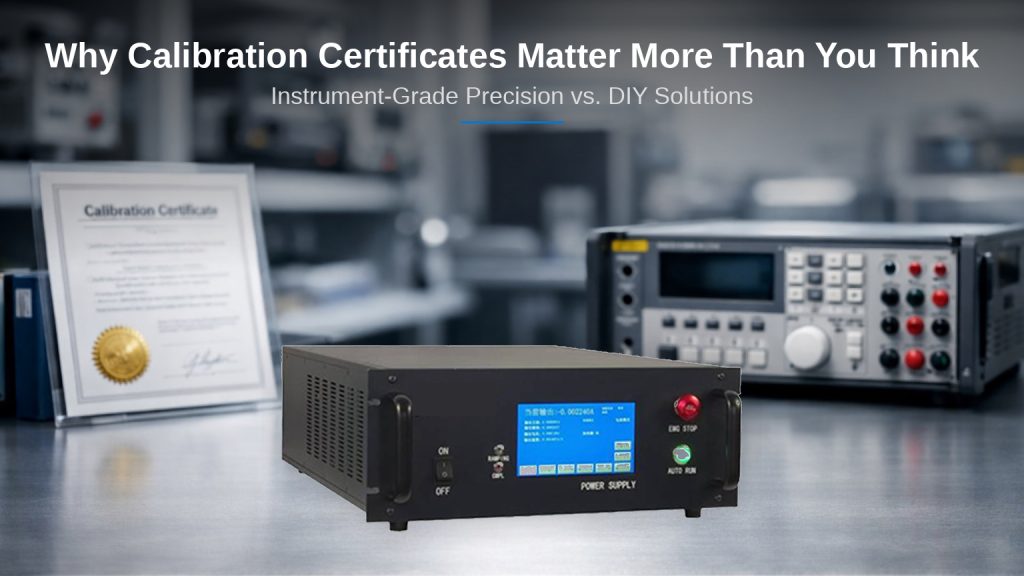
When purchasing a high precision excitation power supply or a superconducting magnet power supply, most teams focus on current range, stability, ripple, and noise.
But experienced laboratories know something more important:
If your system does not have a valid calibration certificate with traceability, it may not survive an audit, a peer review, or a grant inspection.
This article explains why calibration certificates matter — from both procurement and laboratory perspectives — and why instrument-grade systems are fundamentally different from DIY-grade solutions.
1. What Is a Calibration Certificate?
A calibration certificate is a formal document confirming that an instrument’s output has been verified against a traceable standard.
It typically includes:
- Measurement results
- Uncertainty values
- Reference standards used
- Traceability chain (often to national standards)
- Environmental conditions
- Date and validity period
Calibration ensures that your excitation current or voltage output is not just “close enough,” but quantitatively verified.
For a general overview of calibration and measurement traceability, see:
- Wikipedia – Calibration
https://en.wikipedia.org/wiki/Calibration
2. Traceability: The Hidden Requirement in Research and Industry
Traceability means that your measurement can be linked through an unbroken chain of comparisons to a national or international standard.
Without traceability:
- Industrial quality audits may fail
- ISO-compliant labs cannot validate data
- Published results become harder to defend
In fields like precision magnetics, superconducting measurements, and transport characterization, excitation current accuracy directly affects:
- Magnetic field calibration
- Hall coefficient extraction
- Resistivity measurements
- Spin transport experiments
When your excitation source drifts or lacks documented calibration, your entire dataset inherits that uncertainty.
3. Procurement Perspective: Risk Reduction
From a procurement standpoint, calibration certificates are not paperwork — they are risk management tools.
A certified excitation power supply:
- Reduces compliance risk
- Satisfies internal audit requirements
- Protects research funding
- Supports regulatory documentation
In regulated industries (semiconductor, aerospace, national labs), undocumented instruments are often disqualified during vendor evaluation.
That is the difference between an instrument-grade system and a bench-built power supply.
4. Laboratory Perspective: Data Integrity and Publication
In academic research, calibration becomes critical during:
- Peer review
- Reproducibility checks
- Cross-laboratory validation
Major journals increasingly emphasize reproducibility and measurement rigor. For example:
- Nature – Reporting standards and reproducibility policies
https://www.nature.com/nature-research/editorial-policies/reporting-standards
If your excitation current accuracy is ±1% but undocumented, reviewers may question:
- Magnetic field scaling
- Signal linearity
- Systematic error control
A calibration certificate provides documented uncertainty — not assumptions.
5. Superconducting Magnet Systems: Why Calibration Is Even More Critical
In superconducting magnet power supplies:
- Persistent mode stability
- Current ramp linearity
- Long-term drift
- Noise spectral density
all directly influence magnetic field accuracy.
A 0.01% current error in a 10 T magnet is not trivial.
Calibration certificates verify:
- Output current accuracy
- Measurement reference method
- Stability over defined conditions
This is especially critical in:
- Quantum transport measurements
- Low-temperature physics
- NMR and material characterization
6. DIY-Level vs Instrument-Level: The Real Difference
Many labs can technically build a current source.
But the difference lies in:
| DIY-Level Supply | Instrument-Grade Supply |
|---|---|
| No traceable calibration | Traceable calibration certificate |
| Unknown measurement uncertainty | Documented uncertainty |
| Limited audit defensibility | Audit-ready documentation |
| No formal verification records | Structured calibration records |
Precision electronics alone do not define an instrument.
Documentation and traceability do.
7. How Cryomagtech Supports Instrument-Grade Calibration
Cryomagtech supplies excitation power systems designed for laboratory and industrial compliance requirements.
Our systems can include:
- Factory calibration reports
- Output accuracy verification
- Traceable reference measurements
- Optional third-party calibration support
For high-precision excitation and superconducting magnet systems, see:
👉 Product Link Placeholder – High Precision & Superconducting Magnet Power Supply Systems
Our goal is not just to provide current output — but to provide documented, defensible performance.
8. When You Actually Need a Calibration Certificate
You definitely need documented calibration if:
- Your lab follows ISO procedures
- Your research will be published
- Your data affects product certification
- Your funding agency requires audit traceability
- Your system runs long-term magnetic measurements
If none of those apply, you might not need instrument-level documentation.
But most serious labs eventually do.
Key Takeaways
- Calibration certificates ensure measurement traceability
- Traceability protects audits, publications, and funding
- Superconducting magnet systems require documented accuracy
- Instrument-grade systems differ from DIY-level supplies
- Calibration is a compliance and data integrity decision
If your excitation power supply drives your magnetic field, its calibration status defines the credibility of your results.