
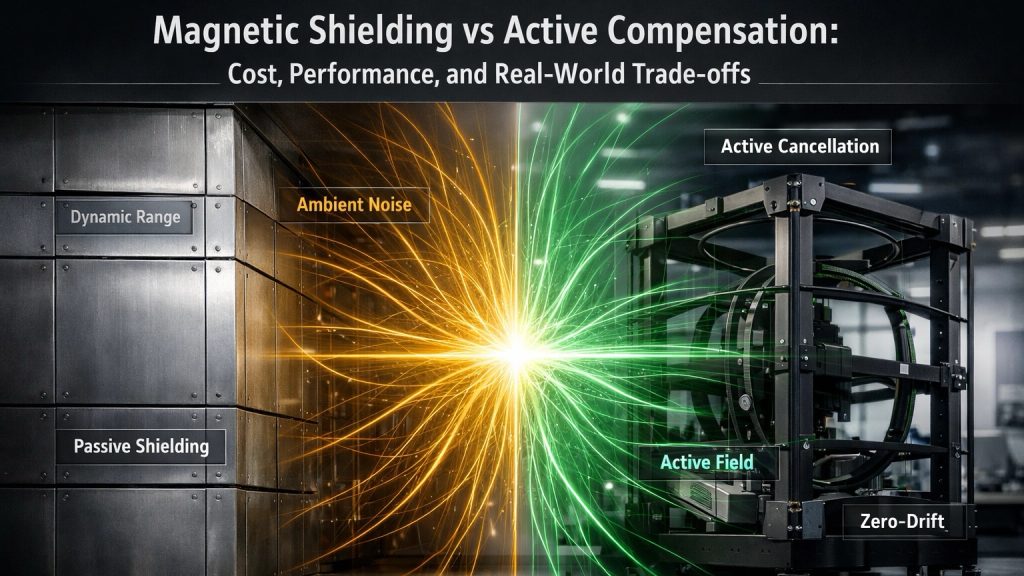
When dealing with ultra-low magnetic noise environments, research laboratories often face a critical decision:
Should we build a magnetic shielding room, or implement active magnetic field compensation?
Both approaches reduce environmental magnetic interference—but their cost structure, scalability, and real-world performance differ significantly.
This article explains the engineering trade-offs between magnetic shielding and active compensation systems, especially for low-frequency noise control and high-sensitivity measurements.
1. Understanding the Noise Problem First
Before choosing a solution, define the problem.
Typical environmental magnetic noise sources include:
- Power line frequencies (50/60 Hz)
- Elevator motors and HVAC systems
- Urban infrastructure currents
- Earth’s magnetic field drift
Low-frequency magnetic noise (especially below 100 Hz) is particularly challenging because it penetrates structures easily and fluctuates over time.
2. Magnetic Shielding: Passive Protection
How Magnetic Shielding Works
Magnetic shielding rooms (MSRs) use high-permeability materials (such as mu-metal) to redirect magnetic flux lines.
According to general shielding principles described in Magnetic Shielding (Wikipedia):
https://en.wikipedia.org/wiki/Magnetic_shielding
Passive shielding reduces static and low-frequency fields by providing a preferential path for magnetic flux.
Advantages of Magnetic Shielding
- Strong attenuation of external static fields
- No active electronics required
- Predictable baseline noise floor
Limitations
- Very high upfront cost
- Large space requirement
- Complex installation
- Limited scalability after construction
- Performance can degrade if material is mechanically stressed
Shielding rooms are capital infrastructure, not flexible instruments.
3. Active Magnetic Compensation: Field Cancellation Approach
How Active Compensation Works
Active compensation systems use:
- Reference magnetic sensors
- 3-axis compensation coils
- Feedback-controlled current sources
The system detects environmental field fluctuations and generates opposing magnetic fields in real time.
This approach is widely used in precision measurement systems where dynamic noise suppression is required (IEEE literature discusses feedback-based field stabilization methods in precision instrumentation environments).
Advantages of Active Compensation
- Lower installation cost
- Modular implementation
- Adjustable compensation bandwidth
- Easier integration with existing lab setups
- Expandable for larger uniform regions
Limitations
- Requires stable electronics
- Limited effectiveness at very high frequencies
- Dependent on sensor accuracy and calibration
- Requires periodic validation
Active systems are dynamic instruments rather than passive barriers.
4. Low-Frequency Noise: The Deciding Factor
For frequencies below 10–20 Hz:
- Passive shielding performs well for static offset reduction
- Active systems excel at suppressing time-varying components
In many laboratories, the dominant issue is not static Earth’s field—but slow drift from nearby infrastructure.
In such cases, active compensation often delivers better cost-to-performance efficiency.
5. Space Constraints and Facility Reality
Magnetic shielding rooms require:
- Dedicated construction space
- Structural support
- Controlled access points
- Integration with ventilation and cable routing
Active compensation systems typically require:
- Coil frames
- Control electronics
- Moderate surrounding clearance
For institutions with limited lab space, active compensation is often more practical.
6. Maintenance and Long-Term Considerations
Shielding Rooms
- Material stress can reduce shielding factor
- Mechanical modifications are expensive
- Difficult to relocate
Active Compensation
- Requires sensor recalibration
- Electronics may need periodic verification
- Easier to upgrade or reconfigure
Active systems tend to offer better adaptability as experimental requirements evolve.
7. When Shielding Is Necessary
Magnetic shielding rooms are appropriate when:
- Extremely low absolute noise floors are required
- DC magnetic environment must be minimized to near-zero
- Ultra-sensitive biomagnetic or quantum experiments are conducted
For many material science, sensor testing, and calibration labs, however:
- Active compensation combined with well-designed 3-axis coil systems provides sufficient performance
- Total system cost is significantly lower
8. Engineering a Balanced Solution
Cryomagtech supports laboratories with background field compensation systems built around:
- 3-axis Helmholtz coil architectures
- Stable current excitation systems
- Modular compensation control
👉 Product link placeholder: Cryomagtech 3-Axis Background Field Compensation Systems
In many real-world laboratories, combining optimized coil geometry with active compensation provides the best balance between cost, performance, and scalability.
Key Takeaways
- Magnetic shielding is passive and infrastructure-heavy
- Active compensation is flexible and scalable
- Low-frequency noise often determines system choice
- Space, budget, and upgrade path matter as much as noise floor
The optimal solution depends on measurement sensitivity, lab constraints, and long-term research plans—not on which approach sounds more sophisticated.