
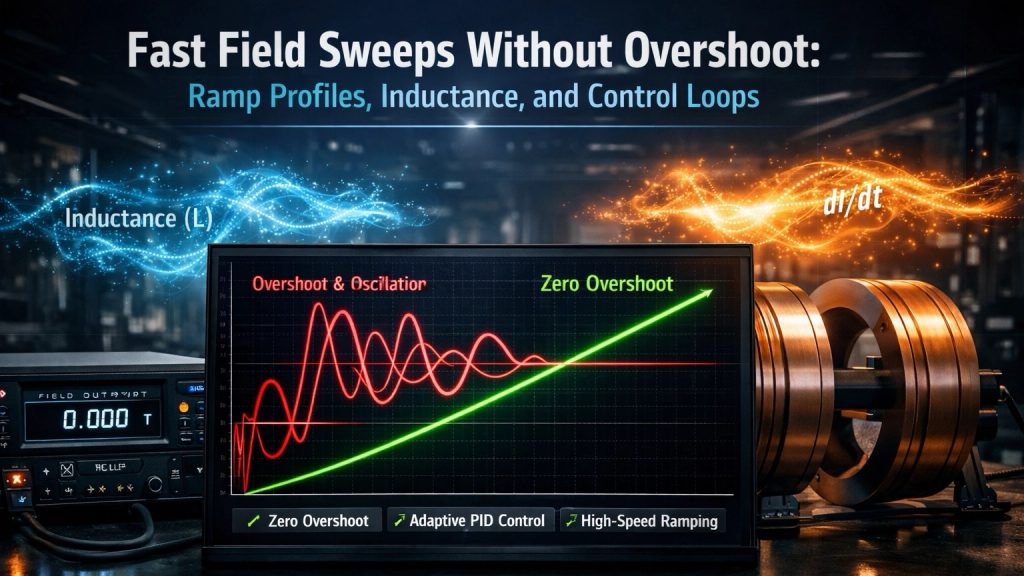
Fast magnetic field sweeps are essential in many physics and materials experiments, such as hysteresis loop measurements, magnetoresistance (MR) studies, and dynamic device characterization.
However, increasing sweep speed often introduces a frustrating problem: field overshoot.
Overshoot does not just slow experiments down. It can distort data, reduce repeatability, and in extreme cases, stress coils and power electronics.
This article explains why overshoot happens and provides practical, engineering-oriented strategies to achieve fast field sweeps without sacrificing stability.
Why Overshoot Happens in Fast Magnetic Field Sweeps
At its core, overshoot is not a software issue.
It is a physical consequence of inductance and control dynamics.
A magnetic coil is an inductive load. The voltage required to change current is governed by:
V = L · (di/dt)
This relationship is well established in electromagnetic theory and power electronics (see general references such as Wikipedia: Inductor and standard control textbooks).
When the requested di/dt exceeds what the power supply can support within its compliance voltage, or when the control loop reacts too aggressively, the system temporarily loses regulation. The result is overshoot.
In practical laboratory systems, overshoot typically arises from a combination of:
- Coil inductance
- Insufficient compliance voltage
- Inappropriate ramp profiles
- Poorly tuned current or field control loops
The Role of Inductance and Compliance Voltage
Inductance is the dominant limiting factor for fast sweeps.
For a given coil:
- Higher inductance → higher voltage required for the same sweep rate
- Faster sweep → higher di/dt → higher voltage demand
If the power supply compliance voltage is too low, the current loop saturates during fast ramps. When regulation resumes, the stored energy in the inductance can push the current beyond the target value, creating overshoot.
This is why fast-sweep applications often fail when a “general-purpose” power supply is used instead of a driver designed for inductive loads.
Ramp Profiles: Linear Is Not Always Your Friend
Linear ramps
Linear current ramps are easy to implement and widely used.
However, at high sweep speeds, the abrupt start and stop of a linear ramp can excite the system dynamics, increasing the likelihood of overshoot.
S-curve ramps (recommended)
S-curve ramps gradually change the slope of the current command.
This reduces excitation of the control loop and significantly improves stability during fast transitions.
For experiments requiring both speed and precision, S-curve ramps are often the safest choice.
Two-stage ramps
A common practical compromise is a two-stage approach:
- Fast ramp close to the target field
- Slower final approach for settling
This method minimizes total sweep time while maintaining control near the target field.
Control Loops: Current Control vs. Field Control
Current-controlled systems
Most laboratory magnet systems operate in current control mode, assuming a fixed relationship between current and magnetic field.
This approach works well when:
- Coil geometry is stable
- Thermal effects are controlled
- Absolute field accuracy is not critical during the sweep
It is also simpler and more robust at high speeds.
Closed-loop field control
Some systems use a magnetic field sensor (Hall, fluxgate, etc.) to close the loop on the actual field.
Field control can compensate for drift and nonlinearity, but it introduces new challenges:
- Sensor noise limits bandwidth
- Sensor placement affects loop stability
- Poor tuning can increase overshoot instead of reducing it
In fast-sweep applications, field control must be designed carefully, especially at low fields.
Practical Engineering Checklist for Fast Sweeps Without Overshoot
Before blaming software or firmware, work through this checklist:
1. Verify electrical margins
- Confirm coil inductance and resistance
- Calculate required voltage using L · di/dt
- Ensure sufficient compliance voltage with margin
2. Choose an appropriate ramp profile
- Avoid abrupt step commands
- Use S-curve or segmented ramps when possible
3. Tune control loops conservatively
- Reduce proportional gain before increasing speed
- Prioritize damping over response time
- Validate with repeated sweeps, not single runs
4. Account for thermal effects
- Monitor coil temperature during fast cycling
- Expect resistance changes during long or repeated sweeps
5. Define acceptance criteria
Instead of “no overshoot,” specify measurable targets:
- Maximum overshoot (% of setpoint)
- Settling time to a defined tolerance
- Repeatability across multiple sweeps
System-Level View: Why Coil and Driver Must Be Matched
Fast, stable field sweeps are not achieved by software alone.
They require a matched system consisting of:
- Coil geometry optimized for inductance and uniformity
- Power supply designed for inductive loads and fast di/dt
- Control firmware tuned for magnetic systems
This is why many laboratories move from component-level solutions to integrated magnet and driver systems.
👉🏻Learn more about Helmholtz Coils and Electromagnet Systems for Fast Field Sweeps
Conclusion
Fast magnetic field sweeps do not have to mean overshoot and instability.
By understanding inductance, compliance voltage, ramp profiles, and control loop behavior, laboratories can significantly improve sweep speed without compromising data quality.
Careful system design and realistic specifications are far more effective than aggressive tuning after installation.