
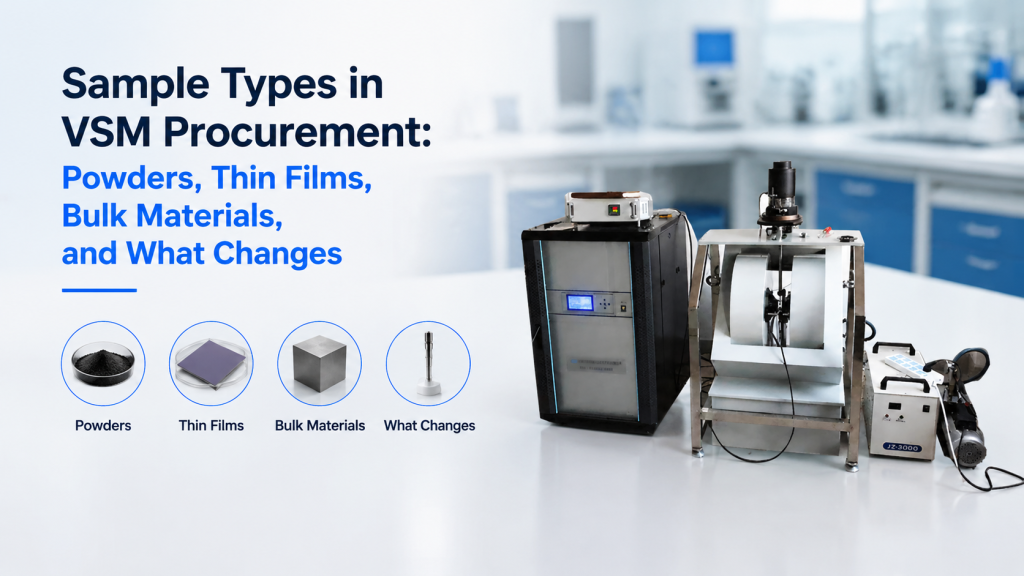
A buyer may send a Vibrating Sample Magnetometer inquiry with one sentence:
“We need a VSM to measure magnetic materials.”
That is not enough information for a reliable quotation.
“Magnetic materials” may refer to:
- Loose magnetic powders
- nanoparticles
- thin films on substrates
- multilayer wafers
- bulk solids
- permanent magnets
- ferrites
- wires and ribbons
- magnetic tapes
- liquids or suspensions
- irregular geological samples
These samples cannot always use the same holder, sample rod, magnetic-field range, sensitivity setting, vibration amplitude, background-subtraction method, or temperature option.
A VSM intended primarily for strong bulk magnets may be poorly configured for a nanometer-scale thin film.
A low-background thin-film holder may not safely support a dense permanent-magnet sample.
A powder cup that works at room temperature may be unsuitable for cryogenic or high-temperature measurements.
That is why VSM sample types must be defined before the supplier selects the instrument configuration and prepares a quotation.
This article explains how powders, thin films, bulk materials, and other sample forms affect:
- VSM sensitivity
- dynamic range
- sample holders
- sample rods
- pickup-coil response
- magnetic-field requirements
- sample orientation
- background subtraction
- temperature options
- measurement speed
- software configuration
- FAT and acceptance testing
1. Why Sample Form Changes the VSM Configuration
A Vibrating Sample Magnetometer detects the magnetic signal produced as the sample vibrates relative to the pickup coils.
The measured response depends not only on the material’s intrinsic magnetic properties, but also on:
- Total magnetic moment
- sample dimensions
- sample shape
- sample position
- orientation
- mounting method
- holder background
- vibration stability
- distance from the pickup coils
Two samples made from the same material may require different configurations when one is a thin film and the other is a bulk pellet.
The VSM quotation should therefore begin with the physical sample—not merely the name of the material.
2. The Four Questions Every Buyer Should Answer First
Before requesting a VSM quotation, define:
What Is the Sample Form?
Powder, film, bulk solid, wire, liquid, or another form.
What Is the Sample Size?
Length, width, thickness, diameter, and mass.
What Magnetic Moment Is Expected?
The approximate weakest and strongest magnetic signals.
Under What Conditions Will It Be Measured?
Magnetic field, temperature, atmosphere, and orientation.
These answers determine whether the supplier should recommend a general-purpose VSM or a more specialized configuration.
3. Sample Holder and Sample Rod Are Not the Same Component
The terms are sometimes used loosely, but they perform different functions.
Sample Holder
The part that directly secures or contains the sample.
Examples include:
- Thin-film clamp
- powder cup
- bulk-sample fixture
- capsule
- adhesive mounting plate
- liquid container
Sample Rod
The mechanical link between the holder and the VSM vibration head.
The rod must:
- Transfer vibration reliably
- remain sufficiently rigid
- fit inside the magnet gap and pickup-coil assembly
- contribute minimal magnetic background
- tolerate the required temperature
- maintain sample position
A complete sample assembly may include:
- Sample rod
- holder
- adapter
- cup or capsule
- cap
- fastener
- adhesive
- alignment reference
The quotation should identify which parts are included for each sample type.
4. One Universal Holder Is Rarely the Best Choice
A universal holder may appear economical, but it can introduce compromises.
It may provide:
- Higher background than a dedicated thin-film holder
- insufficient containment for powders
- inadequate strength for heavy bulk samples
- poor orientation control
- limited temperature compatibility
- slow sample exchange
Commercial VSM platforms commonly provide different holder arrangements for thin films, powders, liquids, and bulk samples, reflecting the fact that sample form changes the mechanical and measurement requirements.
The buyer should request dedicated holders for the sample classes used most often.
5. Powder Samples: Main Procurement Issues
Powders are common in:
- Nanoparticle research
- ferrite development
- battery materials
- magnetic pigments
- catalyst studies
- additive manufacturing
- permanent-magnet precursor research
The main challenges are:
- Preventing particle movement
- measuring the sample mass accurately
- controlling packing density
- minimizing capsule background
- avoiding contamination
- safely containing hazardous material
- maintaining repeatable position
A supplier should not quote a powder measurement configuration without knowing how the powder will be contained.
6. Powder Must Not Move During Vibration
Loose particles may shift inside the holder as the sample vibrates.
This can cause:
- Signal fluctuation
- poor repeatability
- apparent moment changes
- inconsistent centering
- contamination of the VSM
- difficulty reproducing results
Possible containment methods include:
- Threaded powder cup
- sealed capsule
- compressed pellet
- packed nonmagnetic tube
- immobilization with an approved material
- removable cup with a lid
The selected method should prevent movement without adding excessive magnetic background.
7. Powder Mass Must Be Measured Independently
Powder results are often normalized as:
- emu/g
- A·m²/kg
- magnetization per mole
- magnetization per magnetic component
The VSM measures magnetic moment.
It does not automatically determine powder mass.
The buyer may need:
- A suitable laboratory balance
- recorded empty-holder mass
- loaded-holder mass
- net sample mass
- uncertainty or resolution of the mass measurement
For very small powder quantities, uncertainty in mass can dominate the normalized magnetization result.
8. Powder Packing Density Affects Reproducibility
Two powder holders containing the same mass may not produce identical results when:
- One sample is loosely packed.
- one sample is compressed.
- particles are distributed differently.
- the sample occupies a different vertical length.
- particles settle during handling.
The procurement specification should define:
- Maximum powder volume
- recommended filling depth
- packing procedure
- compaction method
- permitted sample movement
- sample-position reference
A repeatable preparation procedure is part of the measurement system.
9. Powder Holder Background Must Be Measured
Possible background sources include:
- Cup material
- capsule material
- lid
- adhesive
- contamination
- sample rod
- sealing compound
For weak powders, the background can be comparable with the sample signal.
Request:
- Empty powder-cup measurement
- empty capsule measurement
- background file
- subtraction procedure
- background repeatability after removal and reinstallation
The holder background should be measured over the same magnetic-field and temperature range used for the sample.
10. Air-Sensitive and Hazardous Powders Need Special Handling
The RFQ should state whether the powder is:
- Air-sensitive
- moisture-sensitive
- toxic
- radioactive
- pyrophoric
- corrosive
- biologically hazardous
- likely to release particles
The system may require:
- Hermetically sealed capsule
- glovebox-compatible loading
- disposable holder
- secondary containment
- controlled atmosphere
- special cleaning procedure
The supplier should understand the sample risk before recommending a holder.
11. Powder Measurement May Require a Larger Dynamic Range
A powder research laboratory may measure:
- A few milligrams of weak nanoparticles
- tens of milligrams of ferrite
- strongly magnetic permanent-magnet powders
The magnetic moments may differ by several orders of magnitude.
Ask whether the VSM provides:
- Multiple gain ranges
- automatic range selection
- overload protection
- range-change records
- calibration across the full range
One powder holder does not guarantee that one sensitivity range covers every powder sample.
12. Thin Films: Main Procurement Issues
Thin films are commonly measured in:
- Spintronics
- magnetic-memory research
- semiconductor development
- multilayer structures
- exchange-bias studies
- magneto-optical materials
- thin-film sensor development
The main challenges are:
- Low total magnetic moment
- strong substrate background
- orientation requirements
- sample-position repeatability
- film-thickness uncertainty
- magnetic-area definition
- holder contamination
Thin-film procurement should usually prioritize sensitivity and background control more strongly than bulk-sample procurement.
13. Thin-Film Signal May Be Much Smaller Than Substrate Background
A thin magnetic layer may be deposited on:
- Silicon
- sapphire
- glass
- MgO
- GaAs
- another nonmagnetic or weakly magnetic substrate
The substrate can contribute a field-dependent background larger than the film signal.
A complete workflow may require:
- Measure the film and substrate together.
- measure a blank substrate from the same batch.
- align the two datasets.
- subtract the substrate response.
- retain both raw and processed data.
The quotation should confirm that raw data and background-subtraction tools are available.
14. Thin-Film Measurements Require Low-Background Holders
The holder should:
- Secure a flat sample
- minimize magnetic material near the pickup coils
- preserve a known orientation
- allow repeatable placement
- avoid unnecessary adhesive
- support the sample without bending it
Possible mounting methods include:
- Mechanical clip
- clamp
- slot
- low-background adhesive
- replaceable film carrier
A convenient holder with unstable background may be unsuitable for weak-film measurements.
15. In-Plane and Out-of-Plane Measurements Are Different
For anisotropic thin films, buyers may require:
- Field parallel to the film plane
- field perpendicular to the film plane
- measurements at several angles
Changing orientation may require:
- A separate holder
- a rotation adapter
- manual remounting
- an automated rotation stage
- a different magnet pole gap
The RFQ should state:
- Required orientations
- angular range
- angular resolution
- whether rotation must occur under magnetic field
- whether rotation must operate at low temperature
“In-plane and out-of-plane supported” should be translated into an actual mechanical configuration.
16. Thin-Film Dimensions Must Be Provided
Specify:
- Substrate length
- width
- thickness
- film thickness
- magnetic area
- patterned area
- number of magnetic layers
- total sample mass
These dimensions affect:
- Holder compatibility
- pole-gap requirement
- pickup-coil geometry
- sample centering
- moment normalization
- demagnetization considerations
A holder designed for a 5 mm coupon may not support a 25 mm wafer piece.
17. Film Thickness Determines the Normalization Basis
The VSM may report raw magnetic moment in:
- emu
- A·m²
The buyer may then calculate magnetization using:
- Total film volume
- magnetic-layer volume
- patterned magnetic area
- nominal deposition thickness
- measured thickness
For multilayers, the buyer should define whether nonmagnetic spacer and capping layers are excluded from the magnetic volume.
The software should preserve the selected normalization basis with the result.
18. Thin-Film Reference Measurements Matter
NIST has conducted interlaboratory work on low-moment magnetic thin-film measurements. In one comparison, NiFe films on silicon substrates were measured across multiple laboratories using several magnetometer types, including VSM systems, illustrating the importance of sample design, reference methods, and reproducibility for low-moment films.
For procurement, request a thin-film FAT sample whose magnetic moment is relevant to the intended application.
A strong bulk nickel reference alone does not prove low-moment thin-film capability.
19. Thin Films May Require Longer Measurement Times
Weak-film measurements may need:
- Longer averaging
- slower field sweep
- more field settling
- repeated background measurements
- precise centering
- repeated loops
- environmental stability
The quotation should state sensitivity together with:
- Averaging time
- bandwidth
- holder
- field
- temperature
- background procedure
A low published noise floor may not represent routine thin-film throughput.
20. Bulk Materials: Main Procurement Issues
Bulk materials may include:
- Ferrite pellets
- metal pieces
- ceramic samples
- sintered magnets
- geological samples
- molded magnetic composites
- bulk single crystals
These samples often produce stronger signals than thin films.
The main configuration questions become:
- Sample dimensions
- sample mass
- maximum magnetic moment
- holder strength
- magnetic-field range
- geometric corrections
- magnet gap
- sample orientation
Bulk samples may need less extreme sensitivity but greater mechanical and dynamic-range capability.
21. Bulk Sample Mass Must Stay Within Mechanical Limits
A heavy sample increases the load on:
- Sample rod
- vibration head
- attachment mechanism
- centering system
- motor or actuator
The supplier should state:
- Maximum sample mass
- maximum holder-plus-sample mass
- permitted vibration amplitude
- permitted sample dimensions
- whether the limit changes with temperature options
A system may detect the sample magnetically but still be unable to vibrate it safely.
22. Strong Bulk Samples Can Overload the Detection Range
A large ferromagnetic sample may generate a signal above the optimal range of a high-sensitivity pickup configuration.
Ask:
- Maximum measurable moment
- overload limit
- available gain ranges
- automatic range switching
- accuracy on coarse ranges
- whether different pickup coils are required
A VSM configured only for low-moment films may not be the best choice for strong bulk magnets.
23. Bulk Geometry Affects the Measured Result
Large or irregular samples may not behave like ideal point magnetic dipoles.
Measurement response can depend on:
- Sample length
- width
- thickness
- radial position
- vertical position
- vibration amplitude
- pickup-coil geometry
The supplier should state the sample-size range over which the quoted accuracy is valid.
Very large samples may require:
- Geometry correction
- reduced vibration amplitude
- dedicated calibration
- smaller specimens cut from the original material
24. Demagnetizing Effects Are Important for Bulk Samples
The internal magnetic field can differ from the applied field because of sample shape.
Relevant shapes include:
- Sphere
- cylinder
- plate
- rectangular block
- long rod
- irregular object
The software may support:
- Demagnetizing-factor entry
- internal-field correction
- standard shape models
- user-defined corrections
- raw uncorrected data
The buyer should confirm which corrections are included and which remain the researcher’s responsibility.
25. Sample Orientation Matters for Anisotropic Bulk Materials
Examples include:
- Textured permanent magnets
- rolled magnetic sheet
- single crystals
- oriented ferrites
- elongated composite samples
The RFQ should state:
- Easy-axis direction
- hard-axis direction
- required field orientation
- number of orientations
- angular accuracy
- remounting tolerance
A bulk clamp should prevent the sample from rotating under magnetic torque.
26. Permanent Magnets Need Strong Fixtures
Permanent magnets can experience:
- Strong magnetic force
- torque
- attraction to nearby magnetic parts
- movement during field reversal
- mechanical impact
The holder may require:
- Positive mechanical restraint
- nonmagnetic fasteners
- defined orientation
- greater rod stiffness
- lower vibration amplitude
- additional operator safety procedures
Adhesive-only mounting may not be appropriate for every permanent-magnet sample.
27. Permanent Magnets May Require Higher Reverse Field
Hard magnetic materials may require a high reverse field to measure:
- Intrinsic coercivity
- complete hysteresis loop
- remanence
- saturation behavior
- loop squareness
The required magnet and power supply depend on:
- Expected coercivity
- sample volume
- pole gap
- required continuous duty
- field ramp rate
A general-purpose ±0.5 T VSM may be inadequate for some hard magnetic materials.
28. Soft Magnetic Bulk Materials Need Better Low-Field Control
Soft magnetic samples may produce strong moment but small coercive field.
Their important requirements may include:
- Low residual field
- accurate zero crossing
- fine field steps
- low current noise
- demagnetization sequence
- repeatable minor loops
The buyer should not select a VSM only by maximum field and moment sensitivity.
For soft magnetic samples, low-field quality can be the decisive specification.
29. Wires, Ribbons, and Magnetic Tapes
These samples introduce additional issues:
- Long sample geometry
- bending
- vibration-induced movement
- field orientation
- strong demagnetizing anisotropy
- holder background
The RFQ should provide:
- Length
- width or diameter
- thickness
- permitted cutting
- measurement direction
- number of pieces
- whether the sample must remain straight
A long ribbon may need a dedicated clamp or support to prevent flexing.
30. Fibers and Very Small Wires
For thin wires or fibers, the holder may need:
- Tensioning
- alignment grooves
- adhesive at controlled positions
- optical inspection
- several pieces mounted together
The buyer should decide whether results are normalized by:
- Total mass
- length
- cross-sectional area
- number of fibers
- active material volume
Mounting material may contribute more background than the sample itself.
31. Liquid Samples and Suspensions
Liquid VSM measurements may be relevant for:
- Ferrofluids
- nanoparticle suspensions
- biological magnetic particles
- magnetic inks
- liquid precursors
The sample must be contained in a leak-resistant holder.
Important requirements include:
- Liquid volume
- concentration
- viscosity
- vapor pressure
- chemical compatibility
- temperature range
- evaporation risk
- particle settling
- holder sealing
Liquid movement inside the container can affect signal stability.
32. Liquid Holders Need Reliable Sealing
The holder should prevent:
- Leakage
- evaporation
- contamination
- pressure-related opening
- reaction with holder material
The RFQ should state whether the liquid is:
- Water-based
- oil-based
- solvent-based
- corrosive
- volatile
- biologically active
A holder suitable for water may be unsuitable for an organic solvent or high-temperature liquid.
33. Suspensions May Change During the Measurement
Particles may:
- Settle
- agglomerate
- align
- separate
- react
- change concentration
The buyer should define:
- Time from preparation to measurement
- mixing procedure
- measurement duration
- temperature
- permitted settling
- whether repeated agitation is needed
The VSM cannot distinguish instrumental drift from a sample that is physically changing without additional controls.
34. Irregular and Geological Samples
Irregular samples may include:
- Rock fragments
- minerals
- archaeological materials
- natural composites
- broken devices
The main challenges are:
- Uncertain geometry
- difficult centering
- nonuniform material distribution
- large holder gaps
- orientation uncertainty
- poor reproducibility after remounting
Possible strategies include:
- Cutting a regular specimen
- embedding the sample
- using a custom cup
- measuring several orientations
- reporting raw moment rather than geometry-normalized magnetization
The quotation should identify whether a custom holder is required.
35. Biological Samples
Biological magnetic samples may require:
- Sealed containment
- low sample mass
- sterile handling
- controlled temperature
- disposable holders
- low-background capsules
- biosafety procedures
The buyer should state:
- Biological risk classification
- liquid or solid form
- permitted exposure
- disposal method
- required temperature
- whether the sample can be dried or fixed
The supplier should not assume that a standard open powder cup is acceptable.
36. Samples Embedded in a Matrix
Magnetic particles may be embedded in:
- Polymer
- epoxy
- ceramic
- tissue
- composite
- battery electrode
The measured moment includes the entire mounted sample, while normalization may refer only to the magnetic component.
The buyer may need:
- Magnetic component mass fraction
- total sample mass
- active volume
- blank matrix measurement
- substrate or binder background
The software should retain these normalization inputs.
37. Temperature Options Change Holder Selection
A room-temperature holder may not work at:
- Cryogenic temperature
- several hundred kelvins
- high temperature above 1000 K
Material selection must consider:
- Thermal expansion
- brittleness
- oxidation
- outgassing
- magnetic background
- chemical reaction
- mechanical strength
- electrical insulation
The quotation should identify the permitted temperature range of every holder and rod.
38. Cryogenic Holders
Cryogenic sample assemblies may require:
- Low thermal mass
- suitable thermal conductivity
- stable mechanical coupling
- low outgassing
- vacuum compatibility
- temperature-compatible adhesive
- reduced differential contraction
The cryogenic option may also reduce:
- Maximum sample dimensions
- sample mass
- available magnet gap
- vibration amplitude
- sensitivity
- sample exchange speed
Room-temperature sample limits should not automatically be applied to the cryogenic configuration.
39. High-Temperature Holders
High-temperature holders may use:
- Ceramic
- quartz
- boron nitride
- high-temperature alloy
- specialized cement
The buyer should state:
- Maximum temperature
- atmosphere
- vacuum level
- sample reactivity
- oxidation risk
- melting or decomposition risk
- contamination tolerance
A sample that vaporizes or reacts with the holder can damage or contaminate the measurement system.
40. Adhesives Can Become Part of the Magnetic Background
Possible mounting materials include:
- Tape
- varnish
- epoxy
- grease
- cement
- adhesive film
Before use, determine:
- Magnetic background
- temperature range
- vacuum compatibility
- curing requirement
- chemical compatibility
- removability
- mass reproducibility
For weak samples, the adhesive should be measured separately where practical.
41. Sample Position Must Be Repeatable
The VSM signal depends on the sample’s position relative to the pickup coils.
Useful holder features include:
- Mechanical stop
- keyed orientation
- fixed mounting surface
- reference mark
- automatic centering
- stored center position
- alignment fixture
A sample that shifts by a small distance may produce a measurable change in the reported moment.
42. Automatic Centering Must Work for the Actual Sample Signal
A centering system demonstrated with a strong nickel reference may not work equally well for:
- Weak thin films
- dilute powders
- diamagnetic samples
- low-mass nanoparticles
Ask:
- What minimum moment is needed for automatic centering?
- How long does centering take?
- What happens if the sample is too weak?
- Can a stored mechanical position be used?
- Is manual centering available?
- Is the final center position recorded?
Centering capability should be tested using a representative sample class.
43. Vibration Amplitude May Need to Change
Larger vibration amplitude can increase signal, but it may also create limitations for:
- Large samples
- heavy samples
- fragile films
- loose powders
- long wires
- cryogenic inserts
- high-temperature holders
The supplier should state:
- Available vibration-amplitude range
- standard amplitude
- amplitude used for sensitivity specifications
- limitations by holder or temperature option
- whether calibration changes with amplitude
Do not assume maximum vibration amplitude is appropriate for every sample.
44. Pickup-Coil Configuration and Sample Geometry
Pickup coils are designed around an expected sample region.
Performance can change when the sample is:
- Too long
- too wide
- displaced from the center
- irregularly shaped
- distributed through a large powder volume
- mounted asymmetrically
The buyer should ask for:
- Qualified sample dimensions
- recommended sample volume
- geometry corrections
- calibration method
- sensitivity change with different holders
A sample that physically fits may still fall outside the optimum measurement geometry.
45. NIST Reference Materials Illustrate the Importance of Range and Geometry
NIST lists magnetic reference materials in different forms and signal ranges, including sphere, disc, and cylinder geometries intended for different magnetometer calibration purposes. This illustrates that reference selection—and more broadly VSM configuration—depends on magnetic moment, geometry, and the intended measurement range.
A laboratory measuring both weak films and strong bulk materials may need more than one reference sample.
46. Match Reference Samples to the Sample Portfolio
Possible reference categories include:
- Strong magnetic-moment reference
- low-moment reference
- thin-film reference
- susceptibility or near-zero reference
- holder-background reference
The RFQ should ask:
- Which reference is included?
- What sample form does it represent?
- What value is assigned?
- At what temperature?
- Over what field range?
- Is a certificate supplied?
- Can it be used for FAT and routine checks?
One strong bulk reference cannot validate every thin-film measurement condition.
47. Software Must Support Different Sample Forms
The sample database should record:
- Sample type
- holder type
- sample dimensions
- mass
- film thickness
- active magnetic volume
- substrate
- orientation
- background file
- temperature
- normalization basis
The software should allow separate templates for:
- Powders
- thin films
- bulk materials
- permanent magnets
- liquids
- temperature-dependent measurements
This reduces data-entry errors.
48. Preserve Raw Magnetic Moment
The original magnetic moment should remain available even when the result is normalized as:
- Magnetization
- specific magnetization
- moment per area
- moment per mole
If the buyer later corrects:
- Mass
- thickness
- area
- density
- background
the raw data should support reprocessing without repeating the measurement.
49. Background Files Should Be Traceable
Each background file should identify:
- Holder ID
- holder type
- adhesive or capsule
- temperature
- field sequence
- measurement date
- software version
- averaging
- sample orientation
- cleaning or reuse history
Do not subtract an unidentified “standard background” from every sample type.
50. Sample Throughput Depends on Holder Design
Daily throughput may be limited by:
- Powder filling
- film clamping
- adhesive curing
- bulk-sample fastening
- sample centering
- holder cleaning
- background measurement
Multiple holders can allow the next sample to be prepared while the current measurement is running.
For laboratories with mixed sample types, request:
- Several thin-film carriers
- several powder cups
- several bulk holders
- replacement caps
- holder storage boxes
- identification labels
51. Request Sample-Exchange Time by Sample Type
Do not request one universal exchange-time figure.
Ask separately for:
| Sample Type | Exchange Workflow |
|---|---|
| Thin film | Clamp, orient, install, center |
| Powder | Weigh, fill, seal, install, center |
| Bulk solid | Secure mechanically, orient, center |
| Cryogenic sample | Mount, close, evacuate, cool, stabilize |
| High-temperature sample | Mount with suitable material, purge, heat, stabilize |
The fastest room-temperature bulk workflow does not represent a cryogenic powder measurement.
52. Define the Main Sample Portfolio
Before ordering, estimate the expected workload.
Example:
| Sample Type | Share of Annual Work | Typical Moment | Required Temperature |
|---|---|---|---|
| Thin films | 50% | Low | 300 K |
| Powders | 25% | Low to medium | 80–400 K |
| Bulk samples | 20% | Medium to high | 300 K |
| Permanent magnets | 5% | High | 300 K |
This helps determine where to spend the budget.
A thin-film-dominated laboratory should not select the VSM around the occasional large permanent magnet.
53. Choose the VSM Configuration Around the Hardest Important Sample
The selection should not necessarily be based on:
- The strongest sample
- the weakest imaginable sample
- the largest optional temperature range
It should be based on the most demanding sample that is:
- Scientifically important
- measured regularly
- realistically within the project scope
An extremely rare special sample may be better handled through:
- Optional holder
- future upgrade
- external laboratory
- separate instrument
54. A Practical Configuration Strategy
Configuration A: Thin-Film Priority
Include:
- Low-moment pickup configuration
- precision centering
- in-plane and out-of-plane holders
- blank-substrate workflow
- long averaging
- low-background materials
- low-moment reference sample
Configuration B: Powder and General Materials
Include:
- Several sealed powder cups
- balance and mass-record workflow
- broad dynamic range
- easy cleaning
- room-temperature and optional temperature holders
- automatic gain selection
Configuration C: Bulk and Permanent Magnets
Include:
- Strong sample rod
- mechanical bulk clamp
- high moment capacity
- larger magnet gap
- sufficient reverse field
- high-current bipolar power supply
- cooling and duty-cycle margin
Configuration D: Mixed University Laboratory
Include:
- Multiple interchangeable holders
- wide dynamic range
- automated centering
- configurable averaging
- raw-data reprocessing
- modular temperature options
- stored sample templates
55. FAT Should Use Representative Sample Types
A strong Factory Acceptance Test should not use only one easy reference sample.
The FAT may include:
Thin-Film Test
- Low-moment film
- blank-substrate background
- precision centering
- repeated loop
- in-plane or out-of-plane orientation
Powder Test
- Filled and sealed cup
- empty-cup background
- removal and reinstallation
- mass-normalized result
Bulk Test
- Strong sample
- coarse gain range
- holder-strength verification
- complete hysteresis loop
Remounting Test
- Remove sample.
- reinstall it.
- re-center.
- repeat measurement.
- compare results.
56. Define Pass/Fail Criteria by Sample Type
Example criteria may include:
Thin Film
- Required SNR
- background-subtraction repeatability
- moment reproducibility
- centering repeatability
Powder
- No sample movement
- repeatable cup position
- stable mass record
- acceptable empty-cup background
Bulk Sample
- No mechanical movement
- no detection overload
- complete field loop
- acceptable repeatability
The criteria should reflect the intended application rather than one universal VSM number.
57. Request Raw FAT Data
Useful FAT data may include:
- Field setpoint
- field readback
- raw magnetic moment
- processed moment
- sample position
- gain range
- averaging time
- vibration amplitude
- temperature
- holder ID
- background file
- time stamp
This allows the buyer to understand how the final result was produced.
58. VSM Sample-Type RFQ Checklist
General Sample Information
- Sample type:
- material:
- dimensions:
- shape:
- typical mass:
- maximum mass:
- expected minimum moment:
- expected maximum moment:
- measurement frequency:
Powder Samples
- Particle size:
- sample mass:
- powder volume:
- loose or compacted:
- air-sensitive:
- hazardous:
- containment method:
- temperature range:
Thin Films
- Substrate:
- substrate dimensions:
- substrate thickness:
- magnetic-layer thickness:
- magnetic area:
- in-plane measurement:
- out-of-plane measurement:
- blank substrate available:
Bulk Samples
- Sample dimensions:
- shape:
- sample mass:
- expected coercivity:
- expected saturation field:
- anisotropic:
- required orientation:
- demagnetizing correction:
Other Samples
- Liquid or suspension:
- wire or ribbon:
- irregular sample:
- controlled atmosphere:
- disposable holder required:
Supplied Scope
- Sample rods:
- thin-film holders:
- powder cups:
- bulk holders:
- rotation holder:
- cryogenic holders:
- high-temperature holders:
- spare holders:
- reference samples:
59. Better RFQ Language
Instead of writing:
“We need a VSM for powders, films, and bulk materials.”
write:
“We require a VSM for three primary sample classes.
Thin-film samples are deposited on substrates up to 10 mm × 10 mm × 0.5 mm, with expected net magnetic moments down to approximately 10⁻⁶ emu after substrate subtraction. Both in-plane and out-of-plane measurements are required.
Powder samples are typically 10–100 mg and must be contained in sealed, low-background sample cups. Please provide at least five reusable powder cups and empty-cup background data.
Bulk samples are typically up to 8 mm in diameter, 10 mm long, and 20 g in mass, with magnetic moments up to the stated maximum range. A mechanically secured bulk-sample holder is required.
Please state the maximum sample dimensions and mass for each holder, sample-rod material, holder background, permitted vibration amplitude, moment range, automatic-centering capability, expected sample-exchange time, and compatibility with the requested temperature options.
FAT shall include representative thin-film, powder, and bulk measurements, including background files, sample removal and reinstallation, centering repeatability, and delivery of raw data.”
60. VSM Sample-Type Comparison Matrix
| Evaluation Item | Powder | Thin Film | Bulk Material |
|---|---|---|---|
| Typical signal | Low to high | Usually low | Usually medium to high |
| Main holder need | Secure containment | Low background and orientation | Mechanical strength |
| Main background | Cup or capsule | Substrate and holder | Holder and geometry |
| Main normalization | Mass | Magnetic volume or area | Mass or volume |
| Movement risk | Particle shifting | Sample slipping | Torque or heavy load |
| Sensitivity priority | Medium to high | High | Low to medium |
| Dynamic-range priority | High | Medium | High |
| Orientation importance | Sometimes | Usually high | Material-dependent |
| Temperature complexity | Cup compatibility | Holder and substrate | Mass and geometry |
| Common FAT test | Cup remounting | Background subtraction | Full-range loop |
61. Common Buyer Mistakes
Mistake 1: Saying Only “Magnetic Samples”
The supplier cannot select holders and ranges without knowing the sample form.
Mistake 2: Expecting One Holder to Fit Everything
Powders, films, and bulk solids have different containment and background requirements.
Mistake 3: Ignoring Expected Magnetic Moment
The system may lack sensitivity or become overloaded.
Mistake 4: Forgetting Substrate Background
Thin-film signal may be smaller than the substrate response.
Mistake 5: Allowing Powder Movement
Particle shifting can damage repeatability.
Mistake 6: Using Adhesive Without Measuring Its Background
The mounting material may contribute a significant signal.
Mistake 7: Ignoring Sample Orientation
Anisotropic films and bulk materials may require dedicated holders or rotation.
Mistake 8: Applying Room-Temperature Holder Limits to Cryogenic Use
Temperature options can change sample size, mass, background, and mounting materials.
Mistake 9: Testing FAT with Only a Strong Reference
A strong bulk sample does not verify thin-film or powder performance.
Mistake 10: Ordering Only One Holder per Sample Type
Parallel preparation and replacement become difficult.
62. How Cryomagtech Supports VSM Sample Configuration
Cryomagtech supplies VSM systems and related magnetic-characterization equipment, including:
- Electromagnets
- bipolar excitation power supplies
- field probes
- gaussmeters
- water chillers
- thin-film holders
- powder cups
- bulk-sample fixtures
- sample rods
- rotation holders
- cryogenic temperature controllers
- low-temperature options
- high-temperature options
- software and data-acquisition solutions
- custom Magnet & Field Systems
For VSM projects, we help buyers evaluate:
- Sample type and geometry
- minimum and maximum magnetic moment
- sample mass
- powder containment
- thin-film substrate background
- in-plane and out-of-plane orientation
- bulk-sample mechanical restraint
- dynamic range
- sensitivity
- field and coercivity
- holder and rod compatibility
- temperature range
- sample exchange
- background subtraction
- reference samples
- FAT sample selection
- raw-data requirements
- spare holder quantities
The correct VSM configuration does not begin with the question:
“What materials do you measure?”
It begins with more specific questions:
“What physical form are the samples, how large and magnetic are they, how must they be mounted and oriented, and under what field and temperature conditions will they be measured?”
References
- NIST — Magnetic Moment and Susceptibility Standard Reference Materials
https://www.nist.gov/mml/materials-science-and-engineering-division/magnetic-moment-and-susceptibility-standard-reference - Lake Shore / Janis — 8600 Series Vibrating Sample Magnetometer
https://www.janis.com/products/categories/overview/material-characterization-products/vsm-systems/8600-series-vsm
Key Takeaways
- VSM sample types directly affect the required holder, sample rod, sensitivity, dynamic range, magnetic field, and acceptance tests.
- Powders require secure containment, accurate mass measurement, controlled packing, and low-background cups or capsules.
- Thin films often require higher sensitivity, blank-substrate subtraction, low-background holders, and precise in-plane or out-of-plane orientation.
- Bulk samples may require greater holder strength, higher moment capacity, geometry corrections, and larger magnet clearance.
- Permanent magnets need secure mechanical restraint and sufficient reverse magnetic field.
- Wires, ribbons, liquids, irregular samples, and biological materials may require dedicated fixtures or sealed holders.
- The sample holder and sample rod are different parts of the VSM measurement assembly.
- Room-temperature, cryogenic, and high-temperature measurements may require different holder and rod materials.
- Sample dimensions and mass should be checked against the qualified limits of each holder and temperature option.
- Raw magnetic moment should remain available even after mass, volume, area, or thickness normalization.
- Reference samples should represent the magnetic-moment range and sample geometry used by the laboratory.
- FAT should include representative thin-film, powder, and bulk measurements rather than only one strong reference sample.
- Buyers should request spare holders to support parallel sample preparation and reduce instrument downtime.
- A mixed university laboratory may benefit from multiple holders, wide dynamic range, automated centering, and configurable measurement modes.
For VSM procurement, the key question is not only:
“Can this VSM measure magnetic materials?”
The better question is:
“Can the quoted VSM securely mount, correctly orient, accurately detect, and efficiently process our actual powders, thin films, bulk samples, and specialized sample forms across the required field and temperature conditions?”