
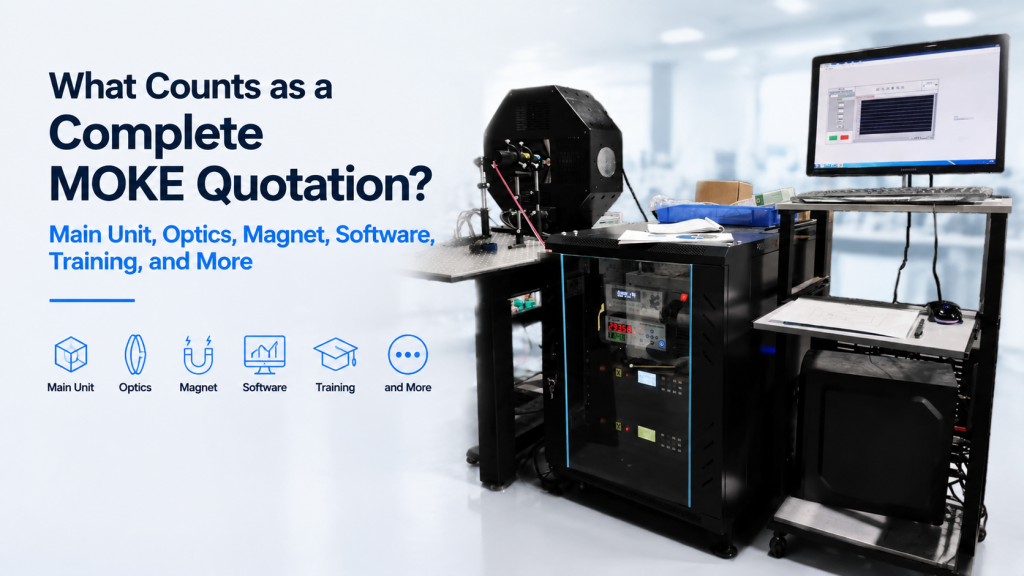
A quotation for a Magneto-Optical Kerr Effect system may contain only a few lines:
- MOKE main unit
- magnetic field module
- control software
- standard accessories
- system price
That does not necessarily describe a complete, measurement-ready system.
A serious complete MOKE quotation should explain exactly what the laboratory will receive, what measurements the system can perform, how the sample will be mounted, how the magnetic field will be generated and measured, how the optical signal will be detected, which software functions are included, and what services remain outside the quoted price.
This matters because the term “MOKE system” can describe very different instruments:
- A focused-beam MOKE magnetometer for high signal-to-noise hysteresis loops
- a wide-field Kerr microscope for magnetic-domain imaging
- a scanning MOKE microscope for spatially resolved measurements
- a vector MOKE system measuring multiple magnetization components
- a polar MOKE system for perpendicular magnetic anisotropy
- a longitudinal MOKE system for in-plane magnetization
- an SOT-MOKE platform with electrical current injection
- a cryogenic or high-temperature MOKE system
These systems may all use the magneto-optical Kerr effect, but their optics, detectors, magnets, sample stages, software, acceptance tests, and prices can differ substantially.
A complete quotation should therefore answer a more useful question than:
“How much does a MOKE system cost?”
It should answer:
“Which complete configuration will perform our required MOKE measurements, under our real magnetic-field, optical, sample, temperature, software, and workflow conditions?”
1. Start by Defining the Type of MOKE System
The supplier should first identify the proposed system architecture.
Possible categories include:
MOKE Magnetometer
Designed primarily for:
- High signal-to-noise hysteresis loops
- coercivity measurement
- remanence measurement
- saturation-field estimation
- angular magnetic characterization
- automated field sweeps
MOKE Microscope
Designed primarily for:
- Magnetic-domain imaging
- domain-wall observation
- spatially resolved hysteresis loops
- local magnetic switching
- patterned structures
- magnetic contrast maps
Scanning MOKE System
Designed for:
- Point-by-point spatial measurement
- mapping magnetic response across a sample
- local hysteresis loops
- patterned devices
- wafer or film uniformity studies
Vector MOKE System
Designed to measure more than one magnetization component, potentially including:
- Longitudinal response
- transverse response
- polar response
- simultaneous in-plane components
- angular magnetic behavior
Academic work distinguishes conventional focused-beam MOKE magnetometers from more complex optical configurations designed for spatially or vectorially resolved magnetic characterization. Conventional systems often focus light onto a small spot and detect the reflected signal with photodetectors, while advanced configurations may use cameras, high-numerical-aperture optics, or additional analysis methods.
The quotation should not simply state “MOKE included.” It should name the instrument type and measurement mode.
2. Magnetometer and Microscope Are Not Interchangeable
A MOKE magnetometer and a Kerr microscope can both produce hysteresis loops, but they may be optimized for different outcomes.
A magnetometer may prioritize:
- Low Kerr-angle noise
- stable loop acquisition
- rapid field sweeps
- repeatable quantitative comparison
- automated angular measurements
A microscope may prioritize:
- Image quality
- field of view
- domain contrast
- spatial resolution
- location-specific measurements
- visual observation of switching
A recent Nature Communications study explicitly used two different MOKE platforms: a magnetometer optimized for high signal-to-noise hysteresis measurements and a microscope tailored for imaging. The microscope made it easier to select local regions, while the loop signal-to-noise ratio was lower than that of the dedicated magnetometer.
Therefore, a complete quotation should state whether the offered system is optimized for:
- Loop measurement
- domain imaging
- local loop acquisition
- or a combination of these functions
3. Define the Required MOKE Geometry
The quotation should identify which Kerr geometries are supported.
Longitudinal MOKE
Usually sensitive to the in-plane magnetization component parallel to the plane of incidence.
Typical applications include:
- In-plane magnetic films
- coercivity measurements
- anisotropy studies
- exchange-bias measurements
- soft magnetic films
Transverse MOKE
Sensitive to an in-plane magnetization component transverse to the plane of incidence.
It may require a different optical detection method from a standard rotation-based longitudinal setup.
Polar MOKE
Primarily sensitive to out-of-plane magnetization.
Typical applications include:
- Perpendicular magnetic anisotropy
- multilayer films
- magnetic memory structures
- spin-orbit torque studies
- out-of-plane switching
Vector MOKE
Designed to separate or simultaneously measure multiple magnetization components.
The quotation should state whether each geometry is:
- Included as standard
- available through optical adjustment
- available with interchangeable modules
- software-selectable
- manually reconfigured
- available only as an option
4. “Supports Polar, Longitudinal, and Transverse MOKE” Needs Explanation
A supplier may claim support for all three geometries.
The buyer should ask:
- Are separate optical paths required?
- Must the sample be remounted?
- Must the magnet or poles be changed?
- Is optical realignment required?
- Are all geometries calibrated?
- Are the sensitivities equivalent?
- Can switching between modes be automated?
- Is the required detector included for each mode?
- Are separate software modules needed?
A theoretical capability is not the same as a delivered, aligned, and tested measurement mode.
5. Define the Main Unit Scope
The “main unit” line in the quotation should identify its actual contents.
It may include:
- Optical enclosure
- optical table or base
- laser or illumination source
- polarizer
- analyzer
- lenses
- mirrors
- beam splitter
- objective
- detector
- modulation unit
- signal-processing electronics
- sample stage
- focus control
- positioning stages
- safety covers
- control computer
A quotation listing only “MOKE main unit” does not allow the buyer to verify whether these components are included.
6. Optical Bench, Enclosure, and Mechanical Base
The optical system may be mounted on:
- A compact enclosed desktop chassis
- an open optical breadboard
- an optical table
- a modular frame
- a microscope stand
- a vibration-isolated base
The quotation should state:
- Overall dimensions
- total weight
- table or bench requirements
- vibration-isolation requirements
- whether an enclosure is included
- whether stray-light protection is included
- whether optical components are factory aligned
- whether realignment is required after shipment
For overseas delivery, a pre-aligned enclosed system may reduce installation work but may offer less modification flexibility than an open optical platform.
7. Light Source
The quotation should identify:
- Light-source type
- wavelength
- wavelength range
- optical power
- power stability
- beam diameter
- polarization state
- expected lifetime
- replacement procedure
Possible sources include:
- Single-wavelength laser
- multiple interchangeable lasers
- wavelength-tunable source
- LED illumination
- broadband lamp
- pulsed laser
- pump-probe laser system
The correct wavelength may depend on:
- Sample reflectivity
- magneto-optical response
- film stack
- substrate
- detector sensitivity
- optical-window transmission
- cryostat compatibility
8. Wavelength Is Part of the Measurement Specification
A MOKE quotation should not state only “laser included.”
Ask:
- What wavelength is used?
- Is the wavelength fixed?
- Can another wavelength be installed?
- Does changing the wavelength require recalibration?
- Is the detector optimized for that wavelength?
- Are the lenses and coatings compatible?
- Does the cryostat window transmit the selected wavelength?
- Is wavelength-dependent MOKE available?
The optical wavelength can influence both the measured Kerr response and the contribution of different materials or layers within a sample. In the Nature Communications study cited above, the authors specifically noted that the selected wavelength affected which magnetic sublattice dominated the measured Kerr response.
9. Optical Power and Sample Heating
Laser power should be appropriate for:
- Detector signal level
- sample reflectivity
- spot size
- measurement speed
- sample thermal sensitivity
Excessive optical power may produce:
- Local heating
- changed coercivity
- drift
- damage to sensitive materials
- altered cryogenic temperature
- nonlinear response
The quotation should state:
- Adjustable power range
- power measured at the source or sample
- attenuation method
- power-monitoring method
- recommended power at the sample
- whether optical heating has been evaluated
10. Polarization Components
A typical MOKE optical chain may include:
- Polarizer
- analyzer
- quarter-wave plate
- half-wave plate
- polarizing beam splitter
- photoelastic modulator
- balanced optical components
The quotation should identify:
- Included polarization components
- adjustment method
- extinction ratio, where relevant
- motorized or manual operation
- mode-specific configuration
- replacement and alignment procedures
“Polarization optics included” is not a complete component specification.
11. Optical Detection Method
Possible detection architectures include:
- Photodiode
- balanced photodiode
- photodetector bridge
- camera
- CMOS or CCD imaging detector
- photomultiplier
- lock-in detection
- photoelastic modulation
- intensity-based measurement
- ellipsometric detection
The quotation should state:
- Detector type
- active area
- bandwidth
- gain range
- noise performance
- saturation limit
- signal-processing electronics
- whether balancing is automatic
- whether a lock-in amplifier is included
Different detection methods can produce different sensitivity, speed, imaging, and calibration capabilities.
12. Kerr Rotation and Intensity Measurements Are Different
Some systems measure an optical intensity change that is proportional to magnetic switching.
Other systems calculate or calibrate:
- Kerr rotation
- Kerr ellipticity
- normalized Kerr signal
- relative intensity
- magnetization-normalized response
The quotation should state the actual reported quantity.
Ask:
- Is the result absolute or relative?
- Is Kerr rotation reported in degrees, millidegrees, or radians?
- How is the Kerr angle calibrated?
- Is the result normalized to saturation?
- Is Kerr ellipticity measured?
- Is the output intended only for loop shape and coercivity?
A loop that clearly shows switching is not automatically an absolute Kerr-angle measurement.
13. Sensitivity Must Have a Defined Test Condition
A quotation may state:
“Kerr-angle sensitivity better than 1 mdeg.”
This should be accompanied by:
- RMS or peak-to-peak basis
- integration time
- detection bandwidth
- optical power
- sample reflectivity
- magnetic-field condition
- vibration condition
- averaging
- detector gain
- reference sample
- test method
Without these conditions, competing sensitivity specifications may not be comparable.
14. Minimum Detectable Signal vs. Kerr-Angle Resolution
Buyers should distinguish:
Kerr-Angle Resolution
The smallest reported or measurable change in the optical signal under defined conditions.
Noise Floor
The variation observed when the magnetic state should be stable.
Minimum Useful Sample Signal
The smallest sample response that produces a sufficiently reliable hysteresis loop.
Repeatability
The agreement between repeated loops.
A system may display a very small angular increment without producing a useful loop from a weak or poorly reflecting sample.
15. Spot Size
The quotation should state:
- Minimum spot size
- typical operating spot size
- adjustment range
- spot-shape definition
- measurement method
- objective used
- working distance
- influence on sensitivity
A smaller spot can improve spatial selectivity but may:
- Reduce reflected power
- reduce signal-to-noise ratio
- increase alignment difficulty
- increase sensitivity to surface roughness
- increase local heating
The smallest available spot is not always the best operating point.
16. Field of View and Imaging Resolution
For a MOKE microscope, define:
- Field of view
- camera-pixel count
- optical magnification
- spatial resolution
- frame rate
- image bit depth
- working distance
- objective options
- image-stitching capability
Field of view and spatial resolution should be quoted separately.
A large field of view may not provide high spatial resolution unless the optics and detector support it.
17. Imaging and Hysteresis Loops at Selected Regions
A microscope quotation should state whether the software can:
- Select a region of interest
- calculate average intensity within that region
- acquire a local hysteresis loop
- compare several regions
- save ROI coordinates
- overlay field data
- export image sequences
- synchronize images with magnetic field
Location-specific loop acquisition is especially relevant for:
- Patterned films
- laser-modified areas
- device structures
- magnetic domains
- nonuniform samples
18. Background Subtraction for Domain Imaging
MOKE images may require reference or saturated-state subtraction to improve magnetic contrast.
The quotation should explain whether the software supports:
- Saturated-image subtraction
- image normalization
- flat-field correction
- drift correction
- contrast enhancement
- image registration
- background library
- unprocessed image retention
Processed images should not replace the original raw images.
The cited Nature Communications study used saturated-state background subtraction to enhance magnetic-domain contrast, illustrating why image-processing functions and raw-data access should be explicitly defined.
19. Sample Reflectivity
MOKE depends on reflected light.
The buyer should provide information about:
- Film material
- surface condition
- roughness
- coating
- substrate
- oxidation
- patterning
- expected reflectivity
- transparent overlayer
Low-reflectivity samples may require:
- Greater optical power
- longer averaging
- another wavelength
- higher detector gain
- a different detection method
The supplier should not guarantee the same sensitivity for every unknown sample surface.
20. Sample Dimensions
The quotation should state:
- Minimum sample size
- maximum sample size
- maximum thickness
- maximum mass
- usable measurement area
- edge-clearance requirement
- stage travel
- holder opening
A system advertised for “up to two-inch samples” may not provide access to every point on the full sample.
The buyer should confirm the actual scanning and field-uniformity area.
21. Sample Holder
A complete quotation should identify:
- Standard holder
- thin-film holder
- wafer holder
- device holder
- vacuum-compatible holder
- cryogenic holder
- heated holder
- electrical-contact holder
- rotation holder
The holder should define:
- Sample dimensions
- mounting method
- magnetic material near the sample
- optical access
- electrical access
- temperature compatibility
- replacement procedure
22. Sample Positioning and Focus
Possible positioning functions include:
- Manual XY stage
- motorized XY stage
- Z focus
- motorized focus
- sample rotation
- tilt adjustment
- stored coordinates
- automated scanning
The quotation should state:
- Travel range
- resolution
- accuracy
- repeatability
- load capacity
- software control
- operation under magnetic field
- operation inside a cryostat or vacuum chamber
A stage’s digital step size is not the same as positioning accuracy.
23. Angular MOKE
For angular anisotropy measurements, define:
- Rotation axis
- angular range
- minimum step
- angular accuracy
- repeatability
- automated sequence
- cable or cryostat limitations
- whether the field direction remains fixed
- whether the sample remains optically aligned during rotation
The buyer should ask whether changing angle requires:
- Refocusing
- beam realignment
- holder replacement
- magnetic-field recalibration
24. Magnet Configuration
The quotation should identify the magnetic-field source.
Possible configurations include:
- Air-cooled electromagnet
- water-cooled electromagnet
- permanent magnet
- Helmholtz coil
- three-axis coil system
- superconducting magnet
- integrated compact magnet
The correct choice depends on:
- Required maximum field
- field direction
- working gap
- optical access
- sample size
- continuous operation
- low-field control
- temperature option
25. Maximum Field Must Include the Working Gap
For electromagnets, the quotation should state:
- Maximum field
- continuous-duty field
- pole gap
- pole-face diameter
- pole geometry
- current
- cooling condition
- field-measurement position
Do not compare:
- 1 T at a 10 mm gap
- 0.6 T at a 30 mm gap
as if they were equivalent.
The quoted field should be guaranteed at the gap required by the optical path, sample holder, cryostat, and electrical probes.
26. Field Direction Must Match the MOKE Geometry
The magnet should generate the field required for:
- Longitudinal MOKE
- transverse MOKE
- polar MOKE
- angular measurement
- SOT-MOKE
- vector measurement
The quotation should include a drawing showing:
- Beam direction
- sample plane
- field direction
- positive and negative field convention
- rotation axis
- pole orientation
Without this drawing, “polar MOKE supported” may be misunderstood.
27. Bipolar Magnetic Field
A hysteresis-loop system normally requires positive and negative magnetic field.
The quotation should state how field reversal occurs:
- Four-quadrant bipolar power supply
- polarity-switching relay
- manual cable reversal
- mechanical reversal
- separate coil windings
Compare:
- Reversal time
- zero crossing
- overshoot
- field settling
- automation
- safety
- remanence
Manual cable reversal is not equivalent to an automated bipolar field sweep.
28. Magnet Power Supply
The power-supply scope should include:
- Output current
- output voltage
- bipolar or unipolar operation
- quadrant capability
- current stability
- ripple
- setting resolution
- readback
- ramp rate
- load-inductance compatibility
- communication interfaces
- protection
- cooling
The magnet and supply should be quoted as a matched subsystem.
A current rating alone does not prove that the supply can drive the magnet through the required field sequence.
29. Chiller and Cooling Scope
For a water-cooled magnet, state whether the quotation includes:
- Chiller
- hoses
- fittings
- coolant
- flow switch
- temperature sensor
- filter
- interlock
- leak tray
Also state:
- Required cooling capacity
- flow
- pressure
- inlet temperature
- permitted fluid
- site power requirement
“Water cooling required” leaves a significant part of the system outside the quoted scope.
30. Field Probe and Gaussmeter
A complete system may include:
- Fixed Hall probe
- removable field probe
- gaussmeter or teslameter
- probe-position fixture
- field-current calibration
- closed-loop field control
The quotation should state:
- Probe range
- accuracy
- resolution
- calibration
- orientation
- active-area location
- probe-to-sample offset
- software integration
The field measured at the probe may differ from the field at the illuminated sample area.
31. Field Uniformity
The quotation should define:
- Uniformity tolerance
- measurement area or volume
- sample-plane location
- field level
- pole gap
- measured or simulated result
- mapping method
This matters when:
- The optical spot is moved across the sample.
- several sample locations are compared.
- wide-field imaging is performed.
- a large device is measured.
- multiple regions are illuminated.
A field-uniformity statement without a defined area is incomplete.
32. Low-Field Performance and Remanence
MOKE measurements of soft magnetic films may require:
- Small coercive fields
- accurate zero crossing
- low residual field
- fine field steps
- repeatable degaussing
Ask for:
- Minimum controllable field
- current offset
- field-probe resolution
- remanent field
- degaussing procedure
- zero-field repeatability
A high maximum field does not guarantee good low-field performance.
33. Field Sweep and Measurement Synchronization
The quotation should state whether the system can synchronize:
- Field setpoint
- measured field
- optical signal
- camera frames
- sample position
- temperature
- electrical current
- time stamp
The software should record whether the plotted horizontal axis is:
- Commanded field
- measured field
- magnet current
- calculated field
Measured field is generally more useful when hysteresis, remanence, or low-field behavior is important.
34. Measurement Speed
A MOKE supplier may quote:
- Seconds per loop
- points per second
- camera frame rate
- field ramp rate
- scanning speed
These are not the same.
The buyer should request the total time for a representative workflow, including:
- Alignment
- focusing
- field ramping
- settling
- optical averaging
- loop acquisition
- image capture
- processing
- data export
35. Fast Loops vs. High-Sensitivity Loops
A complete software package should ideally support different modes.
Fast Screening Mode
- Fewer field points
- shorter averaging
- rapid loop acquisition
- routine coercivity comparison
Standard Research Mode
- Balanced field spacing
- normal averaging
- repeatable background handling
- publication-quality routine data
High-Sensitivity Mode
- Longer integration
- slower field sequence
- repeated loops
- stricter stability
- weak Kerr-signal measurement
The quotation should state whether these modes are configurable and can be stored as recipes.
36. Software Scope
The main software should identify included functions such as:
- Manual field control
- automated hysteresis loops
- positive and negative field sweeps
- angular measurements
- image acquisition
- ROI loops
- sample scanning
- background subtraction
- field calibration
- data normalization
- report generation
- user accounts
- alarm logging
- recipe storage
- raw-data export
“Control software included” is not enough.
37. Raw Data
The software should preserve relevant raw data, potentially including:
- Time
- field setpoint
- field readback
- magnet current
- detector signal
- balanced-detector channels
- Kerr signal
- camera images
- sample position
- sample angle
- temperature
- electrical current
- processing parameters
A PDF hysteresis graph alone is not a complete research-data package.
38. Data Export and Reprocessing
The quotation should state whether data can be exported as:
- CSV
- TXT
- XLSX
- TIFF
- PNG
- video
- native project file
Users should be able to revisit:
- Background subtraction
- normalization
- ROI selection
- smoothing
- coercivity extraction
- saturation-field calculation
- image contrast
The original raw data should remain unchanged.
39. API and Automation
For advanced laboratories, ask whether the system supports:
- Python
- LabVIEW
- SCPI
- Ethernet
- USB
- serial communication
- digital triggering
- external instrument synchronization
The buyer may need to integrate:
- Source-measure units
- current sources
- temperature controllers
- cryostats
- motorized stages
- lock-in amplifiers
- pulsed sources
Standard interfaces and custom software development should be quoted separately.
40. Computer and Software License
The quotation should state whether it includes:
- Computer
- monitor
- keyboard and mouse
- operating system
- software license
- number of installations
- perpetual or subscription license
- offline activation
- future updates
- backup installer
- configuration backup
A system is not fully recoverable if the only software copy remains on one supplied computer.
41. SOT-MOKE and Electrical Measurement Options
Spin-orbit torque or current-induced MOKE projects may require:
- Current source
- source-measure unit
- probe contacts
- device holder
- electrical feedthrough
- pulse generation
- current synchronization
- electrical safety limits
- Joule-heating monitoring
The quotation should define whether the electrical module is:
- Included
- optional
- buyer-supplied
- supported only through an external interface
Optical MOKE measurement of current-induced effects may reduce dependence on some electrical readout artefacts, but the complete experiment still requires carefully defined current injection, device geometry, field orientation, and synchronization.
42. Cryogenic MOKE
A low-temperature MOKE quotation may need to include:
- Cryostat
- cryocooler or cryogen-based cooling
- compressor
- vacuum pump
- temperature controller
- sensors
- heaters
- optical windows
- sample holder
- electrical feedthroughs
- field-compatible materials
- cooldown and warm-up procedures
The quotation should state:
- Minimum temperature
- maximum temperature
- temperature stability
- sample temperature sensor location
- cooldown time
- sample-exchange time
- optical-window wavelength range
- field achievable with the cryostat installed
43. High-Temperature MOKE
A heated sample option may require:
- Heater
- temperature controller
- thermocouple or sensor
- vacuum or inert gas
- thermal shielding
- heat-resistant holder
- optical window
- sample safety limits
Ask:
- Maximum temperature
- continuous temperature
- atmosphere
- vacuum level
- heating rate
- stability
- sample contamination risk
- window heating
- alignment drift
Room-temperature optical performance should not automatically be assumed at high temperature.
44. Vacuum and Gas Scope
The quotation should state whether it includes:
- Vacuum chamber
- roughing pump
- turbomolecular pump
- gauge
- valves
- hoses
- clamps
- dry-gas connection
- regulator
- purge accessories
“Vacuum-compatible sample stage” does not mean that a complete vacuum package is supplied.
45. Optical Windows
For temperature or vacuum options, define:
- Window material
- wavelength transmission
- clear aperture
- number of windows
- window angle
- polarization effect
- anti-reflection coating
- replacement procedure
Windows can influence:
- Optical power
- polarization
- focus
- Kerr calibration
- background reflections
The offered optical system should be tested with the actual window configuration.
46. Safety Scope
A complete MOKE quotation may need to include:
- Laser enclosure
- laser interlock
- emergency stop
- magnet overtemperature protection
- cooling-flow interlock
- power-supply protection
- access-door interlock
- high-temperature protection
- vacuum protection
- warning labels
The quotation should identify the laser-safety responsibility and whether additional site controls are required.
47. Factory Acceptance Test
A useful MOKE FAT may include:
Optical Tests
- Optical alignment
- laser power
- spot size
- focus range
- camera function
- detector function
- polarization adjustment
Magnetic Tests
- Positive and negative field
- maximum field
- field-current relationship
- low-field behavior
- field repeatability
- interlocks
MOKE Tests
- Reference-sample hysteresis loop
- Kerr-signal noise
- coercivity repeatability
- loop repeatability
- sample removal and replacement
- supported geometry verification
Imaging Tests
- Field of view
- spatial resolution
- domain contrast
- ROI loop
- background subtraction
- raw image export
48. FAT Must Match the Quoted System Type
A loop magnetometer should not be accepted only from an image demonstration.
A Kerr microscope should not be accepted only from one averaged hysteresis loop.
The FAT should reflect the purchased functions.
| Purchased Function | Representative FAT |
|---|---|
| High-SNR loop measurement | Repeated reference loops and noise data |
| Domain imaging | Raw and processed domain images |
| Local hysteresis loop | ROI selection and synchronized loop |
| Scanning MOKE | Position grid and local signal map |
| Polar MOKE | Out-of-plane reference sample |
| Longitudinal MOKE | In-plane reference sample |
| Vector MOKE | Component-separation verification |
| Cryogenic MOKE | Low-temperature loop and stability log |
49. Reference Sample
The quotation should state whether a reference sample is included.
Document:
- Material
- dimensions
- magnetic orientation
- expected coercivity
- field range
- MOKE geometry
- wavelength
- typical loop
- storage requirements
A reference sample useful for longitudinal MOKE may not validate polar MOKE.
50. Calibration Scope
Possible calibration tasks include:
- Magnetic-field calibration
- field-probe calibration
- Kerr-angle calibration
- sample-position calibration
- stage-coordinate calibration
- angular calibration
- optical-power verification
The quotation should distinguish:
- Factory adjustment
- functional verification
- traceable calibration
- customer reference comparison
Not every MOKE system provides absolute Kerr-angle calibration as standard.
51. Installation and Commissioning
The quotation should state whether installation is:
- Customer-performed
- remotely guided
- supervised by the supplier
- completed on site by a supplier engineer
Commissioning may include:
- Unpacking review
- optical-alignment verification
- magnet connection
- chiller connection
- software installation
- field calibration
- reference loop
- imaging demonstration
- safety checks
- training
An overseas on-site visit should be quoted separately unless explicitly included.
52. Training
Training should define:
- Number of users
- duration
- remote or on-site format
- training language
- practical exercises
- included materials
- repeat-training policy
Topics may include:
Basic Operation
- Startup
- shutdown
- sample loading
- focusing
- field sweep
- data export
MOKE Measurement
- Geometry selection
- alignment
- polarization
- loop acquisition
- background subtraction
- coercivity extraction
Imaging
- Camera settings
- field of view
- domain contrast
- reference-image subtraction
- ROI selection
Maintenance
- Optical cleaning
- alignment checks
- chiller checks
- configuration backup
- common troubleshooting
53. Application Training vs. Instrument Training
Instrument training explains how to use the system.
Application support may involve:
- Selecting optical wavelength
- developing SOT protocols
- interpreting domain structures
- separating Kerr components
- designing custom fixtures
- optimizing weak-signal measurements
- integrating third-party electronics
These services may require separate engineering work.
The quotation should state whether application-method development is included.
54. Documentation and Handover Package
A complete MOKE quotation should include a documentation list covering:
- Final configuration
- serial-number register
- installation manual
- operating manual
- optical layout
- wiring diagrams
- connector pinouts
- magnet and cooling diagrams
- field calibration
- software installer
- software and firmware versions
- configuration backup
- FAT report
- raw FAT data
- reference-sample data
- maintenance schedule
- training records
- warranty procedure
Project-specific documentation should match the delivered configuration.
55. Maintenance Scope
The supplier should identify routine tasks such as:
- Optical surface inspection
- laser-power verification
- camera or detector check
- stage inspection
- chiller maintenance
- cooling-hose inspection
- field-probe calibration
- configuration backup
- enclosure cleaning
- sample-holder inspection
Ask which tasks are:
- User-serviceable
- remotely supported
- locally repairable
- factory-service only
56. Consumables and Spare Parts
Possible consumables and spare items include:
- Laser source
- LED source
- optical filters
- fuses
- cooling fluid
- filters
- sample holders
- optical windows
- cables
- connectors
- protective covers
The quotation should provide:
- Included spares
- recommended one-year spares
- part numbers
- expected life
- replacement procedure
- lead time
57. Warranty
A complete quotation should state:
- Warranty duration
- start date
- covered components
- laser or illumination-source coverage
- detector coverage
- third-party component terms
- consumable exclusions
- remote diagnosis
- replacement-part procedure
- return-to-factory process
- on-site service boundaries
- freight and customs responsibility
A one-year system warranty does not automatically include engineer travel or optical-source replacement caused by normal wear.
58. Freight, Packing, and Import Costs
The quotation should identify whether the price includes:
- Export packing
- international freight
- cargo insurance
- customs brokerage
- import duties
- VAT or GST
- destination handling
- final delivery
- unloading
- internal transport
- rigging
Optical alignment and shipping risk should also be addressed.
Ask whether the system requires an alignment check after transport.
59. Site Preparation
The supplier should state requirements for:
- Laboratory space
- bench or optical table
- floor loading
- electrical power
- protective grounding
- cooling
- ventilation
- vacuum
- gas
- network access
- temperature and humidity
- vibration
- ambient light
- magnetic clearance
A complete system quotation still depends on a correctly prepared site.
60. Quote Exclusions
Common exclusions may include:
- Freight and insurance
- duties and taxes
- unloading and rigging
- building electrical work
- cooling-water installation
- gases and cryogens
- vacuum equipment
- optical table
- on-site commissioning
- engineer travel
- advanced application development
- custom software
- third-party calibration
- research-sample preparation
Every exclusion should be listed clearly.
61. Complete MOKE Quotation Checklist
Measurement Functions
- Longitudinal MOKE
- transverse MOKE
- polar MOKE
- vector MOKE
- hysteresis loops
- domain imaging
- local ROI loops
- scanning
- angular measurements
- SOT-MOKE
Optical System
- Light source
- wavelength
- power
- polarizer
- analyzer
- modulation
- lenses
- objective
- spot size
- field of view
- detector
- camera
- lock-in electronics
Magnet System
- Magnet
- poles
- pole gap
- maximum field
- continuous field
- field direction
- bipolar power supply
- chiller
- field probe
- gaussmeter
- field uniformity
- low-field performance
Sample System
- Sample dimensions
- sample holder
- XY positioning
- focus
- rotation
- electrical probes
- cryostat
- heater
- vacuum
- gas
Software
- Field control
- loop acquisition
- imaging
- ROI measurement
- scanning
- background subtraction
- raw-data export
- reports
- recipes
- API
- licensing
Services
- FAT
- SAT
- installation
- commissioning
- training
- documentation
- warranty
- post-delivery support
62. MOKE Quote Comparison Matrix
| Category | Buyer Requirement | Supplier A | Supplier B | Supplier C |
|---|---|---|---|---|
| System type | Magnetometer + imaging | Confirmed | Magnetometer only | Microscope only |
| MOKE modes | Longitudinal + polar | Included | Longitudinal only | Polar optional |
| Spot size | ≤10 µm | 5 µm | 20 µm | 2 µm |
| Domain imaging | Required | Included | No | Included |
| Maximum field | 0.5 T at required gap | Confirmed | 0.5 T at smaller gap | 0.3 T |
| Bipolar supply | Required | Included | Included | Optional |
| Chiller | Included | Included | Excluded | Included |
| Field probe | Included | Included | Optional | Excluded |
| Raw image export | Required | Included | Not applicable | Included |
| Reference sample | Required | Included | Included | Excluded |
| FAT | Loop + imaging | Included | Loop only | Imaging only |
| Training | Required | Remote | Optional | On-site optional |
This matrix reveals whether the quotations describe comparable systems.
63. Weak RFQ Example
“We require a MOKE system for magnetic thin films. Please send your best quotation.”
This does not define:
- MOKE geometry
- loop or imaging requirement
- field
- spot size
- sample dimensions
- wavelength
- sensitivity
- temperature
- software
- accessories
- acceptance tests
The supplier can only provide a general configuration or broad price.
64. Better MOKE RFQ Example
“We require an integrated MOKE system for magnetic thin-film hysteresis measurements and magnetic-domain imaging.
The primary samples are films on substrates up to 20 mm × 20 mm. The system shall support longitudinal and polar MOKE, automated positive and negative field sweeps, location-specific hysteresis loops, and wide-field domain imaging.
Please state the laser or illumination wavelength, optical power at the sample, adjustable spot-size range, field of view, spatial resolution, detector type, Kerr-signal sensitivity, averaging conditions, and sample reflectivity assumptions.
The magnetic-field system shall provide at least ±0.5 T at the actual optical and sample working gap. Please state the continuous-duty field, pole gap, field uniformity, bipolar power-supply specifications, chiller requirements, field-probe accuracy, low-field performance, and degaussing procedure.
The quotation shall separately identify the optical main unit, light source, polarization optics, detector, camera, magnet, power supply, chiller, field probe, sample stage, rotation option, software, computer, reference samples, safety enclosure, FAT, export packing, commissioning, training, documentation, warranty, and exclusions.
FAT shall include longitudinal and polar reference loops, repeated-loop performance, spot-size verification, magnetic-domain imaging, ROI loop acquisition, field verification, raw-data export, and delivery of the complete configuration backup.”
65. Common Buyer Mistakes
Mistake 1: Asking Only for a “MOKE System”
The quotation may describe a magnetometer, microscope, or incomplete optical bench.
Mistake 2: Confusing Loop Measurement with Domain Imaging
The two functions may require different detectors, optics, software, and sensitivity priorities.
Mistake 3: Not Defining MOKE Geometry
Longitudinal, transverse, and polar measurements require different field and optical arrangements.
Mistake 4: Comparing Maximum Field Without Pole Gap
Field capability depends on the real optical and sample clearance.
Mistake 5: Accepting Sensitivity Without Test Conditions
Noise and Kerr-angle resolution must include bandwidth, averaging, sample, and optical conditions.
Mistake 6: Ignoring Wavelength
Sample reflectivity and Kerr response may depend on the illumination wavelength.
Mistake 7: Assuming the Chiller and Field Probe Are Included
The quoted magnet may require separately purchased cooling and field measurement.
Mistake 8: Accepting “Software Included”
The software may lack imaging, ROI loops, scanning, raw-data export, or API access.
Mistake 9: Ignoring Training and Alignment
A technically complete instrument may still be difficult to operate without structured training.
Mistake 10: Failing to Define FAT
A single attractive hysteresis loop does not verify the complete system scope.
66. How Cryomagtech Supports Complete MOKE System Planning
Cryomagtech supplies MOKE systems and related magnetic-characterization solutions, including:
- MOKE magnetometers
- Kerr microscopy configurations
- longitudinal, transverse, and polar MOKE options
- electromagnets
- Helmholtz coils
- bipolar magnetic power supplies
- field probes
- gaussmeters
- water chillers
- sample positioning stages
- rotation stages
- cryogenic temperature controllers
- low-temperature and high-temperature options
- software and data-acquisition solutions
- custom Magnet & Field Systems
For MOKE projects, we help buyers define:
- Loop measurement vs. domain imaging
- MOKE geometry
- sample dimensions and reflectivity
- wavelength and optical power
- spot size and field of view
- detector and camera requirements
- Kerr-signal sensitivity
- magnetic-field direction and range
- pole gap and optical access
- power supply and cooling
- field probe and low-field control
- sample movement and rotation
- cryogenic or heated operation
- SOT and electrical interfaces
- software functions
- FAT and SAT
- training
- documentation
- quotation inclusions and exclusions
A complete MOKE quotation should not leave the buyer to discover after delivery that the system price excluded the required detector, magnetic-field probe, chiller, imaging software, cryostat, training, or acceptance testing.
The quotation should show how every optical, magnetic, mechanical, software, service, and commercial component works together as one measurement-ready system.
Authoritative References
- American Physical Society — Fourier-Space Generalized Magneto-Optical Ellipsometry
https://journals.aps.org/prb/abstract/10.1103/PhysRevB.107.174420 - Nature Communications — Two-Dimensional Gradients in Magnetic Properties Created with Direct-Write Laser Annealing
https://www.nature.com/articles/s41467-025-65921-7
Key Takeaways
- A complete MOKE quotation should identify whether the system is a magnetometer, microscope, scanning platform, vector system, or combined configuration.
- High signal-to-noise hysteresis measurement and magnetic-domain imaging are different optimization goals.
- Longitudinal, transverse, polar, and vector MOKE capabilities should be described separately.
- The optical scope should identify the light source, wavelength, power, polarization components, detector, camera, spot size, and field of view.
- Kerr-angle sensitivity should include its test method, bandwidth, averaging, sample, and optical conditions.
- The magnet quotation should state field at the actual working gap, continuous duty, field direction, uniformity, low-field behavior, and cooling.
- The bipolar power supply, chiller, field probe, gaussmeter, hoses, fittings, and interlocks should be clearly marked as included or excluded.
- Sample dimensions, positioning, focus, rotation, electrical access, temperature, and atmosphere requirements should be defined.
- Software should cover loop acquisition, imaging, ROI measurements, background subtraction, raw-data export, reporting, recipes, and interfaces.
- Cryogenic and high-temperature MOKE options affect optical windows, sample access, field capability, alignment, and measurement stability.
- FAT should test the functions actually purchased, including loops, imaging, spot size, field, repeatability, and raw-data delivery.
- Training should distinguish basic operation from advanced application development.
- Documentation, configuration backups, maintenance, warranty, freight, site preparation, and exclusions belong in the quotation.
- Competing MOKE quotations should be normalized using one technical and commercial comparison matrix.
For MOKE procurement, the key question is not only:
“What is the price of the main MOKE unit?”
The better question is:
“Does the quotation include every optical, magnetic, mechanical, environmental, software, testing, training, and support component required to produce reliable measurements from our actual samples?”