
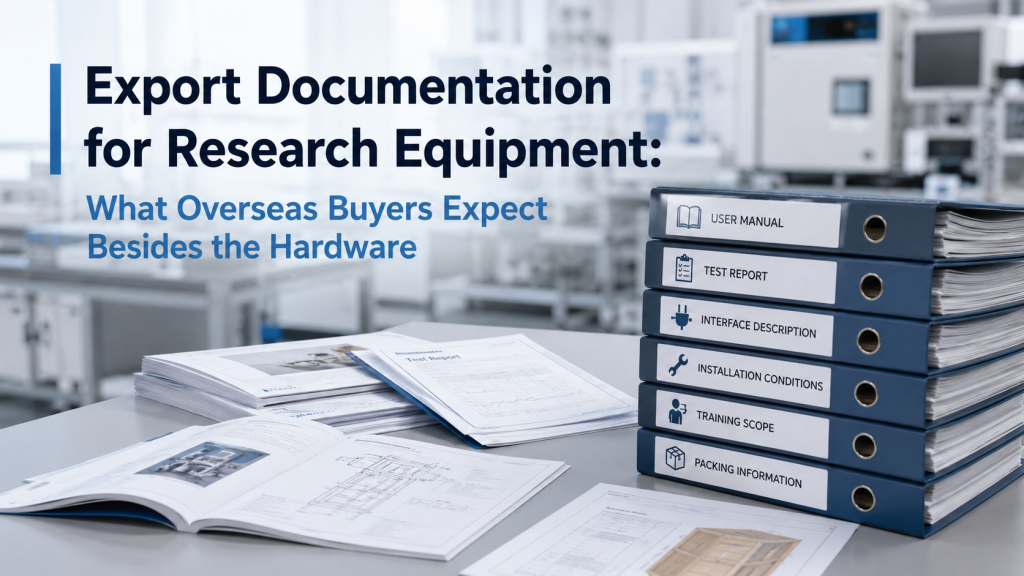
When overseas buyers purchase research equipment, they are not only buying the hardware.
They also expect documents that help the equipment move through customs, arrive safely, get installed correctly, pass internal acceptance, and become usable by researchers, engineers, or students.
For custom magnet systems, Helmholtz coils, electromagnets, Hall systems, VSM, MOKE platforms, power supplies, cryogenic accessories, and other laboratory instruments, documentation is part of the delivered value.
A well-prepared documentation package can reduce customs delays, avoid installation confusion, support university or company acceptance, and make the supplier look more professional.
This article explains what overseas buyers often expect besides the equipment itself.
1. Export Documentation Is Not Just a Customs Requirement
Many suppliers think export documentation only means:
- Commercial invoice
- Packing list
- Air waybill or bill of lading
These documents are important, but they are only one part of the picture.
For research equipment, overseas buyers may also need:
- Technical manual
- Test report
- Interface description
- Wiring diagram
- Installation conditions
- Packing dimensions
- Safety notes
- Training scope
- Warranty terms
- Acceptance checklist
- Software instructions
- Maintenance guidance
The International Trade Administration lists common export documents such as commercial invoice, packing list, transport documents, certificate of origin, and other export-related documents, depending on the shipment and destination.
For research equipment buyers, the real expectation is broader:
“Can this supplier deliver both the instrument and the information needed to receive, install, operate, and accept it?”
2. Commercial Invoice: The Core Customs Document
A commercial invoice is one of the most important documents for international shipments.
It usually includes:
- Seller information
- Buyer information
- Consignee information
- Product description
- Quantity
- Unit price
- Total value
- Currency
- Country of origin
- HS code
- Incoterms
- Shipping terms
- Invoice number
- Date
- Signature or company stamp, if required
FedEx states that the commercial invoice is required for international commodity shipments with commercial value.
For research equipment, the product description should be clear enough for customs and the buyer’s internal records.
Weak Description
“Laboratory equipment”
Better Description
“Three-axis Helmholtz coil system with matched magnetic field driver for laboratory magnetic field simulation”
A vague product description may cause customs questions, classification delays, or internal confusion.
3. Packing List: What Is Inside Each Package
The packing list tells the buyer, customs broker, warehouse, and logistics team how the shipment is packed.
It should usually include:
- Package number
- Item description
- Quantity per package
- Net weight
- Gross weight
- Package dimensions
- Total number of cartons or crates
- Packing method
- Marks and labels
- Accessory list
UPS notes that a packing list may look similar to a commercial invoice, but it is not the same and should not replace the commercial invoice.
For research equipment, the packing list is especially useful because a shipment may include many parts:
- Main system
- Power supply
- Cables
- fixtures
- probes
- sample holders
- software dongles
- manuals
- spare parts
- cooling hoses
- connectors
- accessories
A good packing list helps the buyer confirm that nothing is missing after unpacking.
4. HS Code and Product Description: Small Details, Big Impact
The HS code helps classify goods for customs purposes.
For research equipment, classification can be difficult because one system may include:
- Magnet or coil
- power supply
- control electronics
- sensors
- software
- mechanical fixtures
- cooling components
- cables and accessories
The supplier should provide a reasonable HS code suggestion, but buyers or import brokers may still need to confirm the final classification according to local customs rules.
Why This Matters
HS code and product description can affect:
- Customs clearance
- import duty
- VAT or GST
- import license review
- restricted item screening
- university asset registration
- internal purchasing records
The key is consistency.
The product name, invoice description, packing list, quotation, and purchase order should not contradict each other.
5. Certificate of Origin and Country-of-Origin Information
Some buyers may request a certificate of origin or country-of-origin statement.
This may be needed for:
- Customs clearance
- tariff treatment
- import documentation
- procurement records
- internal compliance
- government-funded projects
- formal tender submissions
Not every shipment requires a formal certificate of origin, but many buyers will still ask for origin information.
For scientific equipment, this should be discussed early if the buyer’s purchasing department or customs broker requires it.
6. Transport Documents: Air Waybill or Bill of Lading
Depending on the shipping method, transport documents may include:
- Air waybill for air freight or courier shipment
- Bill of lading for sea freight
- Tracking documents
- freight booking confirmation
- delivery note
These documents help prove shipment movement and support logistics tracking.
For overseas research equipment, buyers often need transport documents for:
- Customs clearance
- internal receiving process
- payment release
- insurance claims
- warehouse coordination
- delivery scheduling
If the equipment is large, heavy, or packed in wooden crates, logistics documents become even more important.
7. Packing Photos and Crate Information
For system-type research equipment, buyers often appreciate packing photos before shipment.
Useful packing photos may show:
- Equipment before packing
- accessories before packing
- protective foam or supports
- wooden crate
- shipping marks
- crate label
- gross weight and dimensions
- fragile or orientation markings
This is not only for appearance.
It helps the buyer confirm:
- What was shipped
- how it was protected
- whether the crate was damaged in transit
- whether accessories were packed together
- whether the receiving team should prepare lifting tools
For large electromagnets, Helmholtz coil frames, cryogenic components, or precision instruments, packing information can prevent real receiving problems.
8. User Manual: The First Document After Delivery
The user manual is not just a formality.
It helps the buyer operate the equipment safely and correctly.
A useful manual may include:
- System overview
- component list
- installation steps
- wiring instructions
- startup procedure
- shutdown procedure
- operating limits
- software instructions
- safety warnings
- basic troubleshooting
- maintenance recommendations
- contact information for support
For overseas buyers, the manual must be clear enough for remote operation and remote support.
If the supplier cannot be physically present, the manual becomes part of the installation service.
9. Wiring Diagram and Interface Description
For research equipment, wiring and interface information are often critical.
This is especially true for:
- Magnet systems
- power supplies
- Hall systems
- VSM platforms
- MOKE setups
- temperature controllers
- cryogenic accessories
- multi-instrument systems
Useful interface documentation may include:
- Power input requirement
- connector type
- pin definition
- communication protocol
- USB / LAN / RS-485 / GPIB interface
- trigger input and output
- analog control signal
- grounding requirement
- cable labeling
- safety interlock wiring
- software communication settings
This helps the buyer integrate the equipment with existing lab systems.
A system may be technically good, but if the interface is unclear, installation becomes slow and frustrating.
10. Installation Conditions: What the Buyer Must Prepare
Research equipment often requires site preparation.
The supplier should clearly state installation conditions before shipment.
Common Installation Conditions
These may include:
- Required input voltage
- phase and frequency
- power plug or wiring type
- cooling water or chiller requirement
- air ventilation
- bench or floor space
- table load capacity
- ambient temperature
- humidity range
- grounding requirement
- magnetic environment limitation
- computer requirement
- network or software permission
- lifting or unpacking tools
For magnet systems, installation conditions may also include:
- Distance from magnetic materials
- cooling flow rate
- cable routing
- sample space
- non-magnetic fixture requirements
- safety clearance
- maximum current operation limits
A serious supplier should not wait until after delivery to tell the buyer what the lab must prepare.
11. Factory Test Report: Evidence Before Shipment
A factory test report helps the buyer confirm that the system was checked before shipment.
Depending on the product, the report may include:
- Visual inspection
- coil resistance
- insulation test
- power supply output test
- magnetic field test
- field-current relationship
- temperature rise test
- software communication test
- motion test
- safety function check
- basic performance verification
- photos or screenshots
For magnet systems, test reports can be especially valuable because the buyer may not be able to verify every performance item immediately after delivery.
The report does not replace site acceptance, but it provides a baseline.
12. Field Verification or Calibration Data
For magnetic field systems, buyers may request field verification data.
This may include:
- Center field measurement
- field-current curve
- field uniformity data
- field mapping result
- probe position
- gaussmeter model
- test current
- test condition
- magnetic field direction
- measurement date
For Helmholtz coils, field uniformity over a defined volume may matter.
For electromagnets, pole gap and probe position are critical.
For sensor calibration systems, three-axis performance and coordinate definition may matter.
A useful field report should not only show a maximum field number.
It should explain where, how, and under what conditions the field was measured.
13. Acceptance Documents: FAT, SAT, and Handover
Formal buyers may request acceptance documents.
These may include:
- Factory Acceptance Test checklist
- Site Acceptance Test checklist
- acceptance report
- deviation list
- punch list
- handover form
- installation checklist
- training record
For exported research equipment, FAT and SAT boundaries should be clear.
FAT Usually Confirms
- Factory-built configuration
- basic function
- electrical and mechanical checks
- test report before shipment
SAT Usually Confirms
- Delivery condition
- site installation
- local power and cooling
- startup
- basic operation at buyer’s site
- user handover
If the supplier only provides remote support, the acceptance process should be realistic and documented accordingly.
14. Training Scope: Operation, Maintenance, or Method?
Training is another hidden expectation.
Overseas buyers may ask for “training,” but training can mean different things.
Basic Operation Training
This may include:
- Startup and shutdown
- software operation
- setting current or field
- sample loading
- safety precautions
- basic troubleshooting
Maintenance Training
This may include:
- checking cables
- cooling inspection
- fan or filter maintenance
- connector inspection
- routine cleaning
- storage recommendations
Method Training
This is deeper and may include:
- Hall measurement procedure
- magnetometer calibration workflow
- MOKE measurement logic
- VSM measurement sequence
- field mapping method
- data interpretation
Buyers and suppliers should clarify what training is included.
Operation training is not the same as full scientific method transfer.
15. Software Documents and Digital Files
Modern research equipment often includes software.
Useful software documentation may include:
- Installation guide
- license information
- supported operating system
- communication settings
- driver files
- software manual
- example workflow
- data export format
- API commands
- troubleshooting steps
- backup file instructions
- update policy
For university and corporate buyers, software documents help future users operate the system even after the original project engineer leaves.
This is especially important for long-term research platforms.
16. Warranty and After-Sales Support Documents
Warranty terms should be written clearly.
The buyer may need to know:
- Warranty period
- warranty start date
- covered components
- excluded damage
- remote support method
- spare parts availability
- repair process
- who pays freight for repair
- response time expectation
- software support scope
- consumable or wear-part exclusions
For international research equipment, vague warranty language creates risk.
A clear warranty document protects both sides.
17. Import-Side Documents and Buyer Responsibilities
The supplier can prepare export documents, but the buyer often has import-side responsibilities.
These may include:
- Import license, if required
- local customs broker
- tax ID or importer registration
- duty and VAT / GST payment
- customs bond, if applicable
- local delivery arrangement
- site unloading
- customs inspection support
- internal receiving paperwork
DHL’s guidance on international shipping documents lists documents such as commercial invoice, air waybill, certificate of origin, export/import licenses, export packing list, and insurance certificate, depending on shipment and destination.
Reference link: https://www.dhl.com/discover/en-kh/logistics-advice/import-export-advice/key-documents-for-international-shipping
The exact requirements vary by country, product, and shipment method.
Buyers should check with their customs broker or logistics department early.
18. Documentation for Different Product Types
Different research equipment needs different documentation.
Electromagnet Systems
Useful documents:
- Field-current curve
- pole gap information
- cooling requirement
- power supply wiring
- operation manual
- safety notes
- test report
Helmholtz Coil Systems
Useful documents:
- Coil dimensions
- field constant
- uniformity region
- axis definition
- driver connection
- software instructions
- field verification data
Hall Effect Measurement Systems
Useful documents:
- sample holder instructions
- contact configuration
- measurement workflow
- software guide
- field and temperature range
- data export instructions
VSM Systems
Useful documents:
- sample mounting guide
- calibration procedure
- vibration and field notes
- software manual
- test report
- maintenance guidance
MOKE Systems
Useful documents:
- optical layout notes
- laser safety guidance
- field direction
- sample positioning
- software and camera instructions
- alignment guidance
Cryogenic or Low-Temperature Systems
Useful documents:
- temperature controller manual
- sensor wiring
- vacuum or cooling instructions
- sample space drawing
- thermal interface notes
- installation conditions
A complete documentation package should match the actual product and application.
19. What Buyers Should Ask Before Order Confirmation
Before placing an order, overseas buyers should confirm the documentation scope.
Customs and Shipping Documents
- Commercial invoice
- packing list
- HS code
- country of origin
- shipping document
- crate dimensions and weight
- packing photos
- insurance document, if applicable
Technical Documents
- Datasheet
- user manual
- wiring diagram
- interface description
- software manual
- installation conditions
- safety notes
- maintenance guidance
Test and Acceptance Documents
- Factory test report
- FAT checklist
- field verification data
- calibration or test data, if included
- SAT checklist, if applicable
- deviation list, if any
Support Documents
- Training scope
- warranty statement
- spare parts list
- remote support contact
- troubleshooting guide
This list helps avoid last-minute confusion before shipment or after delivery.
20. How Cryomagtech Supports Export Documentation for Research Equipment
Cryomagtech supplies Magnet & Field Systems and related research equipment for overseas university, laboratory, and industrial customers, including electromagnets, Helmholtz coils, magnetic field drivers, Hall systems, and custom magnetic field platforms.
For export and system delivery, we can support documentation such as:
- Formal quotation
- commercial invoice
- packing list
- product description and HS code reference
- packing dimensions and weight
- system configuration list
- user manual
- wiring and interface notes
- installation conditions
- factory test report
- field verification data, if included
- FAT checklist support
- remote installation guidance
- training scope clarification
- warranty statement
👉 Product link placeholder: Cryomagtech Research Equipment and Magnet System Documentation Support
For overseas research equipment projects, documentation is not a secondary detail.
It is part of the product experience, part of the acceptance process, and part of the buyer’s confidence in the supplier.
References
- International Trade Administration – Common Export Documents
https://www.trade.gov/common-export-documents - FedEx – Customs Documents and Commercial Invoice
https://www.fedex.com/en-us/shipping/international/create-documents.html - UPS – Forms Needed for International Shipping
https://www.ups.com/us/en/support/international-tools-resources/international-forms-certificates - DHL – Key Documents for International Shipping
https://www.dhl.com/discover/en-kh/logistics-advice/import-export-advice/key-documents-for-international-shipping
Key Takeaways
- Overseas buyers expect more than hardware when purchasing research equipment.
- Export documentation usually includes commercial invoice, packing list, transport documents, HS code, origin information, and packing details.
- System-type research equipment also needs technical documents such as manuals, wiring diagrams, interface descriptions, software instructions, installation conditions, and test reports.
- Field verification data, FAT documents, and acceptance checklists can reduce disputes and improve buyer confidence.
- Training scope, warranty terms, and support boundaries should be clarified before shipment.
- Import-side requirements vary by country, so buyers should coordinate with their customs broker or logistics team early.
- Good documentation helps the equipment clear customs, arrive safely, install smoothly, and pass internal acceptance.
For exported research equipment, the key question is not only:
“Has the hardware been shipped?”
The better question is:
“Does the buyer have the documents needed to clear, receive, install, operate, accept, and maintain the system?”