
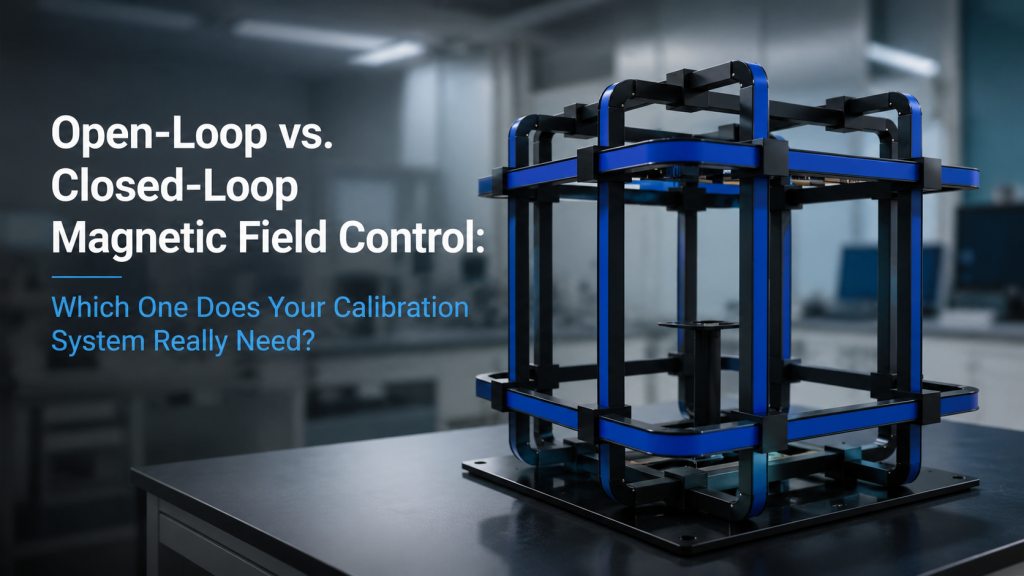
In magnetic calibration systems, one question often separates basic systems from higher-level platforms:
“Do we need open-loop or closed-loop magnetic field control?”
Many buyers assume this is only a software detail.
It is not.
Open-loop control usually means the system controls coil current and calculates the magnetic field from the coil constant or calibration data. Closed-loop control means the system measures the actual magnetic field with a field sensor and adjusts the output to reduce the difference between the target field and the measured field.
For three-axis Helmholtz coil systems, geomagnetic simulation platforms, magnetometer calibration systems, and precision magnetic field testing, this distinction matters because stable current and stable magnetic field are related, but they are not always the same thing.
This article explains when open-loop control is enough, when closed-loop field feedback is useful, and what buyers should consider before specifying a calibration system.
1. What Is Open-Loop Magnetic Field Control?
Open-loop magnetic field control means the system sets an output current based on a known relationship between coil current and magnetic field.
For example:
- The software receives a target field value.
- The system converts that target field into a coil current.
- The power supply outputs the required current.
- The magnetic field is assumed based on coil geometry, calibration data, or a field-current curve.
In general control theory, open-loop control means the control action does not depend on the measured output of the process. In a magnetic field system, this means the system does not continuously measure the actual field and correct the output in real time.
Typical Open-Loop Architecture
An open-loop magnetic field system may include:
- Helmholtz coil or electromagnet
- Constant-current power supply
- Field-current calibration table
- Manual or software current control
- Optional field verification before testing
- No real-time feedback sensor in the control loop
For many systems, open-loop control is practical, stable, and cost-effective.
2. What Is Closed-Loop Magnetic Field Control?
Closed-loop magnetic field control uses feedback.
The system measures the actual magnetic field and adjusts current to keep the measured field close to the target value.
A closed-loop controller uses feedback to control the state or output of a system. In magnetic field control, the measured field becomes part of the correction process.
Typical Closed-Loop Architecture
A closed-loop magnetic field system may include:
- Helmholtz coil or electromagnet
- Precision current driver
- Field sensor or magnetometer
- Feedback controller
- Software control loop
- Field error calculation
- Real-time or periodic correction
- Calibration table or correction matrix
In simple terms:
Open-loop controls the input.
Closed-loop controls the measured result.
That difference can be important.
3. Stable Current and Stable Field Are Not Exactly the Same
Many buyers assume:
“If the current is stable, the magnetic field must be stable.”
Often, this is mostly true.
For a well-designed Helmholtz coil operating in a stable environment, magnetic field is strongly related to applied current. Lake Shore’s Helmholtz coil documentation describes field generation based on applied coil current, which is why constant-current control is widely used for Helmholtz coil systems.
But in real calibration environments, the measured field can also be affected by:
- Background magnetic field
- nearby steel structures
- current-carrying cables
- magnetic fixtures
- coil heating
- field sensor position
- local magnetic noise
- multi-axis coil alignment
- mechanical changes in the setup
- Earth-field variation or site disturbance
So current stability is necessary, but it may not always be sufficient.
4. When Open-Loop Control Is Usually Enough
Open-loop control is often suitable when the magnetic environment is stable and the required uncertainty is moderate.
Good Use Cases for Open-Loop Control
Open-loop control may be enough for:
- Simple magnetic field exposure
- educational demonstrations
- routine low-field testing
- one-axis Helmholtz coil operation
- stable laboratory environments
- applications where field-current calibration is sufficient
- short-duration measurements
- systems where field verification is done before the test
- experiments that do not need real-time field correction
Why Open-Loop Is Attractive
Open-loop systems are often:
- simpler
- lower cost
- easier to troubleshoot
- faster to operate
- less sensitive to feedback sensor errors
- easier to document
- suitable for many standard coil systems
For many buyers, open-loop is the right choice.
A closed-loop system is not automatically better if the application does not need real-time field correction.
5. When Closed-Loop Control Becomes Useful
Closed-loop field control becomes more useful when the actual magnetic field must be maintained, corrected, or verified in real time.
Good Use Cases for Closed-Loop Control
Closed-loop control may be useful for:
- precision magnetometer calibration
- geomagnetic simulation
- Earth-field cancellation
- long-duration calibration runs
- low-field stability testing
- three-axis vector field control
- magnetic field compensation
- environments with changing background field
- systems with strict field accuracy requirements
- automated calibration platforms
- applications where field drift cannot be tolerated
NIST’s magnetic sensing and metrology program characterizes magnetic sensors used in industrial, biomedical, electronics, environmental, infrastructure, defense, and other applications. This broad application range shows why controlled calibration environments can matter when sensor accuracy and repeatability are important.
For these projects, closed-loop control can help reduce the gap between commanded field and actual field.
6. The Main Benefit of Closed-Loop Control
The main benefit of closed-loop control is correction.
If the measured field differs from the target field, the system can adjust the current.
This may help compensate for:
- slow drift
- coil heating effects
- background field changes
- small current-to-field errors
- offset field at the test location
- multi-axis vector error
- low-frequency environmental disturbance
For example, in an Earth-field simulation system, the target field may be only tens of microtesla.
At that level, small background changes or offsets can be meaningful.
A closed-loop system may help maintain the desired vector field more accurately than current control alone.
7. Closed-Loop Control Is Not Magic
Closed-loop control sounds better, but it is not automatically better in every case.
It introduces new requirements and possible error sources.
Closed-Loop Risks
Closed-loop systems may suffer from:
- field sensor noise
- field sensor offset
- sensor calibration error
- sensor placement error
- feedback delay
- control loop instability
- limited bandwidth
- over-correction
- cross-axis correction errors
- local field differences between sensor and DUT
- software complexity
A badly implemented closed-loop system can be worse than a good open-loop system.
The feedback sensor must measure the field that matters.
If the sensor is not located at the same effective position as the DUT, the system may stabilize the field at the sensor but not at the sample.
8. Field Sensor Placement Is Critical
In closed-loop control, the field sensor is part of the control system.
That means its position matters.
Important Sensor Placement Questions
Buyers should ask:
- Where is the field sensor located?
- Is it at the same position as the DUT?
- If not, how is the offset handled?
- Does the sensor block the sample or optical path?
- Does the sensor measure one axis or three axes?
- Is the sensor inside the uniform region?
- Is the sensor stable during the test?
- Is the sensor affected by nearby fixtures or cables?
- Can the sensor remain in place during real operation?
A closed-loop system is only as good as the feedback signal.
If the feedback signal is not representative, the correction may be misleading.
9. Open-Loop Control with Field Verification Is Often a Strong Compromise
Many calibration systems do not need full closed-loop control.
They need open-loop control plus good field verification.
This means:
- The system uses stable current control during operation.
- Field-current data is measured during setup or FAT.
- The user verifies the field at the DUT position.
- Correction factors or calibration tables are applied.
- Real-time feedback is not continuously required.
This approach can work well when:
- The field environment is stable
- the coil system is repeatable
- the test duration is not too long
- the required accuracy is moderate
- background field is measured before testing
- field drift is acceptable or known
For many laboratory systems, this is the best balance between cost, reliability, and data confidence.
10. Three-Axis Systems Make the Question More Complex
For a one-axis coil, open-loop vs. closed-loop is relatively simple.
For a three-axis Helmholtz coil system, the question becomes more complex.
A three-axis system must control:
- X-axis field
- Y-axis field
- Z-axis field
- axis polarity
- axis orthogonality
- vector magnitude
- vector direction
- background field compensation
- cross-axis coupling
- software coordinate transformation
If open-loop control is used, each axis needs a reliable field-current relationship.
If closed-loop control is used, the system may need a three-axis field sensor and a correction matrix.
Why This Matters
In a three-axis calibration system, the buyer may not only care about field magnitude.
They may care about field direction.
For magnetometer, compass, and IMU calibration, vector direction can be just as important as field strength.
A three-axis closed-loop system may improve vector accuracy, but only if the sensor calibration, coordinate transformation, and control strategy are properly implemented.
11. Background Field Compensation
Background field compensation is one of the main reasons buyers consider closed-loop control.
In low-field systems, the local magnetic environment may include:
- Earth’s magnetic field
- building steel
- lab benches
- motors
- elevators
- power cables
- nearby instruments
- magnetized fixtures
An open-loop system can generate a calculated field, but the sensor or sample experiences the sum of the generated field and the background field.
Open-Loop Compensation
Open-loop compensation may use:
- pre-measured background field
- manual offset correction
- calibration table
- fixed compensation current
This works if the background field is stable.
Closed-Loop Compensation
Closed-loop compensation may use:
- real-time field measurement
- automatic offset correction
- feedback control
- continuous or periodic compensation
This is more useful if the background field changes or if the system requires higher accuracy.
12. Long Calibration Runs: Drift Matters
During long calibration runs, the magnetic field may drift.
Possible causes include:
- coil heating
- current driver drift
- ambient temperature change
- sensor drift
- background field changes
- nearby equipment cycling on and off
- mechanical movement
Open-loop current control can keep current stable, but it may not compensate for all field changes.
Closed-loop control may help correct slow field drift, especially if the feedback sensor is stable and properly located.
However, the feedback sensor itself can also drift.
For long-duration calibration, the system should consider both:
- current stability
- field measurement stability
Do not assume feedback automatically removes all drift.
13. Dynamic Fields and Feedback Bandwidth
Closed-loop control is more difficult when the magnetic field changes quickly.
Examples include:
- field sweeps
- AC magnetic fields
- rotating vector fields
- waveform generation
- fast step response
- dynamic sensor testing
In these cases, feedback bandwidth matters.
A slow feedback loop may be useful for correcting slow drift, but not for fast field changes.
Questions to Ask
- What is the required field update rate?
- Is the field DC or dynamic?
- Does the feedback sensor have enough bandwidth?
- Is the control loop stable at the required speed?
- Does the coil inductance limit response?
- Does the driver have enough voltage headroom?
- Is phase delay acceptable?
For dynamic magnetic testing, closed-loop control must be designed carefully.
14. Noise: Open-Loop and Closed-Loop Can Both Have Problems
Open-loop systems can have noise from the current driver.
Closed-loop systems can also add noise from the feedback sensor.
Open-Loop Noise Sources
- Current ripple
- driver noise
- grounding issues
- cable coupling
- power-line interference
- thermal drift
Closed-Loop Noise Sources
- field sensor noise
- feedback correction noise
- digital control noise
- sensor quantization
- loop instability
- over-correction
If the feedback sensor is noisy, the control system may chase noise and inject unnecessary current variation.
For low-noise calibration, the feedback loop should not only be accurate.
It must also be stable and quiet.
15. Cost and Complexity Comparison
Closed-loop systems usually cost more.
They may require:
- field sensor
- sensor calibration
- sensor mount
- additional software
- feedback controller
- more testing
- more documentation
- more setup time
- more troubleshooting
- higher engineering cost
Open-loop systems are usually simpler and more affordable.
But if the application requires real field correction, open-loop may create hidden cost through uncertainty, repeated testing, or poor calibration confidence.
The right decision depends on the value of accuracy and repeatability in the real application.
16. Which Architecture Fits Different Applications?
Simple Exposure Testing
Usually enough:
- Open-loop current control
- basic field-current calibration
- optional field verification
Sensor Screening
Often enough:
- Open-loop control
- periodic field check
- stable current driver
- simple software workflow
Magnetometer Calibration
Often better:
- open-loop with strong field verification
- or closed-loop if high accuracy or background compensation is required
IMU and Compass Calibration
Often better:
- three-axis field control
- background compensation
- optional closed-loop vector correction
- careful fixture and coordinate setup
Geomagnetic Simulation
Often needs:
- three-axis control
- background field measurement
- open-loop compensation for stable environments
- closed-loop correction for higher precision or changing environments
Long-Duration Calibration
May benefit from:
- high-stability current source
- temperature monitoring
- field verification
- closed-loop correction if drift limits performance
Production Calibration
Depends on throughput and repeatability:
- open-loop may be faster and simpler
- closed-loop may improve consistency if environment changes
17. Practical RFQ Questions Before Choosing Open-Loop or Closed-Loop
Before requesting a quotation, buyers should define the control requirement clearly.
Magnetic Field Requirements
- Required field range:
- Required field accuracy:
- Required field stability:
- Required uniformity:
- Required vector direction accuracy:
- One-axis, two-axis, or three-axis control:
Control Requirements
- Open-loop current control acceptable?
- Field verification required?
- Closed-loop field feedback required?
- Real-time feedback or periodic correction?
- DC, sweep, AC, or rotating vector field?
- Required feedback speed:
- Required data logging:
Field Sensor Requirements
- One-axis or three-axis field sensor?
- Sensor accuracy:
- Sensor bandwidth:
- Sensor position:
- Sensor calibration requirement:
- Sensor remains during operation or only used for setup?
Environment
- Stable lab environment?
- Nearby magnetic materials?
- Background field changes expected?
- Long-duration operation?
- Temperature variation expected?
- Production or research use?
Software
- Manual control or PC software?
- Field unit input?
- Vector field generation?
- Feedback control?
- Calibration table?
- API or external integration?
- Report export?
This information helps the supplier recommend the correct architecture instead of adding unnecessary complexity.
18. Common Buyer Mistakes
Mistake 1: Assuming Closed-Loop Is Always Better
Closed-loop control is useful only when the feedback signal is reliable and the application needs field correction.
Mistake 2: Confusing Stable Current with Stable Field
Stable current helps, but field can also be affected by background field, geometry, heating, and nearby objects.
Mistake 3: Ignoring Feedback Sensor Position
A closed-loop system controls the field where the sensor measures, not necessarily where the sample is.
Mistake 4: Asking for Closed-Loop Without Defining Accuracy
“Closed-loop required” is incomplete unless the buyer defines field accuracy, stability, bandwidth, and sensor position.
Mistake 5: Overcomplicating a Simple System
If the application only needs moderate field exposure, open-loop current control may be more reliable and cost-effective.
Mistake 6: Underestimating Three-Axis Calibration
Three-axis field control needs axis calibration, coordinate definition, and sometimes correction matrices.
19. How Cryomagtech Supports Open-Loop and Closed-Loop Magnetic Field Systems
Cryomagtech supplies Helmholtz coil systems, three-axis magnetic field systems, field sensors, precision power supplies, magnetic field drivers, and control software for calibration, geomagnetic simulation, and laboratory testing applications.
Depending on the project, we can help evaluate:
- Open-loop current control
- field-current calibration
- field verification data
- closed-loop field feedback
- three-axis vector control
- background field compensation
- field sensor selection
- sensor placement
- driver stability and resolution
- software control and data logging
- acceptance and test report requirements
👉 Product link placeholder: Cryomagtech Three-Axis Helmholtz Coil and Magnetic Field Control Systems
The best control architecture is not the most complex one.
It is the one that controls the dominant error source in the real calibration environment.
References
- Wikipedia – Control Theory
https://en.wikipedia.org/wiki/Control_theory - Wikipedia – Closed-Loop Controller
https://en.wikipedia.org/wiki/Closed-loop_controller - NIST – Magnetic Sensing and Metrology
https://www.nist.gov/programs-projects/magnetic-sensing-and-metrology - Lake Shore Cryotronics – Helmholtz Coil Application Note
https://www.lakeshore.com/docs/default-source/product-downloads/manuals/f011-05-00.pdf
Key Takeaways
- Open-loop control usually controls coil current and calculates magnetic field from known field-current relationships.
- Closed-loop control measures the actual magnetic field and adjusts the output using feedback.
- Stable current and stable magnetic field are related, but they are not always the same thing.
- Open-loop control is often enough for stable, moderate-accuracy systems.
- Closed-loop control is useful when field drift, background field changes, or high-accuracy requirements matter.
- Feedback sensor placement, calibration, noise, and bandwidth are critical.
- Three-axis systems require careful vector control, axis definition, and sometimes correction matrices.
- The right choice depends on the calibration goal, environment, required accuracy, and acceptable complexity.
For magnetic calibration systems, the key question is not only:
“Do we need closed-loop control?”
The better question is:
“What field error are we trying to control, and is feedback the best way to control it?”