
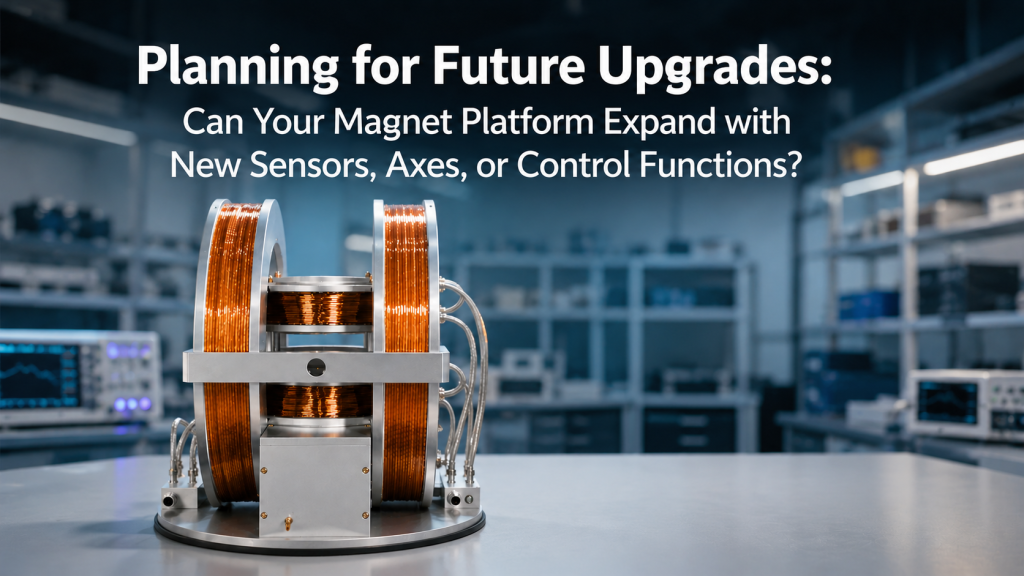
Many university labs and long-term research groups do not buy a magnet system for only one experiment.
They buy a platform.
Today, the system may be used for simple DC magnetic field testing.
Next year, it may need a new sensor fixture, a second measurement axis, automated software control, a field probe, a cryostat interface, or a more advanced driver.
That creates an important purchasing question:
“Can this magnet platform expand later, or will every new requirement force us to replace the whole system?”
For Helmholtz coils, electromagnets, magnetic field drivers, fixtures, software, and control platforms, future upgrade planning should not be treated as a vague sales promise. It should be translated into real technical interfaces, reserved capacity, mechanical space, software structure, and clear upgrade boundaries.
This article explains how to evaluate upgrade potential before purchasing a modular magnet platform.
1. Why Future Upgrades Matter in Magnet Projects
Research requirements change.
A university lab may begin with one project, then later support:
- New students
- New samples
- New sensors
- New funding topics
- New collaborators
- New measurement protocols
- New automation requirements
- New temperature environments
- New field directions
- New data logging needs
If the original magnet system is too closed, future upgrades may be difficult or impossible.
A system that looked cheaper at the beginning may become expensive later if it cannot be expanded.
The NIST guide on open system environment procurement was created to help acquisition teams build flexible, modular systems and notes that up-front planning is important for preserving flexibility. This principle applies directly to research equipment platforms: future expansion must be considered early, not after the system is already locked.
2. What “Modular” Really Means
Many suppliers use the word “modular.”
But not all modular systems are equally expandable.
A truly modular magnet platform should have clear boundaries between subsystems.
These may include:
- Magnet or coil module
- Power supply or driver module
- Field probe module
- Fixture module
- Software module
- Motion module
- Temperature module
- Safety module
- Communication module
- Data acquisition module
Modular design generally means a system is divided into modules that can be independently created, modified, replaced, or exchanged.
For buyers, the practical question is not:
“Is the system called modular?”
The better question is:
“Which parts can actually be upgraded later without redesigning the whole platform?”
3. Upgrade Planning Starts with the Research Roadmap
Before buying a magnet platform, the technical team should consider both current and future experiments.
Current Requirement
The current requirement may be simple:
- One-axis field
- DC operation
- Room-temperature sample
- Manual control
- One sample holder
- Basic field verification
Future Requirement
The future requirement may become more complex:
- Three-axis field control
- rotating vector field
- automated sweep
- low-temperature sample stage
- motorized fixture
- optical access
- higher field range
- better current stability
- field probe feedback
- software API
- data logging
- integration with external instruments
If future needs are likely, the platform should be planned with upgrade paths from the beginning.
Otherwise, the lab may be forced into a complete replacement later.
4. Axis Expansion: From 1-Axis to 2-Axis or 3-Axis
One common upgrade question is whether a system can expand from one magnetic field axis to multiple axes.
1-Axis System
A 1-axis system may be suitable for:
- simple field exposure
- basic Hall measurement
- single-axis sensor response
- material testing along one direction
- teaching experiments
2-Axis System
A 2-axis system may support:
- horizontal field rotation
- compass heading simulation
- two-axis sensor calibration
- planar vector field experiments
3-Axis System
A 3-axis system is often needed for:
- geomagnetic simulation
- magnetometer calibration
- IMU testing
- full vector field control
- three-dimensional magnetic response studies
Upgrade Reality
Not every 1-axis system can be upgraded to 3-axis later.
Axis expansion may require:
- physical space for additional coils
- mechanical frame redesign
- additional driver channels
- software support
- axis alignment
- calibration matrix
- safety updates
- cable routing changes
If future 3-axis control is possible, it should be discussed before the original system is designed.
5. Driver Expansion: Current Channels, Voltage Headroom, and Control
The power supply or magnetic field driver is often the limiting factor in future upgrades.
A system may be mechanically expandable but electrically limited.
Driver Upgrade Questions
Buyers should ask:
- Can additional channels be added later?
- Is the driver architecture single-channel or multi-channel?
- Is the output bipolar or unipolar?
- Is there enough voltage headroom for future coil changes?
- Can the driver support faster ramps or sweeps?
- Can it support continuous operation?
- Can it communicate with future software?
- Is synchronization between channels possible?
- Are spare connectors or cabinet space available?
A low-cost driver may be enough for the first experiment but unsuitable for future multi-axis or automated operation.
For long-term labs, driver architecture should be considered as part of the platform, not as a disposable accessory.
6. Mechanical Interfaces: The Hidden Upgrade Constraint
Mechanical design often decides whether a platform can evolve.
A magnet system may need future accessories such as:
- New sample holders
- non-magnetic fixtures
- rotation stages
- translation stages
- optical modules
- cryostat adapters
- camera mounts
- probe holders
- sensor calibration fixtures
- field mapping tools
If the original structure has no mounting points, no open space, and no defined center reference, upgrades become difficult.
Mechanical Upgrade Features to Consider
A future-ready platform may include:
- Defined sample center
- standard mounting holes
- removable fixture plate
- open access directions
- non-magnetic mounting area
- cable routing path
- space for larger samples
- reserved clearance for future modules
- documented dimensions
- stable mechanical reference points
A platform is easier to upgrade when the mechanical interface is intentional.
7. Sensor Upgrades: Field Probes, Magnetometers, and Feedback
Some systems begin with open-loop current control.
Later, the lab may want to add field measurement or feedback.
Possible Sensor Upgrades
Future sensor modules may include:
- Hall probe
- gaussmeter
- fluxgate magnetometer
- three-axis magnetometer
- temperature sensor
- current monitor
- field mapping probe
- position sensor
- environmental monitoring sensor
Why This Matters
Adding sensors later may require:
- mechanical probe holder
- non-magnetic mounting
- software input channel
- calibration support
- data logging
- communication protocol
- field correction algorithm
- safety logic
If future feedback control is likely, the buyer should confirm whether the software and hardware can accept sensor input later.
A system that cannot read or log external data may be harder to upgrade into a closed-loop platform.
8. Software Expandability: Manual Control vs. Platform Control
Software is where many upgrade promises become real or fail.
A simple system may only allow manual current setting.
A modular control platform may support:
- current control
- field unit conversion
- sweep programming
- sequence control
- three-axis vector generation
- data logging
- API access
- external trigger
- field probe feedback
- temperature integration
- motion control integration
- report export
Software Upgrade Questions
Buyers should ask:
- Is the software limited to one product model?
- Can new channels be added?
- Can future drivers be recognized?
- Is there an API?
- Can users export raw data?
- Can it communicate with LabVIEW, Python, or other tools?
- Can field probes or temperature controllers be integrated?
- Can control sequences be edited?
- Can software be updated later?
Software flexibility is not cosmetic.
It determines whether the magnet system can become a long-term research platform.
9. Communication Interfaces: Small Detail, Big Future Impact
Communication interfaces often look like minor details during purchase.
They are not.
A system may use:
- USB
- RS-485
- RS-232
- Ethernet / LAN
- GPIB
- analog control
- digital I/O
- trigger input/output
- custom protocol
- API command set
For future upgrades, the interface should support integration with external instruments.
IEEE Instrumentation & Measurement Society standards activities include work related to scalability and interoperability in instrumentation and devices, which reflects the broader importance of communication compatibility in modern measurement systems.
Practical Advice
For long-term research groups, Ethernet, documented command sets, API access, or commonly supported communication interfaces may be more valuable than a closed, single-purpose control method.
The more closed the communication interface, the harder the future upgrade.
10. Field Range Upgrade: Can the Platform Handle More Field Later?
Some buyers hope to start with a lower field and upgrade to a higher field later.
This is possible in some cases, but not always.
Field Upgrade May Require
- Higher current driver
- higher voltage driver
- larger cables
- better connectors
- stronger cooling
- coil redesign
- larger yoke
- smaller gap
- better thermal monitoring
- stronger mechanical support
For electromagnets, field range is tied to yoke size, pole gap, coil design, cooling, and power supply.
For Helmholtz coils, field range is tied to coil size, turns, current, heat, and driver capacity.
A platform should not promise unlimited field upgrade unless the original magnetic structure and driver path support it.
11. Temperature and Cryogenic Upgrade Planning
Some labs begin with room-temperature experiments and later move toward low-temperature or cryogenic integration.
This upgrade can be difficult if not considered early.
Future Temperature-Related Needs
A lab may later add:
- cryostat
- vacuum chamber
- cold finger
- sample-in-vacuum holder
- temperature sensor
- heater
- temperature controller
- low-noise wiring
- optical windows
- thermal shield
- vibration-sensitive mounting
Upgrade Constraints
Low-temperature integration may require:
- larger opening
- optical access
- cable feedthrough space
- vertical or horizontal sample access
- non-magnetic fixtures
- stable mechanical support
- safe routing for vacuum and cryogenic lines
- reduced magnetic interference
If cryogenic work is likely, the magnet platform should reserve enough physical and control-system flexibility from the beginning.
12. Optical and Motion Upgrades
Many magnet platforms eventually need optical or motion modules.
Optical Upgrade Examples
Future optical upgrades may include:
- camera monitoring
- laser access
- microscope integration
- MOKE measurement
- photodetector access
- optical windows
- reflection or transmission geometry
Motion Upgrade Examples
Future motion upgrades may include:
- rotation stage
- translation stage
- goniometer
- sample scanner
- automated positioning
- field mapping motion system
These upgrades affect:
- open test space
- cable routing
- non-magnetic material selection
- software integration
- safety
- field uniformity
- sample positioning
If optical or motion upgrades are likely, the platform should not be designed as a closed box.
13. Documentation Makes Upgrades Easier
A system is easier to upgrade when the original documentation is clear.
Useful documentation may include:
- wiring diagram
- mechanical drawings
- coil constants
- field-current relationship
- driver specifications
- communication protocol
- software manual
- accessory list
- safety logic
- connector definitions
- field test report
- deviation list
- recommended upgrade limits
Without documentation, even a technically expandable platform may become difficult to modify.
For universities, documentation is especially important because students and researchers change over time.
The system should not depend only on one person’s memory.
14. Upgrade Boundaries Should Be Written Clearly
Not every system can be upgraded in every direction.
A professional quotation should state realistic upgrade boundaries.
Good Upgrade Boundary Examples
- “The system can support future software-controlled field sequences.”
- “The driver cabinet has space for two additional channels.”
- “The mechanical frame can accept a future non-magnetic rotation fixture.”
- “The current coil body cannot be upgraded to 3-axis control without adding new coil assemblies.”
- “Higher field operation would require a different power supply and cooling configuration.”
- “Cryostat integration requires confirmation of outer diameter and sample position.”
Clear upgrade boundaries are better than vague promises.
A buyer should trust a supplier who explains limits more than one who says “everything can be upgraded” without conditions.
15. The Cost of Future-Proofing
Future-proofing is not free.
A platform designed for upgrades may require:
- larger frame
- more space
- higher-capacity driver
- spare channels
- better software architecture
- additional connectors
- stronger cooling margin
- more documentation
- more engineering work
- higher initial cost
The buyer must decide which upgrades are likely and which are only theoretical.
Smart Future-Proofing
Smart future-proofing means reserving capacity for realistic future needs.
Bad Future-Proofing
Bad future-proofing means overpaying for options that will never be used.
The goal is not to buy every possible function.
The goal is to avoid blocking the most likely future experiments.
16. Questions Buyers Should Ask Before Purchase
Before buying a modular magnet platform, buyers should ask these questions.
Magnetic Upgrade Questions
- Can the field range be increased later?
- Can the system expand from one axis to multiple axes?
- Can field uniformity be improved with mapping or compensation?
- Can a field probe be added?
- Can the system support closed-loop control?
Electrical Upgrade Questions
- Can the driver support additional channels?
- Is there enough voltage and current margin?
- Are cables and connectors rated for future operation?
- Can the system support faster ramping?
- Can the power cabinet be expanded?
Mechanical Upgrade Questions
- Are mounting points available?
- Is the sample space large enough for future fixtures?
- Can a turntable or translation stage be added?
- Is optical access possible?
- Can a cryostat or chamber fit later?
- Are drawings and dimensions documented?
Software Upgrade Questions
- Can new modules be added?
- Is API control available?
- Can external sensors be integrated?
- Can data logging be expanded?
- Can control sequences be customized?
- Is software update support available?
Documentation and Support Questions
- Are drawings provided?
- Are wiring diagrams available?
- Are communication commands documented?
- Are test reports provided?
- Is future configuration support available?
- Are upgrade limits stated clearly?
These questions make “modular” measurable.
17. When a Modular Magnet Platform Makes Sense
A modular magnet platform is usually a good choice when:
- The lab has long-term research plans
- Multiple projects will use the same system
- Different students or groups will share the equipment
- Future sensors or fixtures are likely
- Multi-axis control may be needed later
- Software automation may expand
- External instruments may be integrated
- A cryostat or optical setup may be added
- Funding may come in phases
For universities and research institutes, this is common.
A modular platform allows the lab to start with a realistic configuration and expand when the research direction becomes clearer.
18. When a Simple Fixed System Is Better
A modular system is not always necessary.
A fixed system may be better when:
- The task is clearly defined
- The budget is tight
- No future expansion is expected
- Manual operation is enough
- One sample type will be tested
- One field direction is enough
- Integration with other instruments is unlikely
- The system is for teaching or simple exposure tests
In these cases, paying for upgrade capacity may not be justified.
The right choice depends on the research plan, not on the slogan “future-proof.”
19. How Cryomagtech Supports Modular Magnet Platforms
Cryomagtech supplies modular Magnet & Field Systems for research, calibration, and laboratory testing applications, including Helmholtz coils, electromagnets, magnetic field drivers, control software, fixtures, and system-level accessories.
For future upgrade planning, we help evaluate:
- Initial field range and future field margin
- 1-axis, 2-axis, or 3-axis expansion potential
- driver channel planning
- software control requirements
- sensor and field probe integration
- fixture and sample-space planning
- optical or cryogenic interface possibilities
- power and cooling margin
- documentation and acceptance requirements
- realistic upgrade boundaries
👉 Product link placeholder: Cryomagtech Modular Magnet Platforms and Expandable Field Systems
The best modular magnet platform is not the one with the most accessories on day one.
It is the one that gives the research group a clear, realistic path from today’s experiment to tomorrow’s measurement needs.
References
- NIST – Guide on Open System Environment Procurements
https://nvlpubs.nist.gov/nistpubs/Legacy/SP/nistspecialpublication500-220.pdf - Wikipedia – Modular Design
https://en.wikipedia.org/wiki/Modular_design - IEEE Instrumentation & Measurement Society – Standards Activities
https://ieee-ims.org/activities/about-technical-standards-activities/standards-activities
Key Takeaways
- Future upgrade planning should be part of magnet platform procurement, especially for university and long-term research labs.
- “Modular” should mean real upgrade paths, not just a flexible-sounding product description.
- Axis expansion, driver capacity, mechanical interfaces, software control, sensors, and communication protocols should be checked before purchase.
- A low-cost fixed system may be enough for one defined task, but it may block future experiments.
- Smart future-proofing means reserving capacity for likely upgrades without overpaying for unrealistic options.
- Clear documentation makes future expansion easier and safer.
- Upgrade boundaries should be written clearly in the quotation or technical proposal.
For modular magnet platforms, the real question is not only:
“What can the system do today?”
The better question is:
“What can it reasonably become when the research program grows?”