
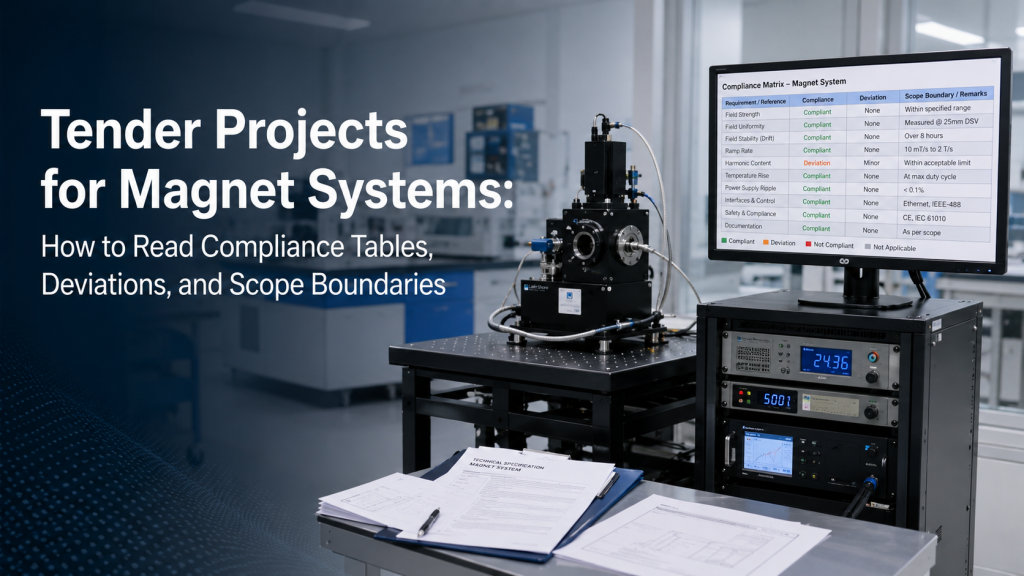
Tender projects for magnet systems are not only about comparing prices.
For formal procurement, buyers often need to review compliance tables, deviation lists, technical schedules, scope boundaries, acceptance documents, and supplier responses. This is especially common for electromagnets, Helmholtz coil systems, Hall effect systems, VSM, MOKE, magnetic field platforms, and other research instruments with detailed technical requirements.
A weak tender response may look attractive at first because the price is low. But if the compliance table is unclear, deviations are hidden, or important items are excluded from the scope, the project can become difficult after award.
This article explains how technical teams, procurement officers, distributors, and system integrators can read magnet system tender documents more carefully before making a supplier decision.
1. Why Tender Projects Are Different from Simple Quotations
A normal quotation may only need a price, delivery time, and basic specification.
A tender project is different.
It usually requires a structured response to:
- Technical specifications
- Mandatory requirements
- Optional requirements
- Compliance tables
- Deviation statements
- Scope of supply
- Installation responsibilities
- Acceptance criteria
- Warranty terms
- Training scope
- Documentation requirements
- Delivery and logistics conditions
- Payment and contractual terms
For magnet systems, this matters because the equipment often includes multiple subsystems:
- Magnet or coil
- Power supply or driver
- Cooling system
- Field probe or gaussmeter
- Sample holder or fixture
- Control software
- Computer or communication interface
- Safety interlock
- Test report
- User manual
- Installation support
- Training or remote guidance
A supplier may be compliant on the magnet itself but not on the full system scope.
That is why tender review must go beyond the headline specification.
2. What a Compliance Table Really Means
A compliance table is a structured way to compare the supplier’s offer against the buyer’s requirements.
It usually includes rows such as:
- Requirement number
- Tender requirement
- Supplier response
- Compliant / partially compliant / not compliant
- Remarks
- Supporting document reference
For magnet projects, a compliance table may cover:
- Maximum magnetic field
- Field uniformity
- Sample space
- Temperature range
- Current stability
- Software functions
- Safety features
- Cooling method
- Test report
- Warranty
- Delivery schedule
- Installation and training
A compliance table should not be treated as a formality.
It is the technical map of what the supplier is actually promising.
3. “Compliant” Does Not Always Mean the Same Thing
One of the biggest mistakes in tender review is assuming every “Compliant” answer has the same value.
It does not.
A supplier may write “Compliant” when they mean:
- Fully compliant as specified
- Compliant with a different method
- Compliant under limited conditions
- Compliant only with optional accessories
- Compliant after customization
- Compliant in principle, but not verified
- Compliant based on calculation, not measurement
For example, if the tender asks for:
“Magnetic field: 1 T at 30 mm pole gap, continuous operation.”
A weak response may say:
“Compliant. Magnet can reach 1 T.”
A stronger response should say:
“Compliant. The system can provide 1 T at 30 mm pole gap under water-cooled continuous operation, with matched bipolar power supply. Field-current test data can be provided during FAT.”
The second response is much more useful because it defines the conditions.
4. Mandatory vs. Preferred Requirements
Tender documents often include both mandatory and preferred requirements.
These should be separated clearly.
Mandatory Requirements
Mandatory requirements usually define pass/fail conditions.
Examples:
- Minimum magnetic field
- Required sample space
- Required temperature range
- Required safety protection
- Required voltage standard
- Required documentation
- Required delivery terms
- Required warranty period
If a supplier cannot meet a mandatory requirement, the bid may be technically non-responsive.
World Bank procurement guidance uses the concept of a “substantially responsive” bid and treats major deviations differently from minor deviations when evaluating bids. This matters because technical omissions can affect whether a tender response is acceptable.
Preferred Requirements
Preferred requirements improve evaluation score but may not automatically disqualify a supplier.
Examples:
- Faster delivery
- Additional software features
- Extended warranty
- Extra sample holders
- More detailed reporting
- Future upgrade capability
- Local service options
A good compliance table should make this distinction clear.
5. How to Read a Deviation List
A deviation list explains where the supplier’s offer differs from the tender requirement.
This is not always negative.
A clear deviation list can actually make a supplier more trustworthy.
Common Deviation Types
For magnet systems, deviations may include:
- Field value slightly different from requested value
- Different cooling method
- Different power supply interface
- Different software platform
- Different sample holder design
- Longer delivery time
- Alternative acceptance test method
- Different warranty condition
- Remote installation instead of on-site installation
- Exclusion of local taxes, customs, or site preparation
The important point is not whether deviations exist.
The important point is whether they are clearly stated and technically acceptable.
6. Major Deviations vs. Minor Deviations
Not all deviations carry the same risk.
Major Deviations
Major deviations may affect the core function of the system.
Examples:
- Required field cannot be achieved
- Required uniformity cannot be met
- Required temperature range is not supported
- Required sample space is too small
- Required software control is missing
- Required safety feature is not included
- Required installation condition is not supported
- Required documentation cannot be provided
These deviations may make the offer unsuitable.
Minor Deviations
Minor deviations may be acceptable if they do not affect the core application.
Examples:
- Different connector model
- Slightly different cabinet size
- Alternative communication interface
- Equivalent power cable standard
- Different document format
- Small cosmetic difference
- Optional accessory offered separately
Procurement teams should not treat every deviation as a failure.
But they should understand which deviations affect the experiment.
7. Hidden Deviations Are More Dangerous Than Stated Deviations
A stated deviation can be evaluated.
A hidden deviation creates risk.
For example, a supplier may not clearly state that:
- Field uniformity is calculated, not measured
- Power supply is not included
- Cooling chiller is excluded
- Software only supports manual current control
- Training is remote only
- Field mapping is optional
- Sample fixture is not included
- Delivery does not include customs clearance
- Installation is not included
- Acceptance test is only visual inspection
These omissions can create disputes after award.
A serious tender response should make scope boundaries visible.
8. Scope of Supply: The Most Important Section After Price
The scope of supply defines what the buyer will actually receive.
For magnet projects, scope should be reviewed line by line.
Typical Scope Items
Check whether the offer includes:
- Magnet or coil body
- Power supply or current driver
- Cooling unit or chiller
- Cooling hoses and fittings
- Field probe or gaussmeter
- Sample holder
- Non-magnetic fixture
- Motion stage or turntable
- Control software
- Control computer
- Communication cables
- Power cables
- Safety interlock
- User manual
- Test report
- Packing list
- Spare parts
- Training
- Installation support
A quote that includes only the magnet is not comparable to a turnkey system quote.
This is where many tender price comparisons go wrong.
9. Technical Compliance Must Include Conditions
A technical requirement is not complete unless the conditions are clear.
Example: Electromagnet Field
Weak compliance:
“Compliant, field up to 1 T.”
Better compliance:
“Compliant, 1 T at 20 mm pole gap, DC operation, water cooling required, with matched power supply.”
Example: Helmholtz Coil Uniformity
Weak compliance:
“Compliant, high uniformity.”
Better compliance:
“Compliant, ±1% uniformity over a 100 mm cube around the coil center, based on design calculation and available for factory verification if included in FAT scope.”
Example: Hall System Temperature Range
Weak compliance:
“Compliant, variable temperature supported.”
Better compliance:
“Compliant, 80–400 K measurement range with temperature controller, sample holder, and software-controlled measurement sequence.”
The difference is not language style.
The difference is whether the buyer can understand the real operating condition.
10. Standards and Equivalent Solutions
Some tender documents mention standards, certifications, or equivalent requirements.
This can be useful, but it must be handled carefully.
CEN and CENELEC guidance on referencing standards in public procurement explains that standards can support procurement by helping define requirements, but they should be used in a way that supports competition and clear technical expectations.
For magnet systems, standards and references may relate to:
- Electrical safety
- EMC requirements
- calibration methods
- documentation format
- test procedures
- quality management
- measurement traceability
- material compatibility
- local installation rules
If a supplier offers an equivalent method, the compliance table should explain why it is technically equivalent.
“Equivalent” should not mean vague.
It should mean functionally and technically acceptable.
11. Acceptance Criteria: FAT, SAT, and Test Reports
Tender projects often require acceptance testing.
For magnet systems, this may include Factory Acceptance Test, Site Acceptance Test, or both.
FAT May Include
- Visual inspection
- coil resistance measurement
- insulation test
- maximum current test
- magnetic field test
- field-current curve
- cooling test
- software communication test
- safety check
- packing inspection
- FAT report
SAT May Include
- Unpacking inspection
- site installation verification
- power and cooling connection
- software startup
- basic field verification
- integration with local equipment
- user training
- SAT report
If FAT or SAT is required, the compliance table should state:
- What will be tested
- Where it will be tested
- Who performs the test
- What instruments are used
- What pass/fail criteria apply
- What documentation will be delivered
A tender response that says “FAT included” without test items is incomplete.
12. Documentation Scope Is Part of Compliance
Formal buyers often need documents for internal approval, equipment registration, acceptance, and future use.
Common Required Documents
Tender projects may request:
- Technical proposal
- compliance table
- deviation list
- official quotation
- datasheet
- brochure
- drawings
- system configuration list
- user manual
- wiring diagram
- installation guide
- FAT report
- calibration or test report
- warranty statement
- certificate of origin
- packing list
- service and maintenance instructions
For complex instruments such as VSM, MOKE, Hall systems, electromagnets, and Helmholtz coil platforms, documentation can be as important as hardware.
If a document is required by the tender but not included in the offer, that should be treated as a scope issue.
13. Installation and Site Preparation Boundaries
Tender documents often underestimate installation responsibilities.
For exported magnet systems, the buyer and supplier should clarify:
- Who prepares the site?
- Who provides power supply input?
- Who provides cooling water or chiller?
- Who handles local lifting and placement?
- Who connects the system?
- Who performs grounding?
- Who verifies environmental conditions?
- Who handles customs clearance?
- Who pays import duties and taxes?
- Who provides operator training?
- Is support remote or on-site?
For formal procurement, these boundaries should be written, not assumed.
A system can be technically compliant but still fail installation because site responsibilities were unclear.
14. Software Scope: A Common Tender Trap
Software requirements are often written too broadly.
A tender may say:
“Software control required.”
But this can mean many different things.
Software Functions to Clarify
For magnet systems, software may include:
- Manual current control
- field unit input
- field-current conversion
- sweep control
- waveform generation
- three-axis vector control
- data logging
- report export
- instrument synchronization
- temperature control integration
- API interface
- LabVIEW or Python compatibility
- user permissions
- alarm logging
A supplier may be compliant with basic software control but not with advanced automation.
The compliance table should specify which functions are included.
15. Training Scope: Basic Operation or Full Method Transfer?
Training is another area where scope can be unclear.
Tender projects may request “training,” but this can mean:
- Basic operation guidance
- software introduction
- safety training
- sample mounting training
- maintenance training
- calibration workflow training
- method development
- advanced data analysis
For Hall, VSM, and MOKE systems, method training can be much broader than operation training.
A supplier may provide basic system operation, but not full scientific method development.
This boundary should be clear before award.
16. Commercial Terms Can Affect Technical Risk
Tender review often separates technical and commercial sections.
That is useful, but commercial terms can still affect technical risk.
Important terms include:
- Delivery term
- freight responsibility
- insurance
- customs clearance
- payment schedule
- warranty period
- warranty exclusions
- spare parts
- installation cost
- on-site service cost
- response time
- validity period
- production lead time
For example, if the offer is EXW, the buyer may need to handle international transport, customs, import taxes, and local delivery.
If the offer is DAP, the supplier may handle more logistics, but import duties and local customs responsibilities may still need clarification.
17. Why Low Price Can Hide High Scope Risk
In tender projects, the lowest price may win only if the scope is truly comparable.
A lower price may be caused by:
- Less powerful driver
- no chiller
- no fixture
- no software automation
- no test report
- no on-site support
- no field mapping
- shorter warranty
- weaker documentation
- excluded accessories
- longer delivery
- unverified assumptions
This does not mean the lowest price is always wrong.
It means procurement teams should compare “complete usable system cost,” not only equipment price.
18. How Technical Teams Should Review Compliance Tables
Technical teams should review compliance tables using three questions.
Question 1: Does It Meet the Requirement?
Check whether the supplier truly meets the stated requirement.
Look for exact numbers, conditions, and supporting data.
Question 2: Is the Compliance Conditional?
Check whether compliance depends on:
- optional accessory
- different configuration
- cooling condition
- reduced duty cycle
- smaller sample space
- longer lead time
- future customization
Conditional compliance may be acceptable, but it must be visible.
Question 3: Does the Response Match the Real Application?
Sometimes the supplier meets the written requirement but not the real use case.
For example, a magnet may reach the required field, but the pole gap is too small for the actual sample holder.
Tender review should connect the compliance table back to the experiment.
19. Practical Compliance Table Review Checklist
Use this checklist when reviewing magnet system tender responses.
Technical Specification
- Are field values clearly stated?
- Are gap, sample space, or coil opening defined?
- Is uniformity volume specified?
- Is duty cycle stated?
- Is cooling method included?
- Is power supply matched to the load?
- Is software scope clear?
- Are safety features included?
- Are fixtures included?
Deviation Review
- Are all deviations listed?
- Are deviations major or minor?
- Are equivalent solutions explained?
- Are assumptions clearly stated?
- Are optional items separated from standard scope?
- Are exclusions visible?
Acceptance Review
- Is FAT included?
- Is SAT included?
- Are test items defined?
- Are pass/fail criteria clear?
- Is field verification included?
- Is documentation included?
- Is training included?
Commercial Scope
- Is freight included?
- Are import duties excluded?
- Is installation included?
- Is warranty clear?
- Is support remote or on-site?
- Is delivery time realistic?
- Is payment term acceptable?
This checklist helps prevent tender decisions based only on price and attractive wording.
20. How Cryomagtech Supports Tender Projects for Magnet Systems
Cryomagtech supports tender-oriented projects for Magnet & Field Systems and related research instruments, including electromagnets, Helmholtz coils, Hall effect systems, VSM, MOKE-related magnetic field platforms, power supplies, fixtures, and system documentation.
For tender projects, we can support:
- Technical proposal preparation
- compliance table response
- deviation list clarification
- scope of supply definition
- optional item separation
- field requirement review
- power supply and cooling configuration
- fixture and installation boundary review
- FAT and test report discussion
- documentation package support
- delivery and warranty clarification
👉 Product link placeholder: Cryomagtech Magnet Systems for Tender and Formal Procurement Projects
A strong tender response should not hide complexity.
It should make the system boundary clear, so the buyer can compare offers fairly and select the supplier with the lowest technical risk—not only the lowest visible price.
References
- World Bank – Procurement Guidance: Evaluation Criteria
https://thedocs.worldbank.org/en/doc/201591478724669006-0290022017/original/ProcurementGuidanceEvaluationCriteria.pdf - CEN-CENELEC – Guide for Referencing Standards in Public Procurement
https://www.cencenelec.eu/media/CEN-CENELEC/Areas%20of%20Work/CEN%20sectors/Services/Quicklinks%20General/guide_standards_public_procurement_december2018.pdf - European Union – Public Tenders and Contracts
https://european-union.europa.eu/live-work-study/public-contracts_en
Key Takeaways
- Tender projects for magnet systems should be reviewed by scope, compliance, deviations, assumptions, and acceptance criteria—not price alone.
- A compliance table should explain the exact technical condition under which the supplier is compliant.
- Stated deviations are not automatically bad; hidden deviations are more dangerous.
- Scope of supply must clearly define whether power supply, cooling, software, fixtures, reports, training, and installation support are included.
- FAT, SAT, documentation, and training should be defined before award.
- A low price may reflect missing items rather than better value.
- Technical teams should connect every tender requirement back to the real experiment and installation conditions.
For tender projects, the key question is not only:
“Which supplier says compliant?”
The better question is:
“Which supplier clearly explains compliance, deviations, scope boundaries, and acceptance responsibility?”