
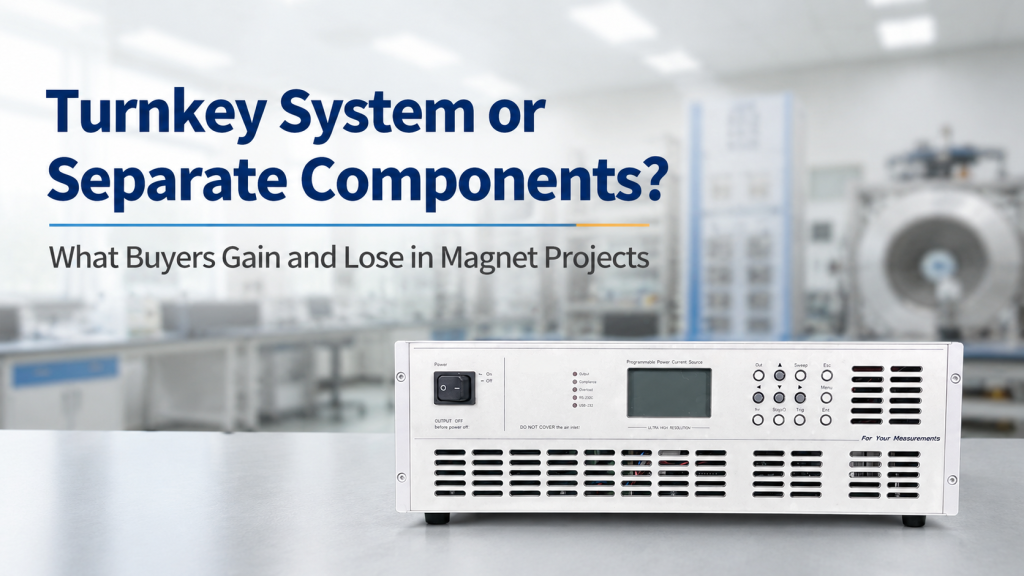
When buyers plan a magnet project, one of the first commercial decisions is not only technical.
It is this:
“Should we buy a turnkey magnet system, or should we purchase the coil, power supply, control software, fixtures, and accessories separately?”
Both approaches can work.
A turnkey system can reduce integration risk and speed up installation. Separate components can provide more flexibility and sometimes lower upfront cost. But each option shifts responsibility in a different direction.
This article explains what buyers gain and lose when choosing between turnkey magnet systems and separate components, especially for Helmholtz coil, electromagnet, magnetic field driver, control, fixture, and testing-report projects.
1. What Is a Turnkey Magnet System?
A turnkey magnet system is delivered as an integrated solution rather than isolated parts.
Depending on the project, it may include:
- Electromagnet or Helmholtz coil
- Matched power supply or current driver
- Cooling system
- Control software
- Communication interface
- Mechanical frame
- Sample fixture
- Non-magnetic holder
- Cables and connectors
- Safety protection
- Field measurement or calibration report
- Factory acceptance test
- User manual
- Training or installation guidance
The key point is not that every possible accessory is included.
The key point is that the supplier takes more responsibility for system compatibility.
2. What Does “Separate Components” Mean?
Buying separate components means the buyer or integrator selects individual parts and makes them work together.
For example, the buyer may purchase:
- A coil from one supplier
- A power supply from another supplier
- A chiller from a local vendor
- A turntable from a motion-control supplier
- Software written internally
- Fixtures made by the university workshop or machine shop
- Magnetic field verification done by the user
This approach can be effective when the buyer has strong internal engineering capability.
But it also means the buyer owns more of the integration risk.
In magnet projects, “component price” and “system cost” are not the same thing.
3. Why This Decision Matters in Magnet Projects
Magnet projects are interface-heavy.
The coil, driver, cooling, control, fixture, and measurement workflow all affect each other.
For example:
- Coil resistance affects power supply voltage requirement
- Coil inductance affects response speed
- Cooling affects duty cycle and field stability
- Fixture material affects magnetic cleanliness
- Software affects repeatability
- Cable routing affects noise and safety
- Field verification affects acceptance confidence
This is why system integration matters.
IEEE’s Transactions on Components, Packaging and Manufacturing Technology covers topics including design, physical testing, reliability, and integration in systems and constituent micro-systems, which reflects a broader engineering reality: components must be evaluated not only individually, but also as parts of a working system.
Reference link: https://eps.ieee.org/publications/ieee-transactions-on-cpmt/
4. What Buyers Gain with a Turnkey System
A turnkey system usually costs more upfront, but it can reduce hidden cost and hidden risk.
Better Compatibility
The coil and power supply can be matched for:
- Current range
- Voltage headroom
- Coil resistance
- Coil inductance
- Thermal load
- Continuous operation
- Bipolar operation
- Control interface
This matters because a power supply that looks strong enough by current rating may still fail if voltage headroom, noise, or stability is not suitable.
Faster Project Start
A turnkey system can reduce the time spent on:
- Selecting compatible components
- Designing cables
- Writing control logic
- Building fixtures
- Troubleshooting driver communication
- Checking thermal limits
- Verifying field output
For buyers with limited engineering time, this may be more valuable than saving money on individual components.
Clearer Responsibility
If the system does not perform as expected, the buyer can ask one supplier to investigate the complete system.
This is often easier than hearing:
- The coil supplier blames the power supply
- The power supply supplier blames the load
- The software supplier blames the communication interface
- The fixture supplier blames the user installation
- The user team spends weeks finding the real cause
A turnkey approach reduces the “interface blame gap.”
Better Documentation
Turnkey delivery can include:
- System configuration sheet
- Wiring diagram
- Operation manual
- Calibration or test report
- Acceptance test procedure
- Safety notes
- Software instructions
- Maintenance recommendations
For universities, companies, and internal procurement teams, documentation is often not optional. It supports project review, training, acceptance, and future maintenance.
5. What Buyers Lose with a Turnkey System
A turnkey system is not always the best choice.
Buyers may lose some flexibility.
Higher Upfront Cost
A turnkey quotation may look more expensive because it includes:
- Integration work
- Testing time
- Documentation
- cables and accessories
- software configuration
- engineering support
- risk responsibility
A component-only quotation may look cheaper because many of these items are not included.
The danger is comparing the two prices as if they cover the same scope.
They often do not.
Less Freedom to Choose Every Brand
Some buyers prefer specific brands for:
- Power supplies
- Motion stages
- Chillers
- Controllers
- Data acquisition
- Software platform
A turnkey supplier may recommend a standard configuration for reliability and support.
This can reduce choice, although it may also reduce compatibility risk.
Possible Over-Specification
A turnkey system may include features the buyer does not truly need.
For example:
- Full software control when manual control is enough
- High-current driver when the test is low-field only
- Custom fixture when the user already has one
- Field report beyond what the application requires
A serious buyer should ask what is included and why.
Turnkey should mean integrated, not inflated.
6. What Buyers Gain with Separate Components
Buying separate components can be attractive for experienced teams.
Lower Initial Purchase Cost
If the buyer already owns some parts, separate purchasing may reduce cost.
For example:
- Existing DC power supply
- Existing chiller
- Existing LabVIEW or Python control system
- Internal machine shop
- Existing non-magnetic fixtures
- Existing magnetic field probe
- Existing motion stage
In this case, buying only the missing components may be reasonable.
More Technical Flexibility
Separate components allow the buyer to:
- Choose preferred brands
- Modify the system later
- Integrate with existing lab infrastructure
- Use internal software
- Build custom fixtures
- Upgrade one part without replacing the full system
This can be valuable for research labs with strong engineering capability.
Easier Local Maintenance
Some buyers prefer local sourcing for items such as:
- Chillers
- standard cables
- connectors
- mechanical brackets
- control computers
- safety switches
This can make maintenance easier if the local team knows the system well.
7. What Buyers Lose with Separate Components
Separate components create hidden responsibilities.
Integration Risk
The buyer must make sure all parts work together.
This includes:
- Electrical compatibility
- Mechanical compatibility
- thermal compatibility
- communication compatibility
- software compatibility
- safety compatibility
- performance verification
Each interface becomes the buyer’s problem.
Integrated system testing is widely recognized as important because individual components can work correctly on their own while still failing to function properly together as a complete system. A system integration test program from Sound Transit describes system integration testing as a key phase used to validate that all elements function properly together as an integrated system.
Reference link: https://www.soundtransit.org/sites/default/files/documents/system-integration-test-program-rev-1-july-2022.pdf
The industry is different, but the principle is the same.
In magnet projects, component success does not guarantee system success.
More Engineering Time
Separate purchasing often requires extra time for:
- Selecting components
- confirming specifications
- designing interfaces
- writing software
- debugging communication
- testing thermal performance
- verifying magnetic field output
- documenting the final setup
This time may not appear in the purchase order, but it still costs money.
Unclear Acceptance Criteria
If the buyer buys components separately, acceptance becomes harder.
What exactly is being accepted?
- Coil resistance?
- Maximum current?
- Center field?
- Field uniformity?
- Software control?
- continuous duty cycle?
- field stability over time?
- complete calibration workflow?
Without a complete system acceptance plan, buyers may receive all components but still not have a working test setup.
8. The Coil and Power Supply Should Not Be Treated Separately
In magnet projects, the coil and power supply are the most important pair.
They should be matched carefully.
Coil Parameters That Affect Power Supply Selection
The power supply depends on:
- Coil resistance
- Coil inductance
- Required current
- Required field strength
- DC or AC operation
- sweep speed
- duty cycle
- cooling method
- bipolar or unipolar output
- continuous operation time
Power Supply Parameters That Affect System Performance
The final field depends on:
- current stability
- current resolution
- output voltage
- output noise
- thermal drift
- communication interface
- protection functions
- response speed
A buyer who selects a coil first and power supply later may discover that the driver is oversized, undersized, noisy, too slow, or too expensive.
For serious magnet projects, coil and power supply selection should be handled as one engineering decision.
9. Fixtures Are Not Just Accessories
Many buyers underestimate fixtures.
A fixture may look simple, but in magnetic testing it can affect:
- sample position
- sensor alignment
- repeatability
- magnetic cleanliness
- cable routing
- thermal contact
- optical access
- rotation accuracy
A poor fixture can ruin a good coil system.
Turnkey Fixture Advantage
In a turnkey project, the fixture can be designed around:
- coil geometry
- uniform region
- sensor size
- sample access
- non-magnetic material requirement
- cable path
- calibration workflow
Separate Fixture Risk
If the fixture is made later by another team, it may introduce:
- magnetic screws
- incorrect height
- poor centering
- tilt error
- blocked access
- unstable cable routing
- repeatability problems
For calibration projects, the fixture is part of the measurement chain.
Treating it as a minor accessory is a mistake.
10. Software and Control Scope Must Be Defined Early
Software can be simple or complex.
A magnet system may require:
- manual current control
- PC current setting
- magnetic field unit input
- three-axis vector control
- field sequence programming
- data logging
- external trigger
- API integration
- LabVIEW or Python support
- closed-loop feedback
- safety interlock monitoring
In a turnkey system, software scope should be defined clearly.
In a component-based system, the buyer must decide who writes, tests, and maintains the control logic.
The dangerous assumption is:
“The hardware is here, so software will be easy.”
Sometimes it is.
Often it is not.
11. Test Reports and Acceptance: What Should Be Included?
For magnet projects, test reports can reduce uncertainty.
Depending on the project, reports may include:
- coil resistance
- insulation check
- maximum current test
- field strength test
- field-current relationship
- uniformity mapping
- temperature rise test
- driver output test
- software communication test
- system operation photos
- factory acceptance test summary
NIST’s role in advancing measurement science, standards, and technology highlights why measurement confidence and documentation matter in technical procurement and calibration-related work.
Reference link: https://www.nist.gov/
A test report does not automatically make a system perfect.
But it gives the buyer a baseline for acceptance, troubleshooting, and future comparison.
12. When a Turnkey Magnet System Is the Better Choice
A turnkey system is usually better when:
- The buyer wants one accountable supplier
- The project has a strict timeline
- The user team has limited integration time
- The system includes software control
- Field uniformity or stability must be verified
- The fixture affects calibration results
- The buyer needs documentation for internal approval
- Multiple subsystems must work together
- Training or handover is important
- The project is for production or routine testing
Typical examples include:
- Sensor calibration systems
- three-axis Helmholtz coil systems
- electromagnet with power supply and cooling
- geomagnetic simulation systems
- university shared-lab platforms
- industrial magnetic test stations
- production calibration fixtures
In these cases, the buyer is not only buying hardware.
They are buying reduced integration risk.
13. When Separate Components May Be the Better Choice
Separate components may be better when:
- The buyer has strong internal engineering capability
- Some components already exist
- The application is exploratory
- budget is very limited
- the system will be modified frequently
- software will be written internally
- local sourcing is required
- acceptance requirements are simple
- the buyer understands integration risks
Typical examples include:
- early-stage research prototypes
- teaching lab setups
- internal engineering experiments
- low-field single-axis tests
- projects with existing power supplies and fixtures
In these cases, component purchasing can make sense.
But the buyer should be honest about the hidden workload.
14. Practical RFQ Questions Before Choosing a Route
Before deciding turnkey or separate components, buyers should ask:
Application
- What is the system used for?
- Is this R&D, calibration, production, or teaching?
- Is repeatability critical?
Magnetic Performance
- Required field range?
- Required uniformity?
- Required stability?
- one-axis, two-axis, or three-axis?
- DC, AC, sweep, or waveform?
Integration
- Who selects the power supply?
- Who designs the fixture?
- Who writes the software?
- Who verifies field performance?
- Who handles troubleshooting?
Documentation
- Is a test report required?
- Is a calibration report needed?
- Is internal procurement review involved?
- Is user training required?
- Is an operation manual enough?
Commercial Decision
- Is the goal lowest component price?
- Or lowest project risk?
- Is the internal team available for integration?
- What is the cost of delay?
- Who owns final system performance?
These questions often reveal the right buying path.
15. How Cryomagtech Supports Turnkey and Component-Based Magnet Projects
Cryomagtech supplies magnet systems and related components for research, calibration, and industrial testing applications.
Depending on project scope, we can support:
- Electromagnets
- Helmholtz coils
- magnetic field drivers
- precision power supplies
- cooling configuration
- control software
- fixtures and mechanical structures
- cables and accessories
- field testing support
- factory test reports
- user operation guidance
👉 Product link placeholder: Cryomagtech Turnkey Magnet Systems and Components
For some projects, a complete turnkey package is the safest path.
For others, a component-based approach is more practical.
The key is to define the responsibility boundary before quotation, not after delivery.
References
- IEEE Electronics Packaging Society – IEEE Transactions on Components, Packaging and Manufacturing Technology
https://eps.ieee.org/publications/ieee-transactions-on-cpmt/ - Sound Transit – System Integration Test Program
https://www.soundtransit.org/sites/default/files/documents/system-integration-test-program-rev-1-july-2022.pdf - NIST – National Institute of Standards and Technology
https://www.nist.gov/
Key Takeaways
- A turnkey magnet system reduces integration risk but usually costs more upfront.
- Separate components may reduce initial cost but shift compatibility, testing, and troubleshooting responsibility to the buyer.
- Coil, power supply, cooling, software, fixture, and test reports should be evaluated as one system.
- Component price and total project cost are not the same thing.
- The right choice depends on internal engineering capability, timeline, documentation needs, and performance risk.
- Buyers should define responsibility boundaries clearly before requesting a quotation.
For magnet projects, the most important question is not only:
“How much does each component cost?”
The better question is:
“Who is responsible for making the full magnet system work reliably in the real application?”