
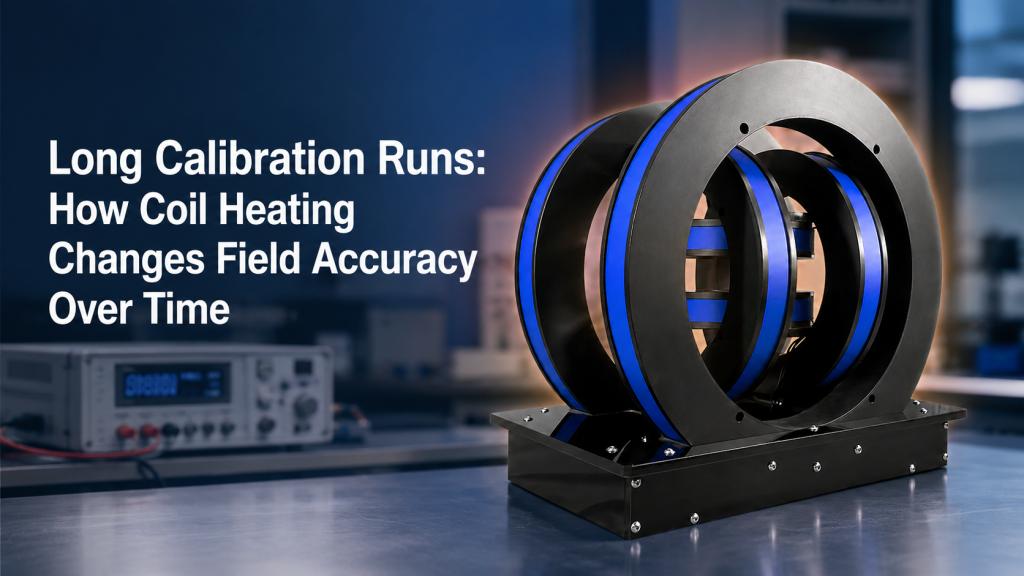
In short magnetic tests, users often focus on the initial field value:
“We set the coil to 100 µT, 1 mT, or 10 mT. Is the field correct?”
For long calibration runs, that is not enough.
When a Helmholtz coil operates for 30 minutes, 2 hours, or a full working day, coil heating can change resistance, driver load, current stability, thermal drift, and field accuracy over time.
For magnetometer calibration, compass testing, IMU validation, and sensor production testing, long-term stability may matter more than the field value measured at the beginning of the test.
This article explains how coil heating affects field accuracy, why the power supply matters, and what users should define before selecting a Helmholtz coil and driver for long calibration runs.
1. Why Long Calibration Runs Are Different from Short Tests
A short test may last only a few seconds or minutes.
A long calibration run may last:
- 30 minutes
- 1–2 hours
- 4–8 hours
- Multiple automated test cycles per day
- Continuous operation for production testing
In long runs, the system does not stay thermally unchanged.
The coil warms up.
The copper resistance changes.
The driver operates under a changing load.
The surrounding temperature may change.
The sensor and fixture may also drift.
That is why long-run calibration should be treated as a thermal stability problem, not only a magnetic field generation problem.
2. Why Coil Heating Happens
A Helmholtz coil generates magnetic field by passing current through copper windings.
Current creates heat due to electrical resistance.
The basic relationship is simple:
- Higher current creates more heat
- Longer operation gives more time for temperature rise
- Larger coils may need more power for the same field
- Compact high-field coils may heat quickly
- Poor ventilation increases temperature rise
In a Helmholtz coil, the magnetic field is typically proportional to the coil current when the geometry is fixed and the system operates within its normal range. Lake Shore’s Helmholtz coil application note states that magnetic flux density or field strength is directly proportional to the applied current in the coils.
Reference link: https://www.lakeshore.com/docs/default-source/product-downloads/manuals/f011-05-00.pdf
This means current stability is central to field stability.
But during long operation, temperature changes make current control and system stability more demanding.
3. Copper Resistance Changes with Temperature
Most Helmholtz coils use copper conductors.
Copper resistance increases as temperature rises. According to NIST copper wire tables, the temperature coefficient for copper of 100% conductivity at 20°C is about 0.00393 per °C.
Reference link: https://www.govinfo.gov/content/pkg/GOVPUB-C13-0623ad8ee79f1b1d92b7a3d7465714eb/pdf/GOVPUB-C13-0623ad8ee79f1b1d92b7a3d7465714eb.pdf
In practical terms:
- A 10°C coil temperature rise can increase resistance by about 3.9%
- A 20°C rise can increase resistance by about 7.9%
- A 30°C rise can increase resistance by about 11.8%
This matters because the power supply must maintain the required current while the coil resistance changes.
Example
If a coil starts at 10 Ω and warms by 20°C, its resistance may rise to about 10.8 Ω.
To maintain the same current, the driver must provide more voltage.
If the driver has enough voltage headroom, the current can remain stable.
If the driver reaches its voltage limit, the current may drop, and the magnetic field will drift.
4. Constant Current Control vs. Constant Voltage Control
For magnetic calibration, constant current operation is usually preferred.
Why?
Because for a fixed coil geometry, magnetic field depends mainly on current.
Constant Current Driver
A good constant current driver tries to keep the current stable even when coil resistance changes.
This helps maintain:
- Field stability
- Repeatability
- Long-run consistency
- Predictable calibration data
Constant Voltage Driver
A constant voltage source applies a fixed voltage.
If coil resistance rises due to heating, current decreases.
That means the magnetic field can decrease over time.
For serious calibration runs, this is usually not acceptable unless the system is designed and corrected carefully.
5. Driver Voltage Headroom: The Hidden Long-Run Requirement
Many users check only the driver’s maximum current.
That is a mistake.
For long calibration runs, voltage headroom is also important.
The driver must provide enough voltage to maintain current when the coil becomes warm.
What Can Go Wrong
If the coil resistance rises and the driver voltage limit is too low:
- Current may slowly decrease
- Field strength may drift
- Calibration data may shift over time
- Repeatability may degrade
- The system may pass a short test but fail a long test
This is why Helmholtz coil and power supply selection should be done together.
A coil that looks suitable on paper may not perform well with an undersized driver.
6. Field Drift During Long Runs
Field drift means the generated magnetic field changes over time.
In long calibration runs, field drift may come from:
- Coil heating
- Driver current drift
- Ambient temperature change
- Sensor drift
- Mechanical expansion
- Cable resistance change
- Background magnetic field changes
- Nearby equipment turning on or off
For low-field calibration, even small drift can matter.
For example, in Earth-field-level testing, the target field may be only tens of microtesla. A drift of a few tenths of a microtesla may already affect sensitive calibration results.
This is why field accuracy should not only be specified as an initial value.
It should be specified over time.
7. Warm-Up Strategy: Why Starting Immediately Can Be Risky
Some calibration errors happen because the test begins before the coil and driver reach a stable thermal condition.
During the early part of operation, temperature may rise quickly.
As the coil warms, the system may move from a cold condition to a warm steady state.
Practical Warm-Up Approach
For long calibration runs, users may consider:
- Preheating the coil at the target current
- Allowing the system to reach thermal equilibrium
- Measuring field after warm-up
- Recording current and coil temperature
- Starting calibration only after drift becomes acceptable
This does not mean every application needs a long warm-up.
But serious calibration projects should at least test whether warm-up affects the result.
8. Duty Cycle: Continuous Operation Is Not Automatic
A coil may be able to reach a field target for a short time.
That does not mean it can maintain the same field continuously.
Duty cycle describes how long the system can operate at a given current or field level without exceeding thermal limits.
Important Duty-Cycle Questions
Users should define:
- Required field level
- Continuous operation time
- Ambient temperature
- Cooling conditions
- Allowed temperature rise
- Recovery time between runs
- Daily operating schedule
Example
A coil may reach 10 mT for a short test, but continuous 10 mT operation for 6 hours may require:
- Larger wire
- Lower resistance design
- Forced air cooling
- Water cooling
- A higher-capacity driver
- Thermal monitoring
- Reduced operating current
Without duty-cycle information, a quotation can easily be under-designed.
9. Air Cooling, Water Cooling, and Thermal Stability
Cooling method affects long-run field stability.
Natural Air Cooling
Natural air cooling is simple and quiet.
It may be suitable for:
- Low-field applications
- Intermittent testing
- Short calibration sequences
- Low-power coil systems
But it may not be enough for high-current continuous operation.
Forced Air Cooling
Forced air cooling improves heat removal.
It may support:
- Moderate continuous operation
- Higher duty cycle
- Better thermal recovery
But fans can introduce:
- Acoustic noise
- Vibration
- Airflow disturbance
- Dust movement
For sensitive sensor calibration, fan placement and vibration should be considered.
Water Cooling
Water cooling provides stronger heat removal.
It may be needed for:
- Higher-field operation
- Long-duration testing
- High duty cycle
- Better thermal stability under load
But it adds:
- Chiller or cooling loop requirements
- Hoses
- Flow monitoring
- Water quality management
- Maintenance responsibility
The right cooling method depends on the required field, run time, noise limits, and lab infrastructure.
10. Power Supply Stability Is Part of Field Accuracy
A stable coil is not enough if the driver is unstable.
For long calibration runs, the power supply should be evaluated by:
- Current stability
- Current resolution
- Temperature drift
- Output noise
- Long-term regulation
- Voltage headroom
- Thermal protection
- Communication stability
- Multi-axis synchronization
For three-axis Helmholtz coil systems, the issue becomes even more important.
Each axis may heat differently.
Each driver channel may have different load conditions.
Vector field accuracy depends on all axes staying stable together.
11. Coil Temperature Monitoring
For long calibration runs, temperature monitoring can help users understand and control drift.
Possible monitoring points include:
- Coil winding temperature
- Coil frame temperature
- Ambient temperature
- Driver temperature
- Cooling water inlet and outlet temperature
- Chiller temperature
- Sensor fixture temperature
Temperature data helps answer practical questions:
- How long does the coil take to stabilize?
- Does the field drift correlate with coil temperature?
- Is the cooling method sufficient?
- Does the test need a warm-up period?
- Is the system operating near its thermal limit?
For production calibration, temperature logging can also improve process traceability.
12. Open-Loop vs. Closed-Loop Field Control
Many Helmholtz coil systems operate in open-loop current control.
That means the system sets current, and the magnetic field is calculated from coil geometry and calibration.
This can work well when:
- The coil constant is known
- Current is stable
- Temperature effects are acceptable
- The environment is magnetically stable
- The application does not require real-time field correction
When Closed-Loop Control May Be Useful
Closed-loop field control uses a magnetic field sensor to measure the actual field and adjust the output.
It may be useful when:
- Long-term drift must be minimized
- Background field changes
- Higher accuracy is required
- Multi-axis field correction is needed
- The system is used for precision sensor calibration
However, closed-loop control also requires careful sensor placement, sensor calibration, and control strategy.
It is not automatically better unless implemented correctly.
13. Practical RFQ Questions for Long Calibration Runs
Before requesting a Helmholtz coil and power supply quotation, users should define the long-run operating conditions.
Magnetic Requirements
- Field range per axis
- Required field accuracy
- Required field stability over time
- Uniform region size
- One-axis, two-axis, or three-axis control
- DC, sweep, or waveform operation
Time and Duty Cycle
- Test duration per run
- Number of runs per day
- Continuous or intermittent operation
- Required warm-up time, if known
- Recovery time between runs
- Maximum allowed temperature rise
Driver Requirements
- Constant current operation
- Current stability
- Current resolution
- Voltage headroom
- Bipolar output
- Communication interface
- Long-term operating rating
- Protection functions
Thermal Requirements
- Natural air, forced air, or water cooling
- Fan noise limitations
- Ambient temperature range
- Coil temperature monitoring
- Cooling water or chiller availability
- Thermal safety interlocks
Calibration Workflow
- Manual or automated calibration
- Data logging
- Background field measurement
- Field verification sensor
- Long-run drift acceptance criteria
- Calibration report requirements
A quotation based on these details will be much more useful than a simple request for “a Helmholtz coil price.”
14. How Cryomagtech Supports Long-Run Calibration Systems
Cryomagtech supplies Helmholtz coil systems and matched power supplies for magnetic calibration, geomagnetic simulation, sensor testing, and long-duration laboratory measurements.
For long calibration runs, we help evaluate:
- Coil field range
- Required uniform region
- Driver current and voltage margin
- Current stability and resolution
- Coil heating and duty cycle
- Cooling method
- Warm-up strategy
- Three-axis field control
- Field verification and monitoring requirements
👉 Product link placeholder: Cryomagtech Helmholtz Coil Systems and Precision Power Supplies
For long-run calibration, the coil and power supply should not be selected separately.
They must be designed as one thermal, electrical, and magnetic system.
References
- Lake Shore Cryotronics – Helmholtz Coil Application Note
https://www.lakeshore.com/docs/default-source/product-downloads/manuals/f011-05-00.pdf - NIST / GovInfo – Copper Wire Tables and Temperature Coefficient
https://www.govinfo.gov/content/pkg/GOVPUB-C13-0623ad8ee79f1b1d92b7a3d7465714eb/pdf/GOVPUB-C13-0623ad8ee79f1b1d92b7a3d7465714eb.pdf
Key Takeaways
- Long calibration runs are affected by coil heating, copper resistance change, driver stability, and thermal drift.
- Magnetic field is mainly controlled by current, so constant current operation is usually preferred for calibration.
- Copper resistance increases with temperature, so driver voltage headroom matters during long operation.
- A coil that reaches the target field briefly may not support continuous operation at that field.
- Warm-up strategy, duty cycle, cooling method, and temperature monitoring should be considered before quoting or purchasing.
- Helmholtz coil and power supply selection should be treated as one integrated system.
For long calibration runs, the most important question is not only:
“Can the coil reach the target field?”
The better question is:
“Can the coil and power supply maintain the required field accuracy over the full calibration time?”