
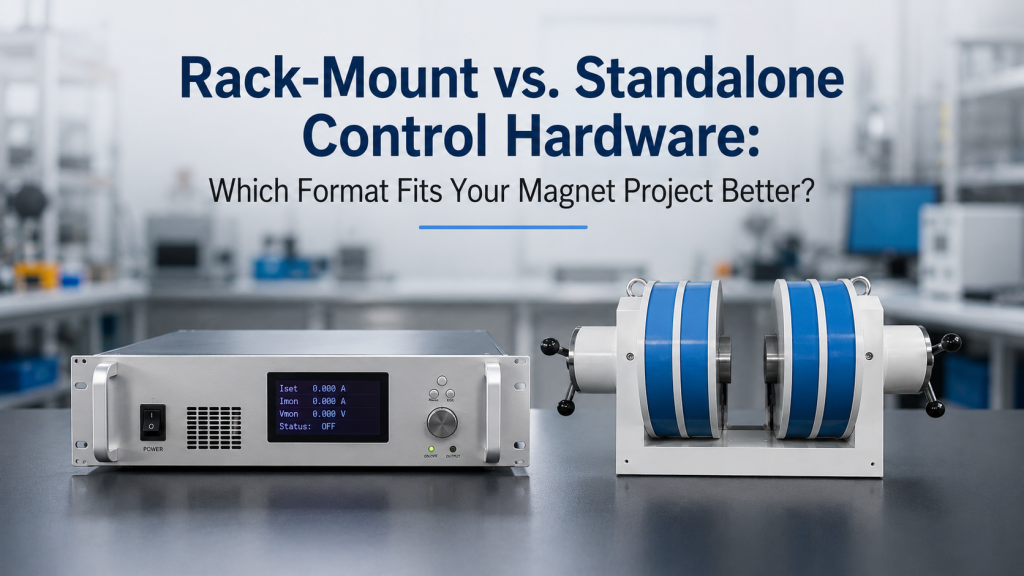
When buying a magnet system, many customers focus first on the magnet or coil:
- Electromagnet
- Helmholtz coil
- 3-axis magnetic field system
- Excitation power supply
- Chiller
- Field sensor
- Control software
But one practical question often appears during system integration:
“Should the control hardware be rack-mounted or standalone?”
This is not only a packaging choice.
The hardware format affects installation space, cooling, cable routing, maintenance, future expansion, system mobility, and integration with existing laboratory platforms.
For magnet projects involving power supplies, controllers, field monitoring, interlocks, and software-based operation, choosing the right format can make the difference between a clean installation and a difficult daily workflow.
This article explains how to choose between rack-mount and standalone control hardware for laboratory magnet systems.
1. What Is Rack-Mount Control Hardware?
Rack-mount hardware is designed to be installed in a standardized equipment rack, commonly a 19-inch rack.
A 19-inch rack is a standardized frame or enclosure used to mount multiple electronic equipment modules. Equipment height is usually measured in rack units, where one rack unit is 1.75 inches high. This format is widely used for computer servers, telecom equipment, professional audio, and scientific equipment.
For magnet systems, rack-mounted hardware may include:
- Excitation power supply
- Bipolar power supply
- Magnet controller
- DAQ module
- Interlock module
- Field meter interface
- Temperature controller
- Chiller communication module
- Industrial computer
- Ethernet switch
- Power distribution unit
- Emergency stop interface
Rack-mount control hardware is often suitable when the magnet system needs to become part of a larger laboratory platform.
2. What Is Standalone Control Hardware?
Standalone hardware is designed as a separate unit, cabinet, desktop instrument, floor-standing controller, or integrated control box.
It does not require a rack.
Standalone control hardware may include:
- Benchtop power supply
- Floor-standing power supply
- Compact controller box
- Touchscreen control unit
- Integrated magnet control cabinet
- Dedicated chiller controller
- Portable test controller
- Custom control enclosure
Standalone format is often easier for laboratories that do not already have rack infrastructure.
It may also be better when the system needs to be moved, installed quickly, or operated as a self-contained package.
3. The First Question: Is This a Platform or a Standalone Experiment?
The format decision should start with the project type.
Ask:
“Is the magnet system part of a larger platform, or is it an independent experiment?”
Rack-mount format is often better when:
- The lab already uses equipment racks
- Multiple instruments must be integrated
- The system needs centralized cable management
- The project is part of ATE, calibration, or production test
- The customer wants scalable expansion
- The system has multiple power supply channels
- The lab needs clean installation and documentation
Standalone format is often better when:
- The system is used by one research group
- The lab has limited rack infrastructure
- The unit may be moved between benches
- The project is smaller or lower power
- Users want direct front-panel access
- Installation must be simple
- The system should arrive as an easy-to-use package
Neither format is automatically better.
The right format depends on the real workflow.
4. Space Planning: Rack Density vs. Flexible Placement
Rack-mounted systems can save space when multiple instruments must be organized together.
A rack can hold several modules vertically, reducing bench clutter and keeping cables in a defined area. Rack enclosures are commonly used to organize hardware while reducing shelf or floor installation needs.
This is useful for:
- Multi-axis magnetic field systems
- Automated calibration platforms
- Production test benches
- Systems with several power supplies
- Systems with computer, DAQ, and communication modules
- Labs with fixed test stations
Standalone hardware may use more bench or floor space, but it can be easier to place near the user, magnet, or chiller.
This is useful when:
- The magnet is moved occasionally
- The lab layout changes
- The equipment is shared
- The control unit must sit close to the sample
- Users need simple physical access
A rack can make a system look organized, but only if the lab has room for the rack itself.
5. Cooling and Ventilation: Do Not Assume Rack-Mount Is Always Cleaner
Power supplies and control electronics generate heat.
Rack-mounted systems need proper airflow.
A common mistake is placing multiple heat-generating devices in a rack without checking ventilation. Rack systems may use different airflow patterns, such as front intake and rear exhaust, side intake, or passive cooling; there is no single universal airflow pattern for all rack-mounted equipment.
For magnet control hardware, check:
- Air intake direction
- Exhaust direction
- Rack ventilation
- Clearance between instruments
- Heat output from power supplies
- Ambient lab temperature
- Fan noise
- Dust filters
- Chiller heat exhaust nearby
- Whether rear access is blocked
Standalone units may be easier to ventilate if placed openly, but they can also be blocked by walls, shelves, or other instruments.
For high-power excitation power supplies, cooling and airflow should be confirmed before choosing the enclosure format.
6. Cable Management: Rack-Mount Can Help, but Only If Planned
Magnet systems often involve many cables:
- High-current magnet cables
- Sensor cables
- Communication cables
- Interlock cables
- Grounding cables
- Power input cables
- Chiller signal cables
- Ethernet or USB connections
- Emergency stop wiring
Rack mounting can make cable management cleaner if the system is planned well.
Benefits may include:
- Shorter internal cable paths between modules
- Clear rear-panel organization
- Cable trays
- Labeling
- Strain relief
- Easier documentation
- Cleaner operator area
But rack systems can become messy if cables are added without planning.
For high-current magnet systems, cable length, bend radius, connector access, and heat must still be considered.
Standalone systems may have fewer internal connections but may require longer external cables between instruments.
The cleanest format is not the one that looks neat in a brochure.
It is the one that supports the real cable path in the lab.
7. Maintenance Access: Front Panel vs. Rear Panel
Maintenance access is often overlooked.
Rack-mounted systems may require:
- Front access for controls and displays
- Rear access for cables and service
- Clearance to slide out modules
- Rack depth compatibility
- Enough space behind the rack
- Labeling for each connection
- Safe handling of heavy modules
Standalone systems may provide easier all-around access, especially if they can be moved or rotated.
But a large standalone cabinet may also require side and rear clearance.
Before choosing the format, ask:
- Can users reach the connectors?
- Can technicians replace cables?
- Can fans or filters be serviced?
- Can modules be removed safely?
- Is there enough space behind the system?
- Are high-current terminals protected but accessible?
Maintenance access matters more after delivery than during quotation.
8. Mechanical Support and Weight
Rack-mounted does not mean weightless.
Large power supplies, amplifiers, and control modules can be heavy. Some rack equipment may require rear support or 4-post mounting, because front-panel support alone can create bending stress on mounting brackets.
For magnet systems, check:
- Equipment weight
- Rack load rating
- Module depth
- Front and rear support
- Slide rail requirement
- Center of gravity
- Installation height
- Lifting method
- Whether one person can remove the unit safely
Standalone systems also require mechanical planning.
For floor-standing cabinets, check:
- Footprint
- Casters or leveling feet
- Floor load
- Tip-over risk
- Transport path
- Doorway clearance
- Vibration sensitivity
Heavy power hardware should never be treated as simple desktop electronics.
9. Integration with Existing Lab Platforms
Rack-mount format is often preferred when the customer already has:
- ATE rack
- Control rack
- DAQ rack
- Calibration station
- Industrial control cabinet
- Server-style equipment room
- Centralized instrument platform
This can make the magnet system easier to integrate with:
- PLC
- DAQ system
- Host computer
- Remote monitoring software
- Safety interlock system
- Existing power distribution
- Network switch
- Data logging platform
For engineering buyers, rack-mount hardware often looks more compatible with platform-level system design.
Standalone hardware may be better when the magnet system is not part of a larger control architecture and the customer wants a self-contained instrument.
10. Remote Monitoring and IT Control
Both rack-mount and standalone systems can support remote monitoring.
The difference is usually how cleanly the control hardware connects to the lab’s IT or automation environment.
Rack-mounted control systems may be easier to integrate with:
- Ethernet infrastructure
- Industrial PCs
- Remote monitoring stations
- Centralized logging
- Networked lab control
- User permission systems
Standalone systems may still support USB, RS-232, RS-485, Ethernet, or remote desktop operation, but the wiring and computer placement may be more flexible or more ad hoc.
If remote monitoring or networked operation is required, the lab should also consider cybersecurity and access control. NIST guidance for industrial control systems emphasizes that control systems have unique performance, reliability, and safety requirements and should be protected accordingly.
For magnet systems, remote access should never be treated casually, especially when high-current power supplies are involved.
11. Expansion: Future Channels, Sensors, and Software
Rack-mount systems are often stronger when future expansion is expected.
Possible future additions may include:
- Extra power supply channel
- Additional coil axis
- Field feedback module
- Temperature controller
- DAQ module
- Chiller interface
- Motion stage controller
- Safety interlock module
- Remote monitoring computer
- Data logging hardware
- Network switch
A rack can reserve space for future modules.
Standalone systems can also expand, but the result may become a collection of separate boxes unless the system is redesigned.
If the customer expects future growth, rack-mount format may provide a cleaner long-term architecture.
If the system scope is fixed and simple, standalone may be easier and cheaper.
12. Operator Experience: Who Uses the System Every Day?
The best format depends on who operates the system.
Rack-mount may suit:
- Engineers
- Calibration technicians
- Production users
- ATE operators
- Shared facility staff
- Labs with standard operating procedures
Standalone may suit:
- Research users
- Graduate students
- Small lab teams
- Occasional operators
- Labs without dedicated facilities support
- Applications requiring direct hands-on control
A rack-mounted system may look professional, but if users constantly need to reach behind it, change wiring, or move it between benches, it may become inconvenient.
A standalone unit may look less integrated, but it may be easier for a research group to use daily.
Design for the user, not only the equipment list.
13. Noise, Grounding, and Signal Separation
Magnet systems may combine high-current power electronics with low-level measurement signals.
This requires careful layout.
Rack-mount systems can improve grounding and cable organization if designed correctly.
But if high-current cables, sensor cables, communication cables, and mains power are crowded together, noise problems may increase.
Standalone hardware can sometimes allow better physical separation between power and measurement electronics, but it can also create long cable runs and multiple grounding points.
For low-noise measurements, consider:
- Separation of power and signal cables
- Shielding strategy
- Grounding point
- Cable routing
- Connector location
- Chassis grounding
- Rack grounding
- Sensor cable entry
- Distance from high-current modules
- Fan and motor noise
The hardware format should support the measurement environment.
It should not create new noise problems.
14. Shipping and Overseas Installation
For overseas projects, packaging and installation matter.
Rack-mounted systems may ship as:
- Individual modules
- Pre-installed rack
- Partial rack assembly
- Control cabinet with mounted hardware
Standalone systems may ship as:
- Separate instrument boxes
- Integrated cabinet
- Benchtop units
- Floor-standing controller
Each method has trade-offs.
A fully assembled rack or cabinet can reduce wiring work on site, but it may be heavier and harder to move through doors or elevators.
Separate modules are easier to transport, but require more installation and cable verification after delivery.
For overseas labs, the supplier and customer should agree on:
- Packing method
- Module labeling
- Cable labeling
- Reassembly instructions
- Power input requirements
- Site photos
- Remote installation support
- Spare cables and connectors
- Installation checklist
A format that is easy to build in the factory may not be the easiest format to install overseas.
15. Cost Differences: Hardware, Cabinet, Wiring, and Labor
Rack-mount and standalone formats can affect cost in different ways.
Rack-mount systems may add cost through:
- Rack cabinet
- Rails
- Power distribution
- Cable management
- Cooling accessories
- Integration labor
- Panel design
- Internal wiring
- Documentation
Standalone systems may add cost through:
- Custom enclosure
- Separate instrument packaging
- Longer external cables
- Additional connectors
- Benchtop or floor support
- More distributed layout
The cheapest format depends on the project.
For a simple one-channel power supply, standalone may be more economical.
For a multi-axis system with software, interlocks, and data logging, rack-mount or cabinet integration may be more efficient.
Buyers should compare total system cost, not only the price of one enclosure.
16. Practical Comparison: Rack-Mount vs. Standalone
| Factor | Rack-Mount Control Hardware | Standalone Control Hardware |
|---|---|---|
| Best for | Integrated platforms | Independent experiments |
| Space use | Good vertical organization | Flexible placement |
| Cable management | Strong if planned | Simple for small systems |
| Expansion | Usually easier | Possible but can become scattered |
| Maintenance | Needs front/rear access | Often easier for small units |
| Cooling | Requires rack airflow planning | Easier open-air placement |
| Mobility | Lower | Higher |
| Integration | Strong for ATE and control platforms | Strong for self-contained systems |
| Overseas installation | Clean if pre-wired, but heavier | Easier to move, more external wiring |
| User type | Engineering/production teams | Research groups and shared labs |
This table is not a ranking.
It is a decision guide.
17. What to Ask Before Choosing the Format
Before deciding rack-mount or standalone, ask:
- Is the system fixed or mobile?
- Does the lab already have a rack?
- How many power channels are needed?
- Is this a one-axis or multi-axis system?
- Is field feedback required?
- Are software and data logging included?
- Will the system connect to existing ATE or DAQ?
- How much floor or bench space is available?
- What are the cooling and airflow requirements?
- How will high-current cables be routed?
- Where will sensor cables enter?
- Who needs daily access?
- Is rear-panel access available?
- Is future expansion expected?
- How will the system be shipped and installed?
- Is remote monitoring required?
These questions prevent the format choice from becoming a cosmetic decision.
18. How Cryomagtech Supports Control Hardware Format Selection
Cryomagtech supplies Magnet & Field Systems, including electromagnets, Helmholtz coil systems, multi-axis magnetic field systems, excitation power supplies, controllers, software, and integrated control configurations.
For magnet projects, we can help customers evaluate:
- Rack-mount vs standalone hardware format
- Power supply and controller layout
- Control cabinet integration
- Cable routing and labeling
- Cooling and ventilation requirements
- Software and data logging needs
- Remote monitoring requirements
- Field feedback integration
- Overseas installation planning
- Future expansion options
Our goal is not only to provide a magnet or power supply.
Our goal is to help customers choose a control hardware format that fits the real laboratory workflow, installation environment, and long-term system plan.
A good format choice makes the system easier to install, easier to operate, and easier to expand.
References
- Wikipedia – 19-Inch Rack
A 19-inch rack is a standardized frame or enclosure for mounting multiple electronic equipment modules, commonly used for servers, telecommunications, audiovisual, and scientific equipment.
https://en.wikipedia.org/wiki/19-inch_rack - NIST – Guide to Industrial Control Systems Security
NIST SP 800-82 explains that industrial control systems have unique performance, reliability, and safety requirements, which is relevant when magnet control hardware is networked or remotely monitored.
https://nvlpubs.nist.gov/nistpubs/SpecialPublications/NIST.SP.800-82r1.pdf - RS Components – 19-Inch Racking
RS explains that 19-inch racks are commonly used to house hardware and network equipment while reducing floor or shelf installation needs.
https://sg.rs-online.com/web/c/enclosures-server-racks/19-inch-racking/
Key Takeaways
- Rack-mount and standalone control hardware solve different magnet project needs.
- Rack-mount format is often better for integrated platforms, multi-channel systems, ATE, centralized cable management, and future expansion.
- Standalone format is often better for flexible research labs, smaller systems, mobile setups, and simpler installation.
- Cooling, cable routing, maintenance access, weight, and rear-panel clearance must be checked before choosing rack-mount hardware.
- Remote monitoring and networked control require access control and safety planning.
- For overseas projects, the best format should consider shipping, unpacking, reassembly, cable labeling, and remote installation support.
- The right format is not the one that looks more professional. It is the one that fits the real magnet project workflow.
Control hardware format is not packaging.
It is part of the system architecture.