
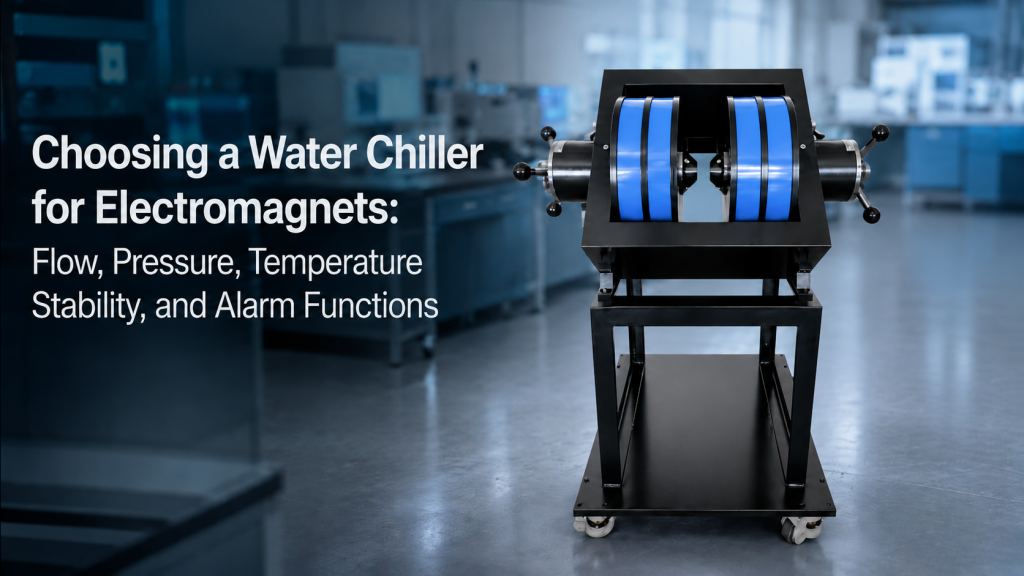
When a laboratory orders a water-cooled electromagnet, the magnet itself often gets most of the attention:
“What is the maximum magnetic field?”
“What is the pole gap?”
“What current is required?”
“What power supply is included?”
“What is the duty cycle?”
But for continuous or high-field operation, the water chiller is not a secondary accessory.
It is part of the magnetic field system.
If the chiller is undersized, unstable, or poorly matched, the electromagnet may still turn on — but it may not operate safely, continuously, or predictably.
This article explains how to choose a water chiller for electromagnets, focusing on flow, pressure, temperature stability, cooling capacity, and alarm functions.
1. Why Water Cooling Matters for Electromagnets
An electromagnet generates a magnetic field by passing current through coils.
The same current that creates the magnetic field also produces heat in the windings.
For low-power or short-duration applications, air cooling may be enough.
For high-field, high-current, or continuous-duty operation, water cooling is often required.
Electromagnets require continuous current to maintain the magnetic field, and the winding resistance creates heat that must be removed. Larger electromagnets may require water cooling to remove waste heat from the windings.
For water-cooled electromagnets, the chiller affects:
- Coil temperature
- Field stability
- Duty cycle
- Long-term reliability
- Safety protection
- Measurement repeatability
- Operator confidence
A water-cooled magnet without a suitable chiller is like a high-performance engine without a proper cooling system.
2. Cooling Capacity: Start with Heat Load
The first question is not only “What chiller model should we buy?”
The first question is:
“How much heat must be removed?”
The heat load depends on:
- Coil current
- Coil resistance
- Operation time
- Duty cycle
- Ambient temperature
- Cooling channel design
- Power supply behavior
- Safety margin
For DC electromagnets, heat generation is closely related to electrical power dissipated in the coil. If the magnet runs at high current for long periods, the cooling system must remove this heat continuously.
A chiller should not be selected only because its nominal cooling capacity looks close to the calculated heat load. Real operation should include margin for ambient temperature, pump performance, flow restriction, and future use.
A practical approach is to select a chiller with enough cooling capacity plus a safety margin, rather than operating the chiller at its absolute limit.
3. Flow Rate: Enough Water Must Actually Pass Through the Magnet
Cooling capacity is meaningless if the coolant does not flow properly through the electromagnet.
Flow rate affects how quickly heat is carried away from the coil or cooling channels.
If flow is too low:
- Coil temperature rises faster
- Field stability may worsen
- Continuous duty operation may not be possible
- Thermal protection may trigger
- Coil lifetime may be reduced
The required flow rate depends on the magnet design. Some magnets have simple water paths, while others use internal cooling channels or hollow conductors.
A chiller manual from SMC notes that rated fluid flow is needed to maintain cooling capacity and temperature stability, which is exactly why flow rate should be checked as a real operating parameter, not just a catalog number.
For electromagnets, always confirm the required flow rate from the magnet supplier before selecting a chiller.
4. Pressure: The Chiller Must Overcome Flow Resistance
Flow rate and pressure must be considered together.
A chiller may have a high nominal flow rate under ideal conditions, but the real flow may drop when connected to:
- Long hoses
- Small-diameter tubing
- Internal magnet cooling channels
- Filters
- Quick connectors
- Valves
- Flow meters
- Height differences
- Multiple cooling branches
The pump must provide enough pressure to push coolant through the actual system.
If pressure is too low, the magnet may not receive enough flow even if the chiller looks powerful on paper.
If pressure is too high, hoses, connectors, or internal cooling channels may be stressed.
A good chiller selection should match both:
- Required flow rate
- Allowable pressure range
For larger water-cooled electromagnets, it is safer to confirm the cooling circuit pressure drop and choose a chiller pump accordingly.
5. Temperature Stability: Why It Affects Magnetic Field Stability
Temperature stability is not only about protecting the coil.
It can also influence magnetic field stability.
As coil temperature changes, coil resistance changes. This can affect voltage demand, heating behavior, and sometimes field stability depending on the power supply and control mode.
For precision magnetic field applications, temperature stability matters in:
- Hall measurement
- Magnetoresistance testing
- MOKE experiments
- VSM-related magnetic field generation
- Sensor calibration
- Long-duration material testing
- Repeated field-current measurements
A chiller with poor temperature control may allow larger thermal variation, which can affect long measurements.
For many laboratory electromagnet systems, the target is not necessarily extremely low temperature. The goal is stable, controlled heat removal.
Useful chiller parameters include:
- Temperature control range
- Temperature stability
- Cooling capacity at the required setpoint
- Ambient operating range
- Pump performance
- Alarm thresholds
Do not compare chillers only by “cooling capacity.”
Temperature stability and operating conditions matter too.
6. Setpoint Temperature: Lower Is Not Always Better
Some users assume colder water is always better.
Not necessarily.
A lower water temperature may increase cooling margin, but it can also create problems such as:
- Condensation on hoses or magnet surfaces
- Thermal stress
- Unnecessary chiller load
- Reduced efficiency
- Water quality concerns
- Unstable room conditions
For many electromagnets, the chiller setpoint is usually selected to keep the coil within a safe operating range, not to make the magnet as cold as possible.
The correct setpoint should consider:
- Room temperature
- Humidity
- Dew point risk
- Magnet design
- Required duty cycle
- Measurement stability
- Supplier recommendation
In normal laboratory environments, avoiding condensation is often more important than chasing the lowest water temperature.
7. Alarm Functions: The Chiller Should Protect the Magnet
Alarm functions are critical for water-cooled electromagnets.
Important alarm functions may include:
- High water temperature alarm
- Low water temperature alarm
- Low flow alarm
- High pressure alarm
- Low pressure alarm
- Pump failure alarm
- Water level alarm
- Compressor fault alarm
- Sensor fault alarm
- External alarm output
- Interlock signal to power supply
Agilent’s recirculating chiller user guide describes fluid pressure alarms and notes that continuous operation outside alarm settings can cause the chiller to alarm, which illustrates why pressure monitoring matters for protecting connected equipment.
For electromagnets, alarm functions should not only warn the user.
Ideally, critical alarms should be linked to system protection.
For example, if cooling flow stops, the magnet power supply should reduce output or shut down safely.
This is especially important for high-current magnets.
8. Flow Interlock: A Small Feature That Prevents Big Damage
A flow interlock is one of the most important protection features for a water-cooled electromagnet.
The purpose is simple:
If water flow is insufficient, the magnet should not continue running at high current.
Without flow protection, a user may accidentally energize the magnet while cooling is blocked, disconnected, or too weak.
A practical water-cooled magnet system may include:
- Flow sensor
- Temperature sensor
- Chiller alarm output
- Power supply interlock input
- Emergency stop
- Software warning
- Manual inspection procedure
For high-value magnet systems, flow interlock should be treated as part of the system design, not an optional luxury.
9. Water Quality and Maintenance
Cooling performance also depends on water quality.
Poor water quality can cause:
- Scaling
- Corrosion
- Biological growth
- Filter blockage
- Reduced flow
- Pump wear
- Cooling channel contamination
- Long-term reliability issues
Depending on the chiller and magnet design, the supplier may recommend:
- Deionized water
- Distilled water
- Approved coolant mixture
- Anti-corrosion additive
- Regular filter inspection
- Periodic coolant replacement
- Conductivity monitoring
- Avoiding untreated tap water
The correct coolant should follow both the chiller manufacturer’s instructions and the magnet supplier’s requirements.
Do not mix coolant types casually.
10. Hose Size, Connectors, and Layout
A good chiller can still perform poorly if the hose system is poorly designed.
Check:
- Hose inner diameter
- Hose length
- Connector type
- Bend radius
- Quick coupling restriction
- Leak resistance
- Hose temperature rating
- Pressure rating
- Accessibility
- Drainage and refill method
- Separation from electrical cables
For water-cooled electromagnets, the cooling loop should be easy to inspect and maintain.
Long, narrow, or sharply bent hoses can reduce flow.
Unclear connector labeling can lead to wrong connection during installation.
Before shipment, the supplier should clearly mark:
- Water inlet
- Water outlet
- Flow direction
- Required hose size
- Cooling connection specification
This reduces installation risk, especially for overseas customers using remote installation support.
11. Chiller Noise, Heat, and Placement
A chiller removes heat from the magnet, but that heat goes somewhere.
If the chiller is air-cooled, it will release heat into the room. It may also generate noise and vibration.
Before installation, consider:
- Chiller footprint
- Ventilation space
- Heat exhaust direction
- Noise level
- Distance from measurement setup
- Hose length
- Floor space
- Maintenance access
- Drainage
- Power outlet location
For sensitive measurements, placing the chiller too close to the experiment may introduce vibration, acoustic noise, or thermal disturbance.
Sometimes the best installation is to place the chiller away from the measurement area while keeping hose length reasonable.
12. Do You Need a Separate Chiller or Facility Cooling Water?
Some laboratories already have facility cooling water.
This may be useful, but it must be checked carefully.
Facility cooling water may have:
- Unstable pressure
- Variable temperature
- Unknown water quality
- Limited flow
- Shared load with other equipment
- No alarm output
- No local temperature control
- Maintenance shutdown periods
A dedicated recirculating chiller provides more controlled conditions and is often easier to integrate with a laboratory magnet system.
However, facility cooling water may still be suitable if it meets the required flow, pressure, temperature, cleanliness, and stability conditions.
The decision should be made based on the actual cooling requirement, not convenience alone.
13. Common Mistakes When Selecting a Chiller
Common mistakes include:
- Selecting by cooling capacity only
- Ignoring pressure and flow resistance
- Using untreated tap water
- Placing the chiller in a poorly ventilated area
- Ignoring condensation risk
- Forgetting alarm and interlock functions
- Reusing an old chiller without checking performance
- Assuming facility water is always stable
- Using hoses that are too narrow or too long
- Failing to confirm coolant compatibility
These mistakes may not appear on the first day of operation.
They often appear later as unstable performance, frequent alarms, reduced duty cycle, or premature maintenance problems.
14. A Practical Chiller Selection Checklist
Before choosing a chiller for a water-cooled electromagnet, confirm:
- Magnet heat load
- Required cooling capacity
- Required flow rate
- Required pressure range
- Coolant type
- Temperature setpoint
- Temperature stability
- Ambient temperature range
- Hose size and connector type
- Water quality requirement
- Alarm functions
- External interlock output
- Power input
- Noise and heat output
- Installation space
- Maintenance access
If these items are unclear, the chiller should not be treated as finalized.
15. How Cryomagtech Supports Water-Cooled Electromagnet Systems
Cryomagtech supplies electromagnets, Helmholtz coil systems, excitation power supplies, and integrated magnetic field solutions for research and industrial laboratories.
For water-cooled electromagnet projects, we help customers evaluate:
- Required magnetic field
- Pole gap and working volume
- Coil current and power
- Continuous-duty operation needs
- Cooling capacity
- Flow and pressure requirements
- Chiller selection
- Alarm and interlock requirements
- Installation and remote support scope
Our goal is to help customers treat cooling as part of the magnet system, not as an afterthought.
A properly matched chiller helps the electromagnet run more safely, more stably, and more predictably.
References
- Wikipedia – Electromagnet
Electromagnets require continuous current to maintain the magnetic field, and winding resistance creates heat that may require water cooling in larger systems. - SMC Thermo-Chiller Operation Manual
The manual notes that rated fluid flow is needed to maintain cooling capacity and temperature stability, which is directly relevant to chiller selection for water-cooled electromagnets. - Agilent Recirculating Chiller User Guide
The guide describes fluid pressure alarms and continuous operation outside alarm settings, showing why alarm functions matter for connected equipment protection.
Key Takeaways
- A water chiller is part of the electromagnet system, not just an accessory.
- Cooling capacity must match the magnet heat load with a practical safety margin.
- Flow rate and pressure must be checked together.
- Temperature stability can affect long-duration magnetic field performance.
- Alarm functions and flow interlocks help protect the magnet and power supply.
- Water quality, hose layout, ventilation, and maintenance access all matter.
- A properly selected chiller improves safety, duty cycle, and long-term reliability.
For a water-cooled electromagnet, the question is not simply “Which chiller is cheap enough?”
The better question is:
“Which chiller keeps the magnet safe, stable, and usable under real operating conditions?”