
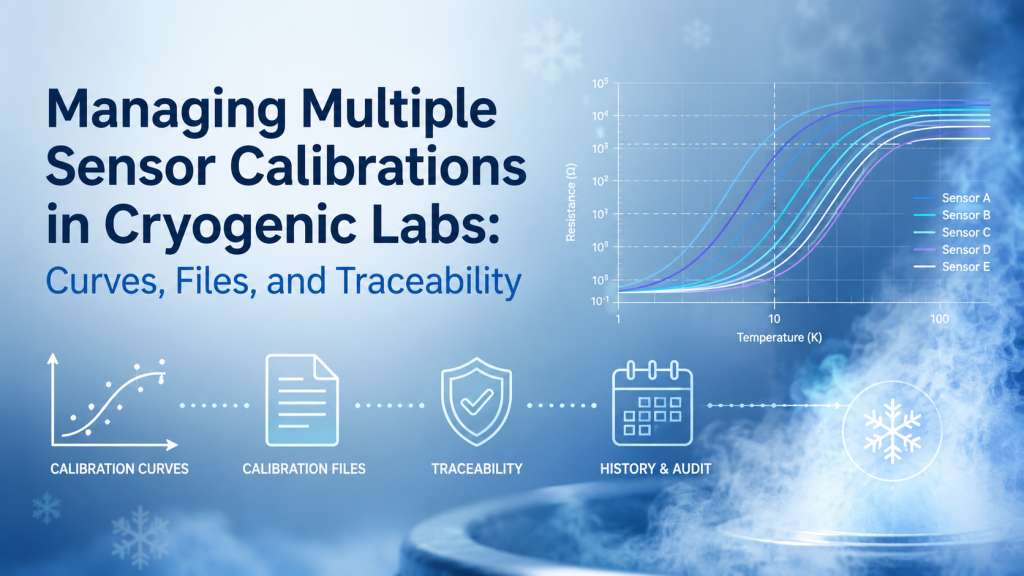
In cryogenic laboratories, temperature measurement is rarely limited to a single sensor.
A typical setup may involve:
- Multiple cryogenic sensors
- Different calibration curves
- Various sample environments
- Long-term experimental data tracking
At first, managing these elements may seem straightforward.
But over time, many labs encounter the same problems:
- Wrong calibration curve loaded
- Missing sensor files
- Unclear traceability
- Inconsistent measurement history
👉 These issues can compromise measurement reliability long before hardware failure occurs.
This article explains why sensor calibration management matters—and how to avoid common long-term problems in cryogenic laboratories.
1. Why Calibration Management Becomes Difficult Over Time
Cryogenic systems often evolve gradually.
Labs may:
- Add new sensors
- Replace damaged probes
- Upgrade controllers
- Reconfigure experiments
As the number of sensors increases:
👉 Calibration management becomes a data management problem—not just a hardware problem.
2. Why Cryogenic Sensors Require Calibration Curves
Cryogenic sensors are highly nonlinear.
According to Wikipedia:
https://en.wikipedia.org/wiki/Cryogenic_temperature_controller
Cryogenic temperature measurement depends on calibration relationships between sensor output and temperature.
Common Sensor Types
- Cernox
- Silicon diode
- Platinum RTD
- Ruthenium oxide sensors
Each sensor typically has:
- Its own calibration curve
- Unique serial-number-based data
👉 Two sensors of the same model may still require different calibration files.
3. The Hidden Risk of Curve Mismatch
One of the most common laboratory mistakes:
👉 Applying the wrong calibration curve to the wrong sensor.
Possible Consequences
- Incorrect temperature readings
- Experimental inconsistency
- Invalid measurement results
Why It Happens
- Similar sensor naming
- Missing labeling
- Lost calibration files
👉 The problem is usually organizational—not technical.
4. File Management Challenges in Multi-Sensor Labs
Cryogenic labs often accumulate:
- Calibration files
- Historical revisions
- Backup datasets
Without structured management:
- Files become duplicated
- Versions become unclear
- Traceability is lost
Common Problems
- “Which file is the latest?”
- “Was this sensor recalibrated?”
- “Is this curve still valid?”
5. Traceability: More Important Than Many Labs Realize
Traceability means:
👉 Being able to connect:
- A physical sensor
- Its calibration curve
- Its measurement history
This is especially important for:
- Long-term research projects
- Multi-user laboratories
- Published experimental results
According to IEEE measurement practices, traceability is essential for reproducibility and measurement confidence.
6. Multi-User Lab Environments Increase Risk
In shared cryogenic labs:
- Different users handle sensors
- Configurations change frequently
- Files are copied between systems
Result
- Human error becomes a major risk factor
👉 The larger the lab, the more important structured management becomes.
7. Why Controller Support for Multiple Curves Matters
Modern cryogenic controllers often support:
- Multiple stored calibration curves
- User-uploaded sensor files
- Channel-specific assignments
Why This Is Important
It allows:
- Easier sensor switching
- Reduced manual errors
- Better experiment repeatability
👉 Controller flexibility becomes a workflow advantage.
8. Best Practices for Calibration Management
1. Label Sensors Clearly
Include:
- Serial number
- Sensor type
- Calibration date
2. Standardize File Naming
Example:
- SensorType_Serial_Date.cal
3. Maintain Backups
Store:
- Local backup
- Shared laboratory archive
4. Keep Revision Records
Track:
- Recalibration history
- Curve updates
9. Long-Term Reliability Depends on Data Discipline
Many cryogenic measurement issues are not caused by hardware failure.
They result from:
- Missing records
- File confusion
- Poor calibration management
👉 Reliable cryogenic measurement depends as much on process discipline as hardware quality.
10. How Cryomagtech Supports Calibration and Traceability Management
At Cryomagtech, cryogenic control systems are designed with long-term laboratory operation in mind.
We support:
- Multiple sensor curve storage
- User-uploaded calibration files
- Structured controller configuration
- Sensor traceability workflows
👉 Product link placeholder: Cryomagtech Cryogenic Temperature Controllers & Sensor Solutions
Our goal is to help laboratories maintain:
- Measurement consistency
- Calibration integrity
- Long-term experimental reliability
References
- Wikipedia – Cryogenic Temperature Controller
https://en.wikipedia.org/wiki/Cryogenic_temperature_controller - IEEE – Measurement traceability and instrumentation practices
https://ieeexplore.ieee.org/
Key Takeaways
- Cryogenic sensor management becomes complex over time
- Each sensor may require its own calibration curve
- Wrong curve assignment can invalidate measurements
- File organization and traceability are critical
- Multi-user labs increase calibration management risk
- Reliable workflows improve long-term measurement consistency
Cryogenic measurement reliability is not only about hardware.
👉 It also depends on how calibration data is managed.