
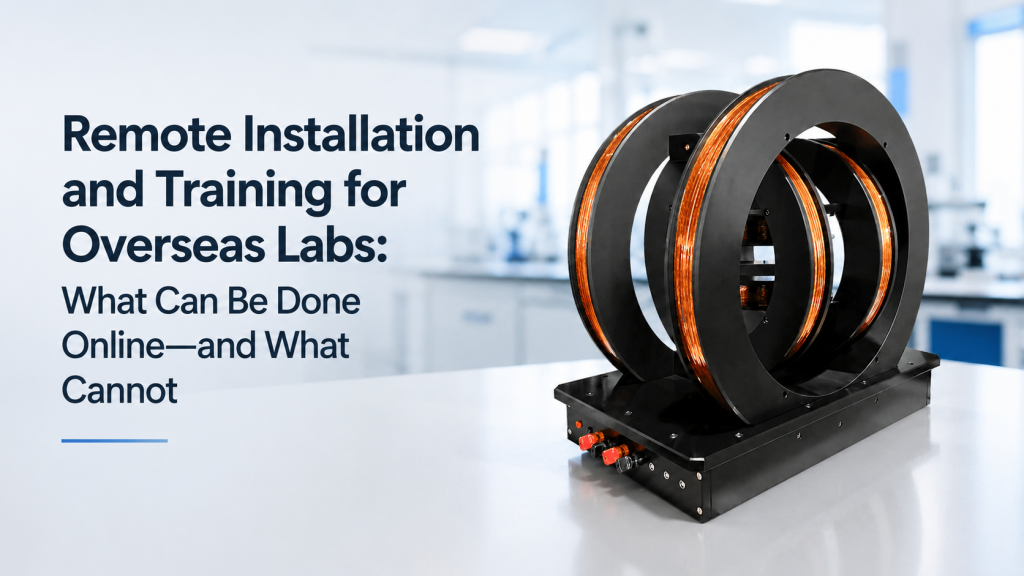
For many overseas laboratories, purchasing a magnetic field system from an international supplier is not only a technical decision.
It also raises practical questions:
“Can the system be installed without an engineer flying to our site?”
“Can our team be trained remotely?”
“What happens if something goes wrong during setup?”
“Which steps still require local hands-on support?”
These questions are reasonable. For research instruments such as electromagnets, Helmholtz coils, power supplies, and magnetic field control systems, remote installation and online training can significantly reduce delivery friction — but only when the scope is clearly defined.
This article explains what can be handled online, what should be prepared before delivery, and what still requires on-site attention.
1. Why Remote Installation Matters for Overseas Laboratories
International procurement has become common for universities, R&D centers, calibration labs, and industrial testing facilities. However, overseas installation can create concerns around:
- Travel cost
- Scheduling delays
- Language and time-zone differences
- Import and customs timing
- Local safety rules
- Internal approval procedures
Remote installation support helps reduce these barriers.
In many cases, the supplier can guide the customer through unpacking, connection, software setup, basic testing, and operator training through video meetings, photos, wiring diagrams, manuals, and test checklists.
This approach is especially practical for modular magnetic field systems where the main components are already tested before shipment.
2. What Can Usually Be Done Online
Remote installation is most effective when the system is pre-configured and the customer has basic technical staff on site.
Typical online-supported tasks include:
- Unpacking guidance
- Visual inspection after shipment
- Component identification
- Cable and connector verification
- Power supply connection guidance
- Software installation support
- Communication interface setup
- Basic operation training
- Initial magnetic field output check
- Troubleshooting based on photos, videos, and measurement data
For many overseas labs, these steps are enough to bring the system into basic operation.
Remote laboratory concepts are already widely used in engineering education and instrumentation contexts, where real equipment can be accessed, demonstrated, or controlled through networked interfaces. Remote labs are commonly described as systems that allow users to interact with real experimental apparatus from another location.
3. What Should Be Completed Before Shipment
A good remote installation process does not start after delivery.
It starts before shipment.
Before the system leaves the factory, the supplier should complete:
- System assembly check
- Electrical safety inspection
- Power supply output test
- Coil or magnet connection verification
- Basic field output verification
- Software or controller communication test
- Packing photo record
- Labeling of cables and connectors
- Preparation of operation manuals and quick-start instructions
For magnetic field systems, this pre-shipment stage is critical because it reduces uncertainty after the equipment arrives overseas.
A well-labeled system is much easier to install remotely than a system that arrives as a collection of unidentified cables, coils, and accessories.
4. What Cannot Be Fully Done Online
Remote support has limits.
Some tasks still require local confirmation, local tools, or local engineering responsibility.
These may include:
- Confirming local electrical compliance
- Final site wiring by a qualified electrician
- Cooling water or chiller installation
- Mechanical fixing on an optical table or test bench
- Grounding and shielding optimization
- Environmental magnetic noise investigation
- Final calibration against the customer’s own reference instruments
- Integration with third-party equipment
- Site-specific safety approval
For example, an electromagnet or Helmholtz coil may work correctly before shipment, but the final measurement environment can still be affected by nearby steel structures, power cables, vibration sources, or magnetic interference.
These are not shipping defects.
They are site-dependent variables.
This is why remote installation should be treated as guided commissioning, not as a substitute for every on-site engineering responsibility.
5. Remote Training: What Works Well
Online training works very well for operation-level knowledge.
A structured remote training session can cover:
- System overview
- Main components and functions
- Safe startup and shutdown
- Current control and field adjustment
- Software interface operation
- Basic measurement workflow
- Common alarm messages
- Routine maintenance
- Data recording and test documentation
For overseas customers, remote training also has one major advantage: sessions can be recorded and reused internally.
This helps new users, graduate students, engineers, or rotating lab members understand the system later without relying only on memory.
6. Remote Training: What Does Not Work Well
Some training cannot be fully replaced by video calls.
Examples include:
- Handling heavy magnet assemblies
- Adjusting mechanical alignment under load
- Diagnosing local grounding noise
- Repairing internal electrical faults
- Performing high-current safety operations without local supervision
- Modifying cooling circuits
- Making unauthorized changes to factory wiring
These tasks should be handled carefully.
For safety reasons, suppliers should not encourage customers to open high-current electrical modules or modify protected internal wiring unless there is a clearly approved service procedure.
A responsible remote support model should tell the customer not only what to do, but also what not to do.
7. Best Practice: Use a Remote Installation Checklist
For overseas magnetic field systems, a checklist-based approach is more reliable than informal video support.
A practical remote installation checklist may include:
Before Delivery
- Confirm lab power supply conditions
- Confirm table space and mechanical clearance
- Confirm cooling requirements if applicable
- Confirm computer and software environment
- Confirm receiving address and unpacking access
After Delivery
- Check package condition
- Take unpacking photos
- Verify accessories and cables
- Inspect connectors and labels
- Confirm no visible shipping damage
During Installation
- Connect components step by step
- Verify input power
- Start controller or power supply
- Perform low-current test first
- Increase output gradually
- Record initial test results
After Installation
- Confirm stable operation
- Review safety notes
- Train operators
- Save test records
- Define future support contact procedure
This structure makes remote installation more predictable and reduces misunderstanding between supplier and customer.
8. Why Magnetic Field Systems Need Clear Installation Boundaries
Magnetic field systems are not ordinary plug-and-play devices.
Even when the main system is simple, performance can depend on:
- Coil geometry
- Magnet gap
- Power supply stability
- Cable length and resistance
- Cooling efficiency
- Field sensor position
- Sample fixture
- Nearby magnetic materials
- Measurement method
For example, a Helmholtz coil system may generate a highly uniform magnetic field in the designed central region, but the customer still needs to place the sample correctly and avoid magnetic interference around the test area.
Similarly, an electromagnet may reach the expected field under defined pole gap and current conditions, but final performance depends on pole configuration, sample placement, cooling status, and measurement method.
This is why remote support should be based on agreed procedures, not vague promises.
9. How Cryomagtech Supports Overseas Labs
Cryomagtech supplies magnetic field systems for overseas research and industrial laboratories, including electromagnets, Helmholtz coil systems, magnetic field power supplies, and related laboratory configurations.
For suitable projects, we can support overseas customers with:
- Pre-shipment system verification
- Cable and connector labeling
- Operation manual and quick-start guidance
- Remote installation support
- Online operator training
- Basic troubleshooting assistance
- Follow-up technical communication after delivery
Our goal is not to claim that everything can be solved remotely.
Our goal is to help laboratories understand what can be completed online, what must be prepared locally, and how to reduce risk before the system arrives.
References
- Wikipedia – Remote Laboratory
Remote laboratories allow real experimental apparatus to be accessed or controlled from another location, which supports the broader concept of remote technical training and online instrumentation support. - Nature Index – Remote Laboratory Applications in Engineering Education
Nature Index describes remote laboratories as online platforms that provide access to real experimental apparatus controlled over a network.
Key Takeaways
- Remote installation can reduce overseas delivery friction.
- Many setup, software, training, and basic testing steps can be supported online.
- Local electrical, cooling, grounding, safety, and site-specific checks still require on-site responsibility.
- Magnetic field systems need clear installation procedures because performance depends on both equipment and environment.
- The best remote support model is checklist-based, realistic, and technically bounded.
Remote installation is not about pretending distance does not matter.
It is about making international laboratory equipment delivery more predictable, transparent, and manageable.