
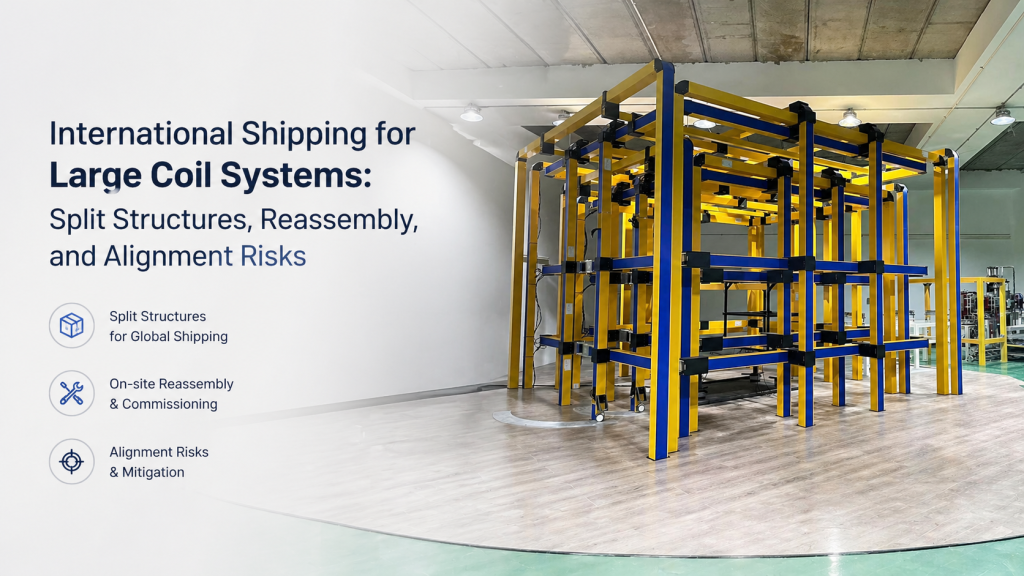
Large coil systems—such as Helmholtz coils and high-power electromagnets—are rarely limited by design alone.
They are limited by something more practical:
👉 how they are transported, assembled, and aligned after delivery
For international shipments, especially to universities and research labs, large systems often require:
- Structural splitting
- On-site reassembly
- Precision alignment
If not properly planned, these steps can introduce:
- Field inaccuracies
- Mechanical instability
- Delays in commissioning
1. Why Large Coil Systems Cannot Always Be Shipped as One Piece
Physical Constraints
- Container size limits
- Air freight dimensional restrictions
- Weight handling limitations
Logistical Considerations
- Customs handling
- Local transport limitations
- Installation access (doors, elevators, labs)
👉 These constraints often make modular or split structures necessary
2. Split Structures: The Standard Engineering Solution
Large coil systems are typically divided into:
- Coil segments
- Support frames
- Mounting structures
Advantages
- Easier transportation
- Reduced shipping risk
- More flexible handling
Trade-Off
👉 Splitting introduces reassembly and alignment challenges
3. Reassembly: More Than Just Mechanical Work
Reassembly is not simply:
- Bolting parts together
It requires:
- Correct positioning
- Structural integrity
- Electrical reconnection
Key Risks
- Misalignment between coil segments
- Uneven spacing
- Mechanical deformation
👉 Even small deviations can affect magnetic field performance
4. Alignment Accuracy and Field Performance
Helmholtz and similar systems rely on precise geometry.
According to Wikipedia:
https://en.wikipedia.org/wiki/Helmholtz_coil
Field uniformity depends on:
- Coil spacing
- Geometric symmetry
What Goes Wrong
- Misaligned coils → distorted field
- Non-parallel structures → reduced uniformity
👉 Alignment is not cosmetic—it directly affects experimental results
5. Mechanical Tolerances and Repeatability
In modular systems, tolerances accumulate.
Sources of Error
- Manufacturing tolerance
- Assembly variation
- Structural flex
Impact
- Reduced repeatability
- Variation between installations
👉 Systems must be designed with alignment tolerance in mind
6. Electrical Reconnection Risks
Splitting the system also affects:
- Power connections
- Signal wiring
- Grounding paths
Common Issues
- Incorrect wiring
- Increased contact resistance
- Ground loop introduction
According to IEEE practices, connection integrity is critical for reliable system performance.
7. Packaging and Transport Protection
Transport itself introduces risks:
- Mechanical shock
- Vibration
- Environmental exposure
Protection Measures
- Custom crates
- Shock-absorbing materials
- Moisture protection
👉 Poor packaging can damage alignment surfaces before installation even begins
8. On-Site Installation Challenges
Many issues appear only during installation:
- Limited workspace
- Lack of alignment tools
- Inexperienced handling
Typical Outcomes
- Extended installation time
- Improvised solutions
- Reduced system performance
9. How to Mitigate Alignment and Assembly Risks
Design-Level Solutions
- Modular interfaces with alignment features
- Precision-machined reference surfaces
- Repeatable positioning mechanisms
Documentation and Support
- Clear assembly instructions
- Alignment procedures
- Verification methods
Validation
- Post-installation field measurement
- Alignment verification
👉 Good systems are designed for reliable reassembly, not just initial performance
10. How Cryomagtech Supports Global Delivery of Large Coil Systems
At Cryomagtech, transport and installation are considered from the design stage.
We provide:
- Modular coil structures optimized for shipping
- Precision alignment interfaces
- Detailed reassembly and installation guidance
- Support for on-site commissioning
👉 Product link placeholder: Cryomagtech Large Coil & Helmholtz Systems with Modular Delivery Design
Our goal is to ensure that:
- The system performs as designed
- Assembly is predictable and repeatable
- Delivery risks are minimized
References
- Wikipedia – Helmholtz Coil
https://en.wikipedia.org/wiki/Helmholtz_coil - IEEE – Mechanical and electrical system integration practices
https://ieeexplore.ieee.org/
Key Takeaways
- Large coil systems often require modular transport
- Splitting structures introduces alignment risks
- Field performance depends on precise reassembly
- Mechanical tolerances affect repeatability
- Electrical reconnection must be handled carefully
- Design for assembly is critical for reliable operation
A system that performs well in the factory is not enough.
👉 It must perform the same way after shipment and reassembly.