
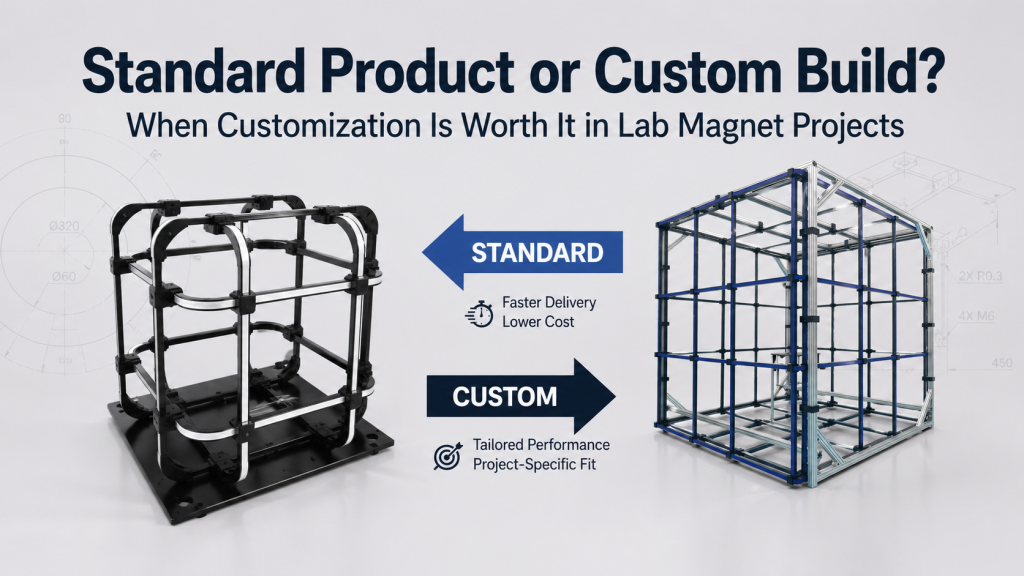
In many laboratory magnet projects, one of the earliest decisions is often unclear:
👉 Should you choose a standard product, or go for a custom-built system?
At first glance, customization sounds attractive:
- Tailored to your exact needs
- Maximum flexibility
- Future-proof
But in reality:
👉 Not every project benefits from customization
👉 And not every “standard system” is truly limiting
This article helps you identify when customization is worth it—and when it is not.
1. What Defines a Standard Magnet System
A standard system typically offers:
- Pre-defined configurations
- Known performance specifications
- Faster delivery
- Lower cost
Typical Characteristics
- Fixed geometry
- Limited parameter adjustment
- Proven and repeatable design
👉 Standard systems answer:
“Can this system meet most common requirements efficiently?”
2. What Defines a Custom Magnet System
A custom system is designed based on:
- Specific experimental requirements
- Unique geometry or integration constraints
- Non-standard performance targets
Typical Characteristics
- Tailored coil design
- Customized power and control
- Integration with external equipment
👉 Custom systems answer:
“How can we make the system match exactly what the experiment needs?”
3. Why Many Projects Default to Custom—Unnecessarily
A common pattern:
- Users assume their setup is unique
- They request full customization early
But in many cases:
👉 A standard or lightly modified system would work just as well
Result of Over-Customization
- Higher cost
- Longer lead time
- Increased complexity
4. When a Standard System Is the Better Choice
Typical Scenarios
- Basic calibration setups
- Standard Helmholtz coil applications
- General-purpose electromagnet use
- Known and repeatable experiments
Advantages
- Lower cost
- Faster delivery
- Proven reliability
👉 If your requirements fall within known ranges, standard is often optimal
5. When Customization Becomes Necessary
Customization is justified when:
1. Geometry Constraints
- Limited space
- Non-standard sample positioning
- Integration with existing equipment
2. Performance Beyond Standard Range
- Unusual field strength
- Large uniform volume
- Specific dynamic behavior
3. System Integration Requirements
- Optical access
- Cryogenic compatibility
- Multi-system coordination
👉 These are real engineering constraints—not preferences
6. Light Customization vs Full Custom Design
Not all customization is equal.
Light Customization
- Minor dimensional adjustments
- Parameter tuning
- Small integration changes
Full Custom Design
- New coil geometry
- New power/control architecture
- Full system redesign
👉 Many projects only need light customization, not full redesign
7. Cost and Time Trade-Off
Customization impacts both cost and timeline.
Standard System
- Lower cost
- Short lead time
- Minimal engineering effort
Custom System
- Higher cost
- Longer development cycle
- Additional validation and testing
According to IEEE engineering design practices, system customization increases design complexity and validation requirements.
8. Risk Considerations
Customization introduces risk:
- Design uncertainty
- Longer iteration cycles
- Potential performance deviation
Standard systems:
- Lower risk
- Known performance
- Faster troubleshooting
👉 The question is not just “can it be customized”
👉 But “should it be”
9. A Practical Decision Framework
Ask these questions:
1. Are your requirements within standard ranges?
- Yes → Standard system
2. Are constraints driven by integration or space?
- Yes → Light customization
3. Do you need fundamentally new performance?
- Yes → Full custom system
👉 Let constraints—not assumptions—drive the decision
10. How Cryomagtech Supports Both Paths
At Cryomagtech, we support:
- Standard configurations for common applications
- Light customization for integration needs
- Full custom systems for advanced projects
We help determine:
- What level of customization is actually required
- Where standard solutions are sufficient
- How to balance cost, performance, and timeline
👉 Product link placeholder: Cryomagtech Standard & Custom Magnet System Solutions
Our goal is not to maximize customization—
👉 It is to match the system to the real need.
References
- Wikipedia – Engineering design process
https://en.wikipedia.org/wiki/Engineering_design_process - IEEE – Engineering system design and customization
https://ieeexplore.ieee.org/
Key Takeaways
- Not all projects require custom magnet systems
- Standard systems are often sufficient and more efficient
- Customization is justified by real constraints, not preference
- Light customization can solve most integration issues
- Full custom design increases cost and complexity
- Correct classification improves project efficiency
Customization is powerful—
👉 but only when it solves a real problem.