
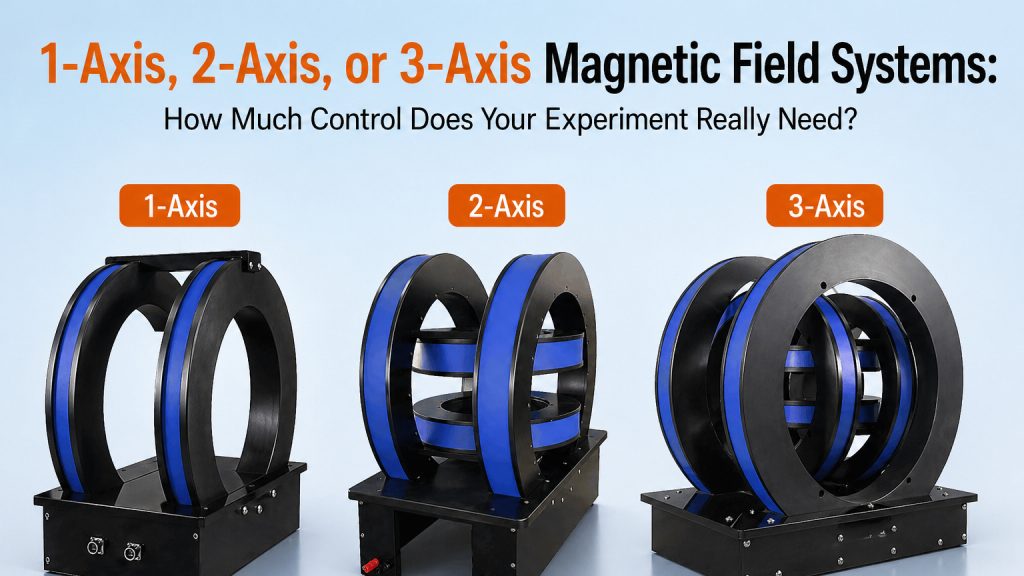
When specifying a magnetic field system, many users start with a simple assumption:
👉 “We need a 3-axis system.”
But in practice, this is often not necessary.
Choosing between 1-axis, 2-axis, and 3-axis systems is not about maximizing capability—it is about matching the system to your actual experimental needs.
Over-specifying leads to:
- Higher cost
- Increased complexity
- Reduced efficiency
This article helps you determine how much control your experiment truly requires.
1. What Do 1-Axis, 2-Axis, and 3-Axis Systems Mean
1-Axis System
- Magnetic field generated along a single direction
- Simplest configuration
2-Axis System
- Independent control in two perpendicular directions
- Enables planar field control
3-Axis System
- Full vector control in X, Y, Z
- Enables arbitrary field direction
According to Wikipedia:
https://en.wikipedia.org/wiki/Vector_field
Magnetic fields are vector quantities, meaning both magnitude and direction matter.
2. Why 3-Axis Systems Are Often Over-Specified
Many users request 3-axis systems because:
- It sounds more complete
- It allows maximum flexibility
- It avoids future limitations
However:
👉 More axes do not always mean better results
Downsides of 3-Axis Systems
- Higher cost (coils + drivers + control)
- Increased system complexity
- More calibration and alignment requirements
- Greater risk of cross-axis interference
3. When a 1-Axis System Is Enough
Typical Use Cases
- Basic field exposure experiments
- Single-direction magnetization
- Simple calibration tasks
Advantages
- Lowest cost
- Simplest operation
- High stability
👉 If your experiment only requires one field direction, adding axes adds no value
4. When a 2-Axis System Makes Sense
Typical Use Cases
- Planar field rotation
- Sensor testing in a fixed plane
- Limited directional control
Advantages
- More flexibility than 1-axis
- Lower complexity than 3-axis
- Cost-effective compromise
👉 Often overlooked, but ideal for many real-world applications
5. When You Truly Need a 3-Axis System
Required for
- Full vector field control
- Arbitrary orientation testing
- Complex sensor calibration (IMU, magnetometer)
- Advanced material studies
Key Capability
- Ability to reproduce any field direction in 3D space
Reality Check
👉 If your experiment requires dynamic orientation control, 3-axis is justified
👉 If not, it may be unnecessary
6. Control Complexity Increases with Axes
Each additional axis requires:
- Independent current drivers
- Precise synchronization
- Calibration between axes
Challenges
- Cross-axis coupling
- Alignment errors
- Control system complexity
According to IEEE studies, multi-axis magnetic systems require careful calibration and control to maintain accuracy.
7. Cost vs Capability Trade-Off
A simplified comparison:
| System Type | Capability | Complexity | Cost |
|---|---|---|---|
| 1-Axis | Low | Low | Low |
| 2-Axis | Medium | Medium | Medium |
| 3-Axis | High | High | High |
👉 The goal is not maximum capability
👉 The goal is sufficient capability
8. Common Mistakes in System Selection
Mistake 1: Over-Specifying
- Choosing 3-axis “just in case”
- Paying for unused capability
Mistake 2: Underestimating Control Needs
- Choosing 1-axis for dynamic experiments
- Running into limitations later
Mistake 3: Ignoring Integration Complexity
- Not considering control software
- Overlooking calibration requirements
9. How to Choose the Right System
Ask these questions:
1. Do I need field direction control?
- No → 1-axis
- Yes → continue
2. Is control limited to a plane?
- Yes → 2-axis
- No → continue
3. Do I need full 3D vector control?
- Yes → 3-axis
👉 Let the experiment define the system—not assumptions
10. How Cryomagtech Supports Axis Selection
At Cryomagtech, system design starts from application requirements.
We help determine:
- Necessary field control level
- Trade-off between complexity and cost
- Integration with measurement systems
👉 Product link placeholder: Cryomagtech 1-Axis, 2-Axis, and 3-Axis Helmholtz Coil Systems
Instead of pushing maximum configuration,
we aim to deliver:
- Right-sized solutions
- Efficient system design
- Reliable experimental performance
References
- Wikipedia – Vector Field
https://en.wikipedia.org/wiki/Vector_field - IEEE – Multi-axis magnetic system control
https://ieeexplore.ieee.org/
Key Takeaways
- Magnetic field systems can be 1-axis, 2-axis, or 3-axis
- 3-axis systems are often over-specified
- 1-axis is sufficient for many applications
- 2-axis offers a practical balance
- 3-axis is necessary for full vector control
- System complexity and cost increase with axes
Choosing the right system is not about maximum capability.
👉 It is about matching the system to your experiment.