
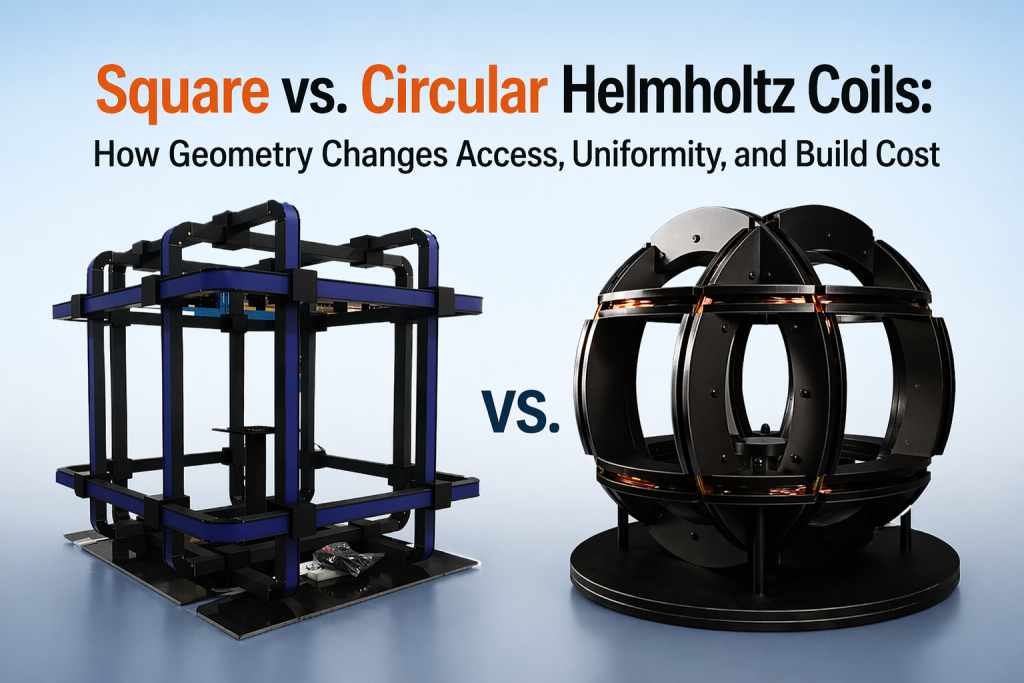
Not all Helmholtz coils look the same.
Some are circular.
Some are square or rectangular.
At first glance, the difference seems purely mechanical.
But in reality:
👉 geometry directly affects field uniformity, accessibility, and cost
Choosing the wrong geometry can lead to:
- Limited access to the sample
- Poor field distribution
- Unnecessary manufacturing complexity
This article explains when to use circular vs square Helmholtz coils, and why the choice matters.
1. The Original Helmholtz Geometry: Why Circular Coils Are Standard
The classic Helmholtz configuration uses two identical circular coils separated by a distance equal to their radius.
According to Wikipedia:
https://en.wikipedia.org/wiki/Helmholtz_coil
This geometry is mathematically optimized to produce:
- Highly uniform magnetic fields
- Minimal field gradients near the center
Key Advantage
👉 Circular coils provide the most predictable and well-understood field uniformity
2. Why Square Helmholtz Coils Exist
Despite the advantages of circular coils, many real applications use square designs.
Primary Reason
👉 accessibility
Square coils provide:
- Larger usable workspace
- Flat boundaries for integration
- Easier alignment with rectangular equipment
3. Field Uniformity: Circular vs Square
Circular Coils
- Optimized for symmetry
- Best theoretical uniformity
- Smooth field gradients
Square Coils
- Slightly less uniform (especially at edges)
- Field distribution depends on design optimization
- Can still achieve acceptable uniform regions
Practical Insight
👉 For most applications, the difference is manageable
👉 For high-precision calibration, circular often performs better
4. Access and Working Volume
Circular Coils
- Limited access due to curved geometry
- Smaller usable opening for instruments
Square Coils
- Larger rectangular working area
- Easier integration of:
- Cryostats
- Optical setups
- Mechanical fixtures
👉 This is often the deciding factor in real systems
5. Mechanical Integration and Customization
Circular Design
- Easier to analyze theoretically
- Standardized configurations
- Less flexible in geometry
Square Design
- More adaptable to custom layouts
- Easier to scale for specific sample shapes
- Supports modular structures
6. Manufacturing Complexity and Cost
Circular Coils
- Simpler winding process
- Standard manufacturing methods
- Lower fabrication cost (in many cases)
Square Coils
- More complex winding and support structure
- Requires precise corner handling
- Often higher cost for custom builds
Reality Check
👉 Cost difference depends on:
- Size
- Precision requirement
- Mechanical constraints
7. Thermal and Structural Considerations
Geometry also affects:
- Heat distribution
- Mechanical rigidity
- Structural stability
Square Coils
- May have stress concentration at corners
- Require stronger mechanical support
Circular Coils
- Naturally uniform stress distribution
- More stable under thermal expansion
8. Application-Based Selection Guide
Choose Circular Helmholtz Coils If You Need
- High-precision field uniformity
- Calibration-grade measurements
- Standard lab configurations
Choose Square Helmholtz Coils If You Need
- Larger accessible workspace
- Integration with complex setups
- Custom mechanical layouts
Choose Based on System Constraints If
- Space is limited
- Sample geometry is non-standard
- Integration dominates over theoretical uniformity
9. When Geometry Becomes a System Decision
In practice, coil geometry is not just a design choice—it is a system-level decision.
It must consider:
- Field requirements
- Mechanical constraints
- Integration with other equipment
- Budget
According to IEEE studies, real-world magnetic systems often balance theoretical optimization with practical constraints.
10. How Cryomagtech Supports Custom Helmholtz Coil Design
At Cryomagtech, both circular and square Helmholtz coils are designed based on application requirements.
We evaluate:
- Required field uniformity
- Available workspace
- Mechanical integration constraints
- Budget and manufacturing considerations
👉 Product link placeholder: Cryomagtech Custom Helmholtz Coil Systems – Circular & Square Designs
Instead of forcing a standard design,
we help match coil geometry to real-world use cases.
References
- Wikipedia – Helmholtz Coil
https://en.wikipedia.org/wiki/Helmholtz_coil - IEEE – Magnetic field design and optimization
https://ieeexplore.ieee.org/
Key Takeaways
- Circular Helmholtz coils offer optimal field uniformity
- Square coils provide better accessibility and integration
- Geometry affects cost, structure, and thermal behavior
- The best choice depends on application, not theory alone
- Coil design must balance performance and practicality
Not all Helmholtz coils are the same.
👉 The right geometry depends on what you need to do—not what looks standard.