
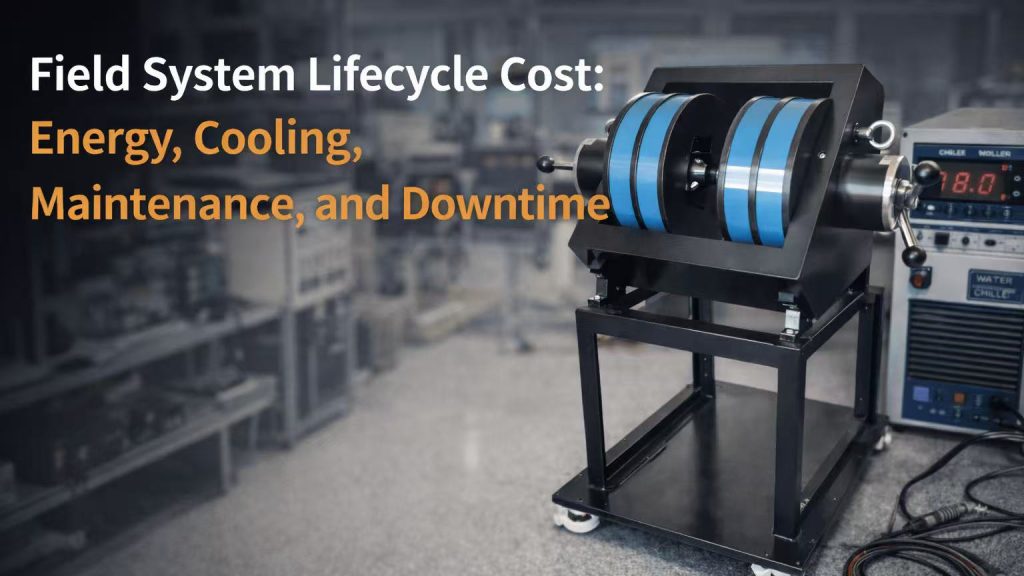
When selecting a magnet system, most decisions are made based on:
- Initial quotation
- Lead time
- Basic specifications
But experienced users know:
👉 the purchase price is only a small part of the total cost
Over the lifetime of a system, the real cost comes from:
- Energy consumption
- Cooling infrastructure
- Maintenance
- Downtime
This is known as lifecycle cost—and it often determines whether a system is truly economical.
1. What Is Lifecycle Cost in Magnet Systems
Lifecycle cost includes all expenses from installation to end-of-life:
- Initial equipment cost
- Operating cost (energy + cooling)
- Maintenance and spare parts
- Downtime and productivity loss
According to engineering studies on magnet systems, lifecycle cost analysis is critical for optimizing reliability and long-term performance .
2. Energy Consumption: The Largest Hidden Expense
Electromagnets require continuous power to maintain the field.
Key Insight
👉 Power loss is dominated by resistive heating (I²R losses)
As explained in Wikipedia:
https://en.wikipedia.org/wiki/Electromagnet
- Electrical energy is dissipated as heat in the coil
- Higher current → exponentially higher energy cost
Practical Impact
- Long-duration experiments → significant electricity cost
- High-field systems → disproportionately expensive to operate
3. Cooling Systems: Cost Beyond the Magnet
Heat generated by the coil must be removed.
Cooling Adds Cost In Multiple Ways
- Chillers or cooling units
- Water treatment systems
- Pumps and infrastructure
- Energy consumption of cooling equipment
Research shows that cooling systems can significantly affect overall system economics and energy efficiency .
Hidden Reality
👉 Cooling is not optional—it is part of the operating cost
4. Maintenance and Spare Parts
Magnet systems are not maintenance-free.
Typical Maintenance Items
- Cooling system servicing
- Cable and connector inspection
- Sensor recalibration
- Replacement of worn components
Cost Factors
- Labor
- Spare parts availability
- System complexity
👉 Poor design increases maintenance frequency—and cost
5. Downtime: The Most Expensive Factor
Downtime is often underestimated.
What Downtime Includes
- System failure
- Maintenance shutdown
- Waiting for spare parts
- Recalibration after repair
Why It Matters
👉 Downtime affects:
- Research timelines
- Production schedules
- Data continuity
Lifecycle studies show that reliability and availability are key cost drivers in magnet systems over long-term operation .
6. Configuration Choices That Affect Lifecycle Cost
Not all systems behave the same over time.
Key Design Variables
- Air-cooled vs water-cooled
- Coil efficiency (resistance, design)
- Power supply efficiency
- System redundancy
Example
- Lower-cost system → higher energy + maintenance cost
- Higher-quality system → lower total lifecycle cost
👉 The cheapest system is often not the most economical
7. When Energy Efficiency Changes the Equation
Advanced systems can reduce operating costs.
Examples
- Optimized coil design → lower resistance
- Efficient power electronics → reduced losses
- Better thermal management → reduced cooling load
Lifecycle assessments in related magnetic systems show energy-efficient designs can reduce long-term operating impact significantly .
8. Practical Cost Breakdown (What Buyers Often Miss)
A simplified lifecycle cost structure:
- 20–40% → initial equipment
- 30–50% → energy + cooling
- 10–20% → maintenance
- 10–30% → downtime impact
👉 Numbers vary, but the pattern is consistent:
Operating cost often exceeds purchase cost
9. How Cryomagtech Optimizes Lifecycle Cost
At Cryomagtech, system design considers total lifecycle cost—not just initial performance.
We evaluate:
- Coil efficiency and current density
- Cooling requirements and infrastructure
- Maintenance accessibility
- System reliability and uptime
Instead of minimizing upfront cost,
we help reduce:
- Energy consumption
- Maintenance burden
- Risk of downtime
References
- Wikipedia – Electromagnet
https://en.wikipedia.org/wiki/Electromagnet - Research – Lifecycle cost analysis of magnet systems
https://inspirehep.net/files/409a5b2962246d466eb927baf96e12ae
Key Takeaways
- Lifecycle cost includes energy, cooling, maintenance, and downtime
- Energy consumption is often the largest long-term expense
- Cooling systems add both capital and operating cost
- Maintenance affects reliability and operating continuity
- Downtime can exceed all other costs combined
- System design determines total cost over time
Choosing a magnet system based only on price is short-term thinking.
👉 The real question is:
What will this system cost you after 3–5 years of operation?