
Magnet systems rarely fail suddenly.
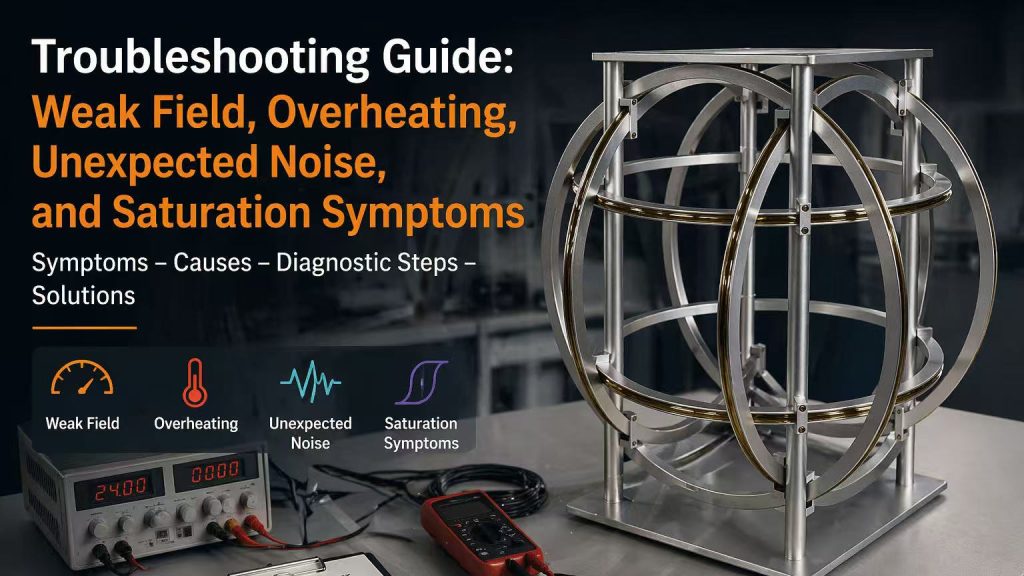
Most issues appear first as subtle symptoms:
- The field is weaker than expected
- The system overheats
- Noise appears in measurements
- Performance stops improving despite higher current
These symptoms are often misdiagnosed.
This guide provides a structured approach to identifying:
👉 what is happening, why it happens, and how to fix it
1. Weak Magnetic Field: When Output Doesn’t Match Expectation
Typical Symptoms
- Measured field lower than calculated value
- Field does not increase proportionally with current
Possible Causes
- Voltage drop in cables or connectors
- Incorrect calibration or sensor positioning
- Power supply current limit reached
- Coil resistance higher than expected
According to Wikipedia:
https://en.wikipedia.org/wiki/Electromagnet
Magnetic field strength is directly related to current and coil design.
Diagnostic Steps
- Verify actual current at coil terminals
- Check cable and connector losses
- Confirm sensor calibration and placement
- Compare with design specifications
Solutions
- Use lower-resistance cables
- Improve connections
- Recalibrate sensors
- Verify power supply capability
2. Overheating: When Temperature Rises Too Fast
Typical Symptoms
- Rapid temperature increase
- System shutdown or thermal alarms
- Reduced duty cycle
Possible Causes
- Excessive current (I²R losses)
- Insufficient cooling
- Blocked cooling channels
- Poor internal thermal design
Diagnostic Steps
- Measure current and voltage
- Check cooling flow rate and temperature
- Inspect for blockage or contamination
- Compare with rated duty cycle
Solutions
- Reduce current or duty cycle
- Improve cooling efficiency
- Clean or maintain cooling system
- Re-evaluate operating conditions
3. Unexpected Noise: When Measurements Become Unstable
Typical Symptoms
- Fluctuating readings
- 50/60 Hz interference
- Random signal spikes
Possible Causes
- Ground loops
- Electromagnetic interference (EMI)
- Poor shielding
- Power supply noise
According to IEEE EMC studies, grounding and shielding are critical for maintaining signal integrity.
Diagnostic Steps
- Check grounding scheme
- Inspect cable routing and shielding
- Isolate system from other equipment
- Test with alternative measurement setup
Solutions
- Implement single-point grounding
- Use shielded and twisted cables
- Add isolation where needed
- Improve power quality
4. Saturation Symptoms: When More Current Doesn’t Help
Typical Symptoms
- Field stops increasing with current
- Nonlinear response
- Increased heating without performance gain
Possible Causes
- Magnetic core saturation
- Coil design limits
- Incorrect operating range
Diagnostic Steps
- Plot field vs current curve
- Identify nonlinear regions
- Compare with design limits
Solutions
- Operate below saturation region
- Redesign coil or core
- Adjust system configuration
5. A Systematic Troubleshooting Workflow
Instead of guessing, follow a structured approach:
Step 1: Identify the Symptom
- Weak field
- Overheating
- Noise
- Saturation
Step 2: Measure Key Parameters
- Current
- Voltage
- Temperature
- Field
Step 3: Isolate Variables
- Power supply
- Coil
- Cabling
- Environment
Step 4: Verify Against Specifications
Step 5: Apply Targeted Fix
👉 Avoid changing multiple variables at once
6. When the Problem Is Not Where You Think
A critical insight:
👉 Many issues are system-level, not component-level
Examples:
- Weak field caused by cable losses
- Noise caused by grounding, not sensors
- Overheating caused by cooling, not coil design
Misdiagnosis leads to:
- Unnecessary replacements
- Increased cost
- Delayed resolution
7. How Cryomagtech Supports Reliable Operation
At Cryomagtech, troubleshooting is built into system design and support.
We provide:
- Clear operating guidelines
- Diagnostic references
- System-level integration support
👉 Product link placeholder: Cryomagtech Magnet Systems with Engineering Support & Reliability Design
Our goal is not only to deliver equipment,
but to ensure systems remain:
- Stable
- Diagnosable
- Reliable over time
References
- Wikipedia – Electromagnet
https://en.wikipedia.org/wiki/Electromagnet - IEEE – EMC and signal integrity practices
https://ieeexplore.ieee.org/
Key Takeaways
- Weak field often comes from losses or misconfiguration
- Overheating is usually linked to current and cooling
- Noise is often caused by grounding and EMI
- Saturation limits system performance
- Structured troubleshooting prevents misdiagnosis
- System-level thinking is essential
Most magnet system problems are not random.
👉 They follow patterns—once you know where to look.