
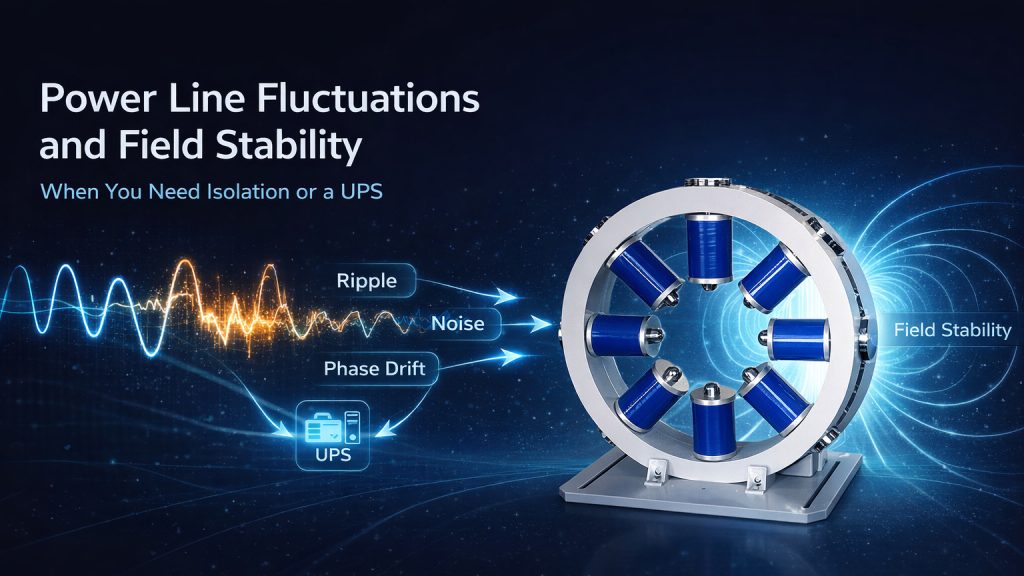
In many magnet system setups, field instability is blamed on:
- The electromagnet
- The power supply
- The measurement system
But there is a quieter, often overlooked source:
👉 the power line itself
Voltage fluctuations, noise, and transient disturbances from the grid can directly affect magnetic field stability.
If not properly managed, even a well-designed system can show:
- Field drift
- Noise in measurements
- Repeatability issues
1. What Are Power Line Fluctuations
Power line fluctuations include:
- Voltage variations (sags, swells)
- Frequency instability
- Harmonic distortion
- Transient spikes
According to Wikipedia:
https://en.wikipedia.org/wiki/Power_quality
Power quality issues can significantly affect sensitive electrical systems, especially those requiring stable output.
2. How Power Instability Affects Magnetic Fields
Magnet systems are ultimately driven by electrical current.
If the input power is unstable:
👉 The output field will reflect that instability.
Common Effects
- Small voltage fluctuations → current drift → field drift
- High-frequency noise → ripple in magnetic field
- Transients → sudden field disturbances
Typical Symptoms in Experiments
- Slowly drifting baseline
- Unexpected noise in measurements
- Irreproducible results across runs
These are often misdiagnosed as instrument issues.
3. The Disturbance Path: From Grid to Field
Understanding the path helps identify where to fix the problem.
Typical Chain
Power grid → Power supply → Current output → Coil → Magnetic field
Where Disturbances Enter
- Input stage of the power supply
- Ground reference instability
- EMI coupling into control circuits
Even high-quality power supplies have:
👉 finite rejection of input disturbances
This is often defined as PSRR (Power Supply Rejection Ratio).
4. Isolation: Breaking the Noise Path
Isolation is one of the most effective ways to reduce power-related disturbances.
Types of Isolation
- Isolation transformers
- Power conditioners
- Dedicated laboratory power lines
What Isolation Does
- Decouples system from grid noise
- Reduces common-mode interference
- Stabilizes reference ground
When You Need It
- Sensitive measurements (ppm-level stability)
- Environments with unstable grid
- Shared industrial power infrastructure
5. UPS Systems: Not Just for Backup Power
A UPS (Uninterruptible Power Supply) is often misunderstood.
It is not only for outages.
What a UPS Can Provide
- Voltage stabilization
- Short-term energy buffering
- Protection from spikes and dropouts
Types of UPS
- Offline (basic backup)
- Line-interactive
- Online (double-conversion)
👉 Only online UPS systems provide true isolation and clean output waveform.
6. Where UPS Helps—and Where It Doesn’t
Effective Use Cases
- Preventing sudden shutdown
- Smoothing short-term voltage fluctuations
- Maintaining operation during brief outages
Limitations
- Not all UPS systems improve waveform quality
- Limited capacity for high-power magnet systems
- Can introduce switching noise (if poorly selected)
7. Grounding and Noise Coupling
Even with stable voltage, grounding issues can introduce noise.
Common Problems
- Ground loops
- Floating references
- Shared grounding with noisy equipment
Impact
- Measurement noise
- Signal instability
- Reduced system accuracy
According to IEEE guidelines on electromagnetic compatibility, grounding and shielding are critical for maintaining signal integrity.
8. When Field Drift Is Not a Magnet Problem
A key insight:
👉 Not all field instability originates from the magnet system.
Before adjusting:
- Coil design
- Power supply parameters
- Control settings
You should evaluate:
- Power input quality
- Grounding configuration
- Environmental electrical noise
Because fixing the wrong problem wastes time—and money.
9. How Cryomagtech Approaches System Stability
At Cryomagtech, field stability is treated as a system-level challenge.
We evaluate:
- Power line conditions
- Power supply rejection capability
- Need for isolation or UPS integration
- Grounding and shielding design
👉 Product link placeholder: Cryomagtech Stable Magnet Systems & Power Integration Solutions
Instead of assuming ideal conditions,
we design systems that perform reliably in real environments.
References
- Wikipedia – Power Quality
https://en.wikipedia.org/wiki/Power_quality - IEEE – Power system stability and noise considerations
https://ieeexplore.ieee.org/
Key Takeaways
- Power line fluctuations directly affect magnetic field stability
- Field drift is often caused by input power instability
- Isolation helps break noise coupling paths
- Only online UPS systems provide true power conditioning
- Grounding plays a critical role in noise control
- Stability must be addressed at the system level
If your magnetic field is drifting,
the problem may not be your magnet—
👉 it may be your power source.