
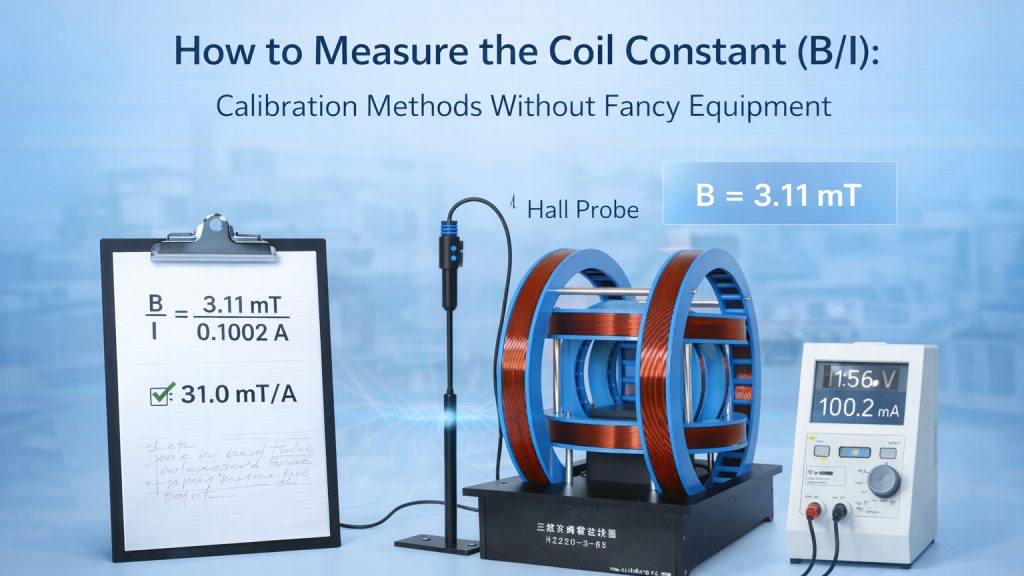
For any Helmholtz or electromagnet system, one parameter matters above all:
👉 Coil constant (B/I) — the relationship between magnetic field and current.
Customers often ask:
“How do I know the field is really what you claim?”
The good news is:
You don’t need expensive equipment to verify it.
This article explains practical calibration methods, error sources, and validation workflows that can be performed in a standard lab.
1. What Is the Coil Constant (B/I)?
The coil constant defines how much magnetic field is generated per unit current:
- B = magnetic field (Tesla or Gauss)
- I = current (Ampere)
👉 Coil constant = B / I
For Helmholtz coils, this value is:
- predictable from geometry
- but must still be verified experimentally
According to Wikipedia, Helmholtz coils are designed to produce highly uniform magnetic fields, making them ideal for calibration purposes.
2. Why Calibration Is Necessary (Even If You Trust the Design)
Even well-designed systems can deviate due to:
- manufacturing tolerances
- coil positioning errors
- material differences
- current source instability
👉 Theoretical value ≠ actual value
Calibration ensures:
- traceability
- repeatability
- confidence during experiments
3. Basic Equipment You Actually Need
Forget complex metrology setups.
A practical calibration can be done with:
- Gaussmeter (Hall probe preferred)
- Stable current source
- Positioning fixture (manual is fine)
- Ruler or simple alignment tool
That’s it. No million-dollar lab required.
4. Step-by-Step Calibration Procedure
Step 1: Define Measurement Position
- Place probe at coil center
- Ensure alignment along coil axis
👉 Misalignment is one of the biggest hidden errors
Step 2: Apply Known Current
- Use stable DC current
- Record exact current value
Step 3: Measure Magnetic Field
- Record B value at center
- Repeat measurement multiple times
Step 4: Calculate Coil Constant
- B/I for each measurement
- Average results
Step 5: Verify Linearity
- Repeat for multiple current levels
- Plot B vs I
👉 A linear relationship confirms correct operation
5. Common Error Sources (Where Most People Get It Wrong)
Probe Position Error
- Even a few millimeters offset changes readings
- Helmholtz uniformity is not infinite
Probe Orientation
- Hall probes are directional
- Misalignment reduces measured field
Current Instability
- Noise or drift directly affects B/I
- Especially critical at low field levels
External Magnetic Interference
- Earth’s magnetic field (~50 µT)
- Nearby equipment
👉 Always measure background field and subtract it
6. Improving Accuracy Without Expensive Tools
Repeatability
- Take multiple readings
- Average values
Symmetry Check
- Measure at +I and –I
- Check consistency
Zero Offset Correction
- Measure with no current
- Subtract baseline
These simple steps significantly improve reliability.
7. Documentation and Verification Workflow
A proper calibration record should include:
- measurement date
- equipment used
- probe type and orientation
- current values
- measured B values
- calculated B/I
👉 This is what builds trust—not just numbers
According to IEEE practices, traceable documentation is essential for reproducible electromagnetic measurements.
8. When You Need Higher Precision
For advanced applications:
- NMR calibration
- fluxgate references
- calibrated reference magnets
But for most lab setups:
👉 a well-executed basic method is already sufficient
9. How Cryomagtech Supports Coil Calibration
Cryomagtech provides Helmholtz coil systems with calibration support, including:
- pre-measured coil constants
- recommended verification procedures
- guidance for field validation
- optional documentation for traceability
👉 Product link placeholder: Cryomagtech Helmholtz Coil Calibration Support
We ensure that your system is not only built correctly—but also verifiable in your own lab.
References
- Wikipedia – Helmholtz coil fundamentals
https://en.wikipedia.org/wiki/Helmholtz_coil - IEEE – Measurement and calibration practices
https://ieeexplore.ieee.org/
Key Takeaways
- Coil constant (B/I) defines field accuracy
- Calibration is necessary even for well-designed coils
- Simple equipment is sufficient for reliable verification
- Positioning and alignment are critical error sources
- Proper documentation builds experimental confidence
- Basic methods can achieve high reliability when done correctly