
Most magnetic systems aim for uniform fields.
But in many advanced experiments, what you actually need is the opposite:
👉 A controlled magnetic field gradient
From cold atom trapping to magnetic sensing, gradient fields are essential.
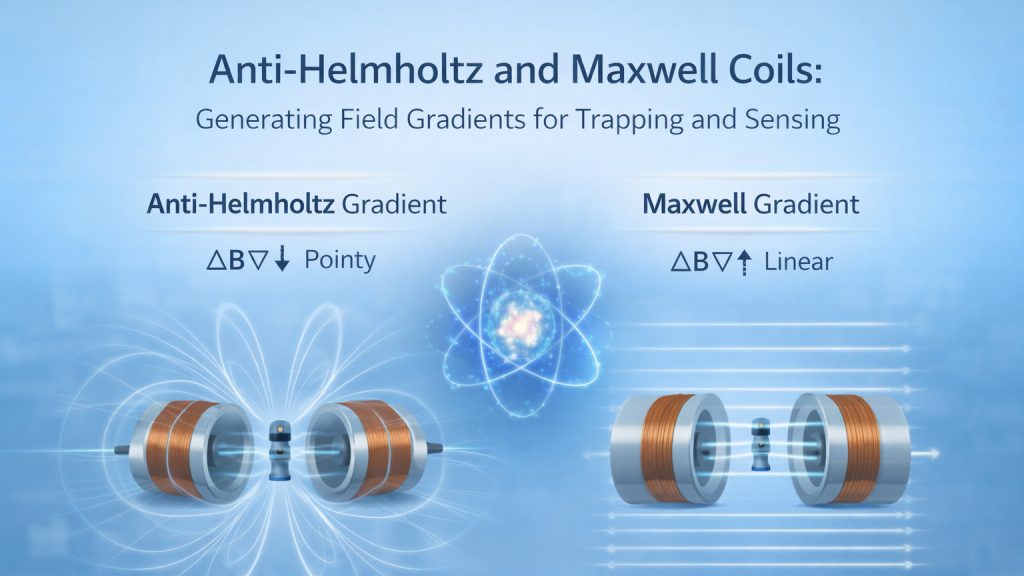
This article explains how anti-Helmholtz and Maxwell coil configurations generate gradients—and how to design them correctly.
1. What Is a Magnetic Field Gradient?
A magnetic field gradient describes how the magnetic field changes in space:
- Uniform field → constant value
- Gradient field → spatial variation
Mathematically:
- Gradient = dB/dx (or dB/dy, dB/dz)
Why It Matters
- Enables particle trapping (force ∝ gradient)
- Defines spatial resolution in sensing
- Controls force on magnetic dipoles
According to Wikipedia, magnetic gradients are fundamental in applications such as atom trapping and magnetic resonance techniques.
2. Anti-Helmholtz Coils: Linear Gradient Generation
Basic Concept
Anti-Helmholtz coils consist of:
- Two identical coils
- Opposite current directions
Result
- Zero magnetic field at center
- Linear gradient around center
Key Characteristics
- First-order gradient (linear)
- Strong gradient near center
- Symmetric field distribution
Typical Applications
- Magneto-optical traps (MOT)
- Cold atom experiments
- Magnetic particle manipulation
3. Maxwell Coils: Higher-Order Gradient Control
Basic Concept
Maxwell coils use:
- Three coils
- Specific spacing and current ratios
Result
- Controlled higher-order field distribution
- Improved gradient uniformity over a region
Key Characteristics
- Reduced second-order distortion
- More precise gradient shaping
- Larger usable volume
Typical Applications
- Precision magnetometry
- Calibration systems
- Advanced sensing setups
4. Geometry Matters: Coil Spacing and Alignment
Gradient performance depends heavily on geometry:
Critical Parameters
- Coil spacing
- Radius-to-spacing ratio
- Mechanical alignment
Even small deviations can:
- distort gradient linearity
- shift the zero-field point
- reduce experimental accuracy
According to IEEE studies, geometric precision is essential for maintaining predictable gradient profiles.
5. Driving Requirements: Current Control Is Everything
Unlike uniform-field systems, gradient coils require:
Precise Current Control
- Stability directly affects gradient accuracy
- Noise translates into force fluctuations
Fast Response (if dynamic)
- Required for time-dependent experiments
- Demands appropriate power supply design
Symmetry
- Current mismatch between coils breaks gradient symmetry
👉 In practice, power supply quality matters as much as coil design
6. Thermal and Mechanical Considerations
Gradient systems often operate at high current densities.
Thermal Effects
- Coil heating changes resistance
- Affects gradient stability
Mechanical Stability
- Coil deformation shifts field distribution
- Mounting rigidity is critical
7. Anti-Helmholtz vs Maxwell: Practical Comparison
| Feature | Anti-Helmholtz | Maxwell Coil |
|---|---|---|
| Coil Count | 2 | 3 |
| Gradient Type | Linear | Higher-order controlled |
| Complexity | Low | Medium–High |
| Precision | Moderate | High |
| Typical Use | Trapping | Sensing / calibration |
👉 Anti-Helmholtz = simpler, stronger central gradient
👉 Maxwell = more controlled, more precise
8. Common Design Mistakes
Typical issues include:
- Assuming uniform-field coil can generate usable gradients
- Ignoring coil spacing tolerances
- Underestimating current stability requirements
- Neglecting thermal drift
These mistakes often lead to:
👉 unstable traps
👉 noisy measurements
👉 unusable data
9. How Cryomagtech Supports Gradient Coil Design
Cryomagtech provides custom Helmholtz, anti-Helmholtz, and Maxwell coil systems, optimized for:
- gradient field strength and linearity
- experimental geometry constraints
- power supply matching
- thermal and mechanical stability
👉 Product link placeholder: Cryomagtech Gradient Coil Systems
We translate gradient requirements into stable, reproducible field configurations—not just theoretical designs.
References
- Wikipedia – Helmholtz and anti-Helmholtz configurations
https://en.wikipedia.org/wiki/Helmholtz_coil - IEEE – Magnetic field gradient design principles
https://ieeexplore.ieee.org/
Key Takeaways
- Gradient fields are essential for trapping and sensing applications
- Anti-Helmholtz coils generate strong linear gradients
- Maxwell coils provide higher-order control and precision
- Geometry and current symmetry are critical
- Thermal and electrical stability directly impact performance
- Proper design prevents instability and measurement errors