
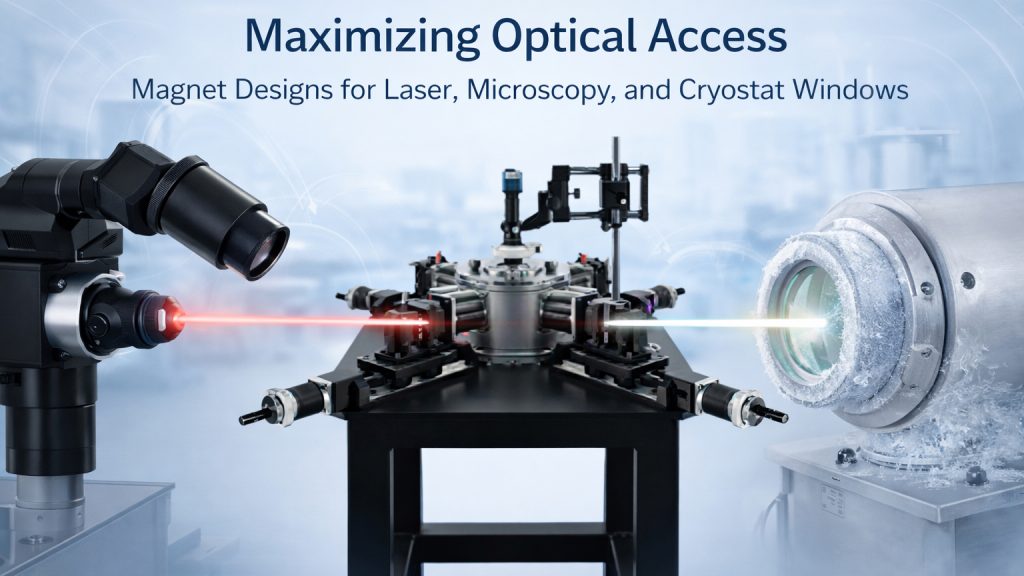
In many laboratory setups, magnetic field strength is not the limiting factor.
Optical access is.
A magnet that blocks your laser path, restricts microscope angles, or interferes with cryostat windows can render an experiment unusable—regardless of its field performance.
This article explains how to design electromagnet systems that maximize optical access without compromising measurement stability.
1. Optical Access: The Real Constraint in Modern Experiments
Typical experimental requirements include:
- laser alignment through the magnetic gap
- microscope imaging at defined angles
- cryostat windows for low-temperature measurements
The real challenge is:
👉 balancing magnetic performance with physical access
Key constraints include:
- pole gap (clearance)
- window angle and optical path
- obstruction from yokes or coils
- thermal and vibration effects
2. Pole Gap: More Than Just “Space”
The pole gap defines the usable region between magnet poles.
Why It Matters
- Determines whether optics and samples can physically fit
- Affects working distance for lenses and probes
- Directly impacts achievable magnetic field strength
Engineering Trade-Off
- Larger gap → better access
- Larger gap → lower field (for same power)
This is a fundamental electromagnetic limitation described in Wikipedia fundamentals of magnetic circuits.
👉 Most optical setups require careful optimization, not simply “make it bigger”.
3. Window Angle and Optical Path Design
Common Requirements
- Single-axis laser access
- Dual-side optical measurement
- Multi-angle microscopy
Design Considerations
- Angular clearance relative to pole faces
- Avoiding clipping by magnet structure
- Maintaining beam alignment stability
Even small structural obstructions can:
- distort beam paths
- reduce signal quality
- limit measurement repeatability
4. Structural Obstruction: The Hidden Problem
Users often underestimate how much structure interferes with optics.
Typical Sources of Obstruction
- iron yokes
- coil housings
- mounting brackets
Design Solutions
- C-frame or split-pair geometries
- recessed pole tips
- customized support structures
These solutions increase access but may:
- reduce field uniformity
- increase stray fields
5. Cryostat Integration: Where Everything Gets Harder
When a cryostat is involved, constraints multiply:
Challenges
- fixed window positions
- limited angular access
- vacuum and thermal shielding
- restricted mounting space
Critical Factors
- alignment between magnet gap and cryostat windows
- avoiding thermal radiation paths
- mechanical compatibility
According to IEEE system integration practices, multi-system alignment is often the dominant design constraint in precision experiments.
6. Thermal Effects: Stability vs Accessibility
Optical experiments are sensitive to:
- temperature drift
- air flow disturbances
- heat-induced expansion
Air-Cooled Systems
- easier integration
- but airflow may disturb optical paths
Water-Cooled Systems
- more stable thermally
- but require additional infrastructure
Poor thermal design can lead to:
- beam drift
- measurement instability
7. Vibration: The Silent Data Killer
Magnet systems introduce vibration through:
- cooling fans
- water flow
- mechanical structures
Impact on Experiments
- laser misalignment
- noise in microscopy imaging
- reduced measurement precision
Mitigation Strategies
- remote cooling units
- rigid mounting frames
- vibration isolation interfaces
8. Choosing the Right Magnet Design for Optical Access
| Requirement | Recommended Approach |
|---|---|
| Single laser path | C-frame magnet |
| Multi-angle optics | Split-pair magnet |
| High-field + limited optics | H-frame magnet |
| Cryostat integration | Custom geometry |
👉 There is no universal solution—only optimized compromises.
9. How Cryomagtech Supports Optical-Critical Designs
Cryomagtech provides custom electromagnet and system integration solutions designed for:
- optical experiments (laser, spectroscopy, microscopy)
- cryostat-compatible systems
- multi-angle access requirements
- stability-sensitive measurements
👉 Product link placeholder: Cryomagtech Custom Electromagnet & Optical Access Solutions
We translate optical constraints into practical magnet geometries—before they become expensive problems.
References
- Wikipedia – Electromagnet fundamentals
https://en.wikipedia.org/wiki/Electromagnet - IEEE – System integration and electromagnetic design
https://ieeexplore.ieee.org/
Key Takeaways
- Optical access often limits experiment feasibility more than field strength
- Pole gap directly affects both accessibility and magnetic performance
- Structural obstruction is a common hidden issue
- Cryostat integration requires precise alignment
- Thermal and vibration effects impact optical stability
- Early design decisions prevent costly redesigns