
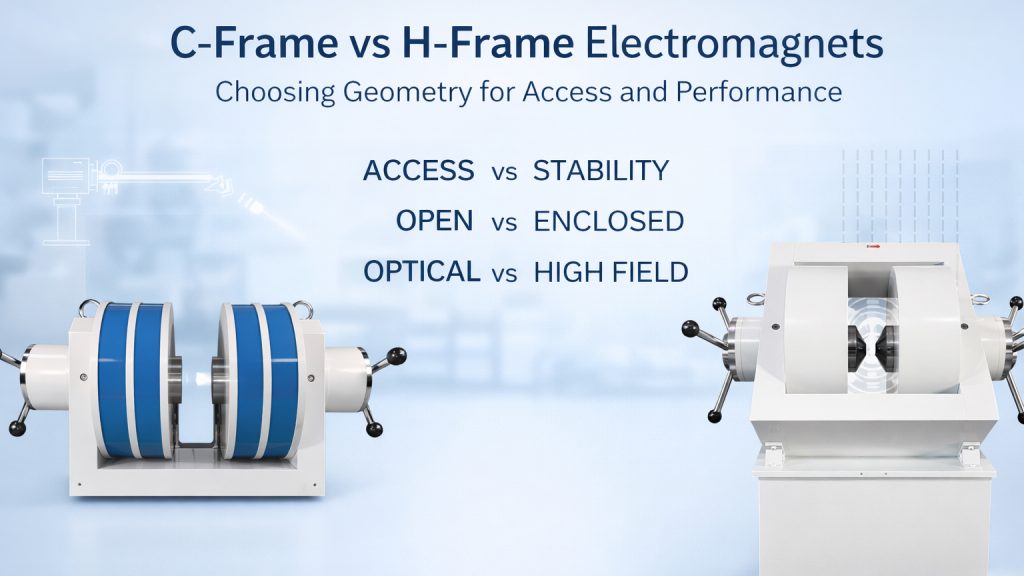
Selecting an electromagnet is not only about field strength.
In many laboratory setups, the mechanical geometry determines whether the experiment is even possible.
A mismatch between magnet structure and experimental access can lead to:
- blocked optical paths
- limited probe positioning
- excessive stray fields
- or simply… a sample that cannot be installed at all
This article explains how C-frame, H-frame, and split-pair electromagnets differ in access, performance, and integration.
1. Why Geometry Matters More Than You Think
Many users start with a requirement like:
“We need a 1 Tesla electromagnet.”
But the real question is:
👉 Can your sample, probe, or optical path actually fit inside the magnetic gap?
Geometry directly affects:
- available working space
- optical or probe access angles
- field uniformity region
- mechanical stability
Once the structure is fixed, these constraints are difficult (and expensive) to change.
2. C-Frame Electromagnets: Maximum Accessibility, Moderate Performance
Structure Overview
A C-frame electromagnet has an open side, allowing easy access to the gap from multiple directions.
Key Advantages
- Excellent sample accessibility
- Easy integration with:
- optical systems (laser, spectroscopy)
- probe stations
- Fast installation and adjustment
Engineering Trade-Offs
- Reduced mechanical rigidity
- Higher magnetic flux leakage
- Lower achievable field compared to closed structures
Typical Use Cases
- Optical measurements (MOKE, Faraday effect)
- Probe-based experiments
- Rapid sample exchange environments
3. H-Frame Electromagnets: Stability and High Field Capability
Structure Overview
An H-frame electromagnet forms a closed magnetic circuit with two vertical columns.
Key Advantages
- Higher magnetic efficiency
- Better field uniformity
- Reduced stray magnetic field
- Strong mechanical stability
Engineering Trade-Offs
- Limited side access
- More complex sample installation
- Restricted optical paths
Typical Use Cases
- High-field measurements
- Magnetic material characterization
- Calibration systems
4. Split-Pair Electromagnets: Designed for Multi-Axis Access
Structure Overview
Split-pair systems separate the coils, creating an open region between them.
Key Advantages
- Full optical and probe access
- Ideal for:
- multi-angle measurements
- cryogenic systems
- in-situ experiments
- Compatible with complex setups
Engineering Trade-Offs
- Lower maximum field for the same power
- More complex alignment
- Higher system cost
Typical Use Cases
- Cryostat-integrated measurements
- Angle-dependent experiments
- Advanced research platforms
5. Access vs Performance: The Core Trade-Off
| Geometry | Access | Field Strength | Uniformity | Complexity |
|---|---|---|---|---|
| C-Frame | Excellent | Moderate | Moderate | Low |
| H-Frame | Limited | High | High | Medium |
| Split-Pair | Excellent | Lower | Moderate | High |
👉 The more access you require, the more you trade off in field strength and efficiency.
6. Optical, Probe, and Sample Considerations
Before choosing geometry, define:
Optical Access
- Single direction or multi-angle?
- Laser alignment requirements?
Probe Access
- Number of probes?
- Contact geometry constraints?
Sample Size
- Diameter and height
- Mounting fixtures
- Clearance for motion or vibration
Ignoring these early leads to redesigns later.
7. Stray Field and Laboratory Impact
Open geometries (C-frame, split-pair):
- Larger stray magnetic fields
- May affect nearby instruments
Closed geometries (H-frame):
- Better magnetic containment
- More stable measurement environment
According to IEEE engineering references, magnetic circuit closure significantly improves efficiency and reduces external field leakage.
8. Installation and Integration Practicalities
Geometry also affects:
- Floor space and mounting
- Cooling layout (air vs water)
- Cable routing and sensor placement
A theoretically perfect magnet can still fail in practice if:
👉 it cannot be installed cleanly into your system
9. How Cryomagtech Supports Geometry Selection
Cryomagtech provides electromagnet systems across multiple geometries, helping match:
- experimental access requirements
- target field strength
- integration constraints
- long-term stability needs
👉 Product link placeholder: Cryomagtech Electromagnet Geometry Options
Instead of forcing a standard design, we align geometry with your actual experimental workflow.
References
- IEEE – Magnetic circuit design principles
https://ieeexplore.ieee.org/ - Wikipedia – Electromagnet fundamentals
https://en.wikipedia.org/wiki/Electromagnet
Key Takeaways
- Geometry determines whether your experiment is physically feasible
- C-frame favors access and flexibility
- H-frame delivers higher field and stability
- Split-pair enables complex multi-directional access
- Choosing the wrong structure often leads to redesign or failure