
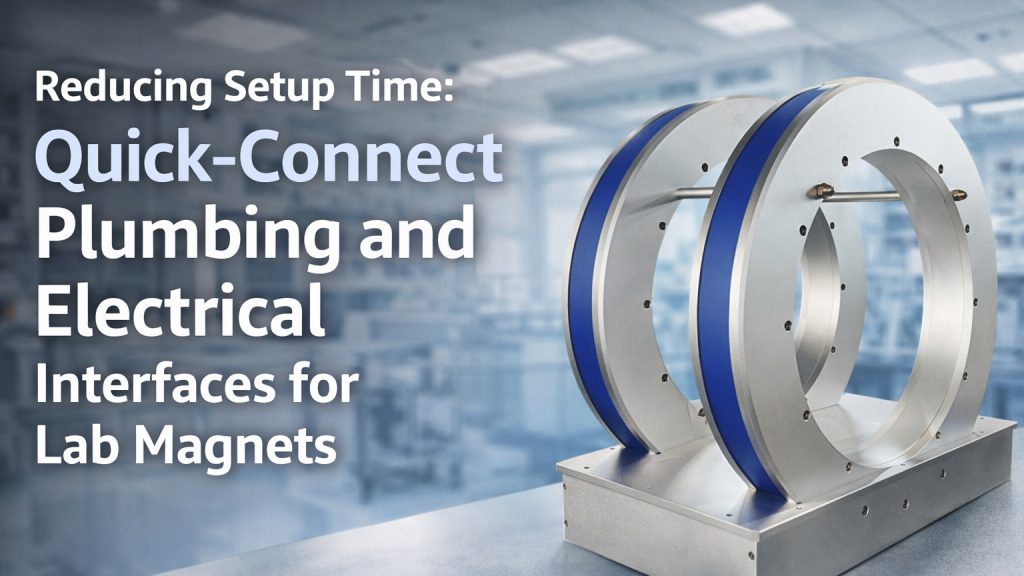
Laboratory magnet systems are often evaluated based on performance parameters such as magnetic field strength and stability.
However, in real-world use, another factor becomes equally important:
How quickly and reliably the system can be installed, connected, and maintained.
For water-cooled electromagnets and integrated systems, poor interface design can lead to:
- long setup times
- connection errors
- leakage risks
- maintenance difficulties
This article explains how quick-connect plumbing and electrical interfaces can significantly improve usability and reduce operational risks.
Why Setup Time Matters More Than You Think
In many laboratories:
- systems are reconfigured frequently
- experiments change regularly
- multiple users interact with the same equipment
Under these conditions, setup complexity directly affects:
- experiment efficiency
- system reliability
- risk of human error
A system that is difficult to connect is more likely to be connected incorrectly.
1. Quick-Connect Plumbing for Water-Cooled Systems
Water-cooled electromagnets require reliable fluid connections.
Traditional threaded fittings can be:
- time-consuming to install
- prone to leakage if improperly tightened
- difficult to maintain
Quick-connect fittings provide a more practical solution.
Key Advantages of Quick-Connect Fittings
- fast installation without tools
- repeatable sealing performance
- reduced risk of incorrect assembly
- easier maintenance and replacement
Quick-connect systems are widely used in industrial fluid systems to improve reliability and reduce installation time.
Preventing Leaks: More Than Just the Connector
Even with quick-connect fittings, leak prevention requires:
- proper hose selection
- secure mechanical support
- correct flow direction
In addition, many systems include leak detection mechanisms to improve safety.
2. Leak Detection and Safety Interlocks
Water leakage is one of the most critical risks in laboratory magnet systems.
To mitigate this, advanced systems may include:
- flow sensors
- pressure monitoring
- leak detection sensors
- automatic shutdown interlocks
These mechanisms ensure that:
- power is disabled if cooling fails
- damage to coils and power supplies is prevented
3. Electrical Interfaces: Reducing Wiring Errors
Electrical connections are another common source of setup issues.
Typical problems include:
- incorrect polarity
- loose connections
- misidentified cables
Clear and standardized electrical interfaces help prevent these errors.
Cable Labeling and Identification
Proper labeling is essential.
Best practices include:
- color-coded cables
- labeled connectors
- clear documentation
These simple measures significantly reduce setup mistakes.
Standardized Connectors
Using standardized connectors:
- improves reliability
- ensures consistent contact quality
- simplifies replacement
Electrical connectors are designed to provide stable and repeatable connections in complex systems. (en.wikipedia.org)
4. Terminal Design and Accessibility
Well-designed terminals allow:
- easy access during installation
- secure connections
- safe operation under load
Poor terminal design can result in:
- overheating
- unstable current delivery
- difficult maintenance
Accessibility is especially important in high-current systems.
5. Interlocks and System Protection
Interlocks connect different subsystems to ensure safe operation.
Examples include:
- cooling flow interlock
- over-temperature protection
- power supply enable/disable logic
These interlocks ensure that:
- the magnet cannot operate without proper cooling
- system failures are detected early
Interlock systems are commonly used in laboratory and industrial equipment to enhance safety.
6. System Integration: Plumbing and Electrical Must Work Together
A magnet system is not just a coil and power supply.
It includes:
- cooling system
- electrical interfaces
- control logic
- safety systems
These elements must be integrated into a coherent system.
Poor integration leads to:
- longer setup time
- higher failure rates
- increased maintenance effort
7. Designing for Real Users
In real laboratories, users are not always the original system designers.
They may include:
- students
- technicians
- visiting researchers
Systems should therefore be designed for:
- intuitive operation
- minimal setup steps
- clear connection logic
Reducing complexity improves both usability and reliability.
8. System-Level Approach in Magnet Platforms
Cryomagtech designs electromagnet and Helmholtz coil systems with attention to quick-connect plumbing, standardized electrical interfaces, and integrated safety interlocks.
👉 Product Link Placeholder – Water-Cooled Electromagnet Systems with Quick-Connect Interfaces
This approach reduces installation time and ensures consistent system performance across different users and experimental setups.
Key Takeaways
- Setup time directly affects laboratory efficiency and reliability
- Quick-connect plumbing simplifies water-cooled system installation
- Leak detection and interlocks improve system safety
- Standardized electrical interfaces reduce wiring errors
- System integration is essential for reliable operation
Well-designed interfaces turn complex magnet systems into practical laboratory tools.