
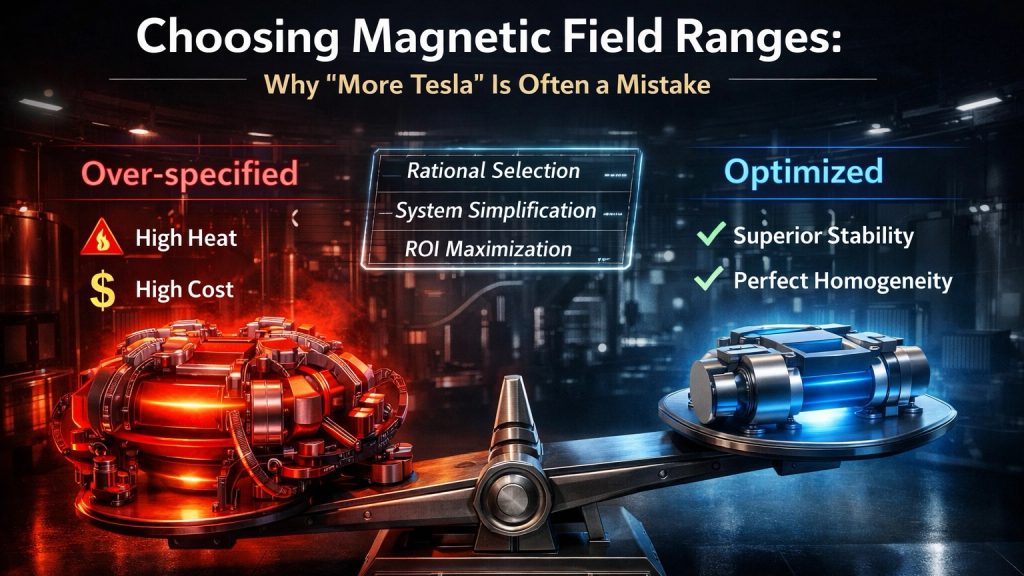
When specifying a magnetic system, many users instinctively request the highest possible field strength.
It feels safer. More capability must mean more flexibility.
In practice, over-specifying magnetic field range often increases system complexity, reduces stability, and inflates cost—without improving experimental outcomes.
This article explains why choosing the right magnetic field range is a strategic engineering decision, not a numbers competition.
1. The “More Tesla” Reflex
A typical inquiry looks like this:
- Required field: “Up to 2 Tesla (just in case)”
- Uniform region: unspecified
- Duty cycle: unspecified
The assumption is simple:
Higher maximum field = better system.
But magnetic system design does not scale linearly with field strength.
2. Magnetic Field Scaling Is Not Free
For electromagnets and coils:
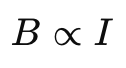
If geometry is fixed, increasing magnetic field requires increasing current.
However:
- Coil resistance increases with temperature
- Heat dissipation increases with :

- Power supply capacity must scale accordingly
According to the basic principles summarized in Electromagnet (Wikipedia):
https://en.wikipedia.org/wiki/Electromagnet
Magnetic field strength is directly tied to current and coil design.
That relationship comes with thermal consequences.
3. Thermal Reality: Heat Scales Faster Than Field
Doubling field strength often means:
- Significantly higher current
- Exponential increase in heat load
- Larger cooling systems
- Reduced duty cycle
This can lead to:
- Thermal drift
- Lower long-term stability
- Increased acoustic noise (cooling systems)
- Higher mechanical stress
In many laboratory measurements, thermal stability matters more than peak field.
4. High Field Often Reduces Uniformity
Increasing field strength frequently requires:
- Narrower pole gaps (electromagnets)
- Larger coil currents (Helmholtz systems)
- More aggressive cooling integration
These changes can reduce:
- Uniform field volume
- Accessibility for probes
- Optical or mechanical integration space
In precision experiments, field homogeneity often matters more than maximum field amplitude.
5. Cost Escalation Is Non-Linear
Higher field ranges typically demand:
- Larger copper cross-sections
- More robust power supplies
- Enhanced cooling infrastructure
- Reinforced mechanical frames
Cost does not increase proportionally—it often jumps in discrete steps.
Many users discover that increasing field from 1 T to 1.5 T may increase total system cost by 40–70%, depending on architecture.
6. When Higher Field Is Actually Necessary
There are valid cases:
- Magnetic saturation studies
- High-coercivity materials
- Fundamental condensed matter research
Research literature often highlights strong-field experiments
(e.g., high-field materials research discussed in journals such as Nature),
but these represent specific use cases—not general laboratory requirements.
For most device characterization and sensor calibration tasks:
- Moderate, stable fields are sufficient
- Repeatability outweighs extreme amplitude
7. Engineering Approach: Start from Data Sensitivity
Instead of asking:
“What is the highest Tesla I can get?”
Ask:
- What field range does the material actually require?
- At what resolution does my data change meaningfully?
- What stability is needed over the experiment duration?
Often, selecting a lower maximum field:
- Improves thermal stability
- Reduces drift
- Lowers maintenance burden
- Enhances uniformity
8. Smarter Magnetic System Specification
Cryomagtech works with laboratories to define magnetic field ranges based on:
- Experimental objectives
- Required uniform region
- Stability targets
- Long-term operational efficiency
Choosing the right field range often improves performance more than simply increasing Tesla.
Key Takeaways
- Magnetic field strength scales with current and heat
- Higher Tesla increases thermal and cost complexity
- Stability and uniformity often matter more than peak field
- Right-sizing field range improves overall system performance
In magnetic system design, restraint is often more powerful than excess.