
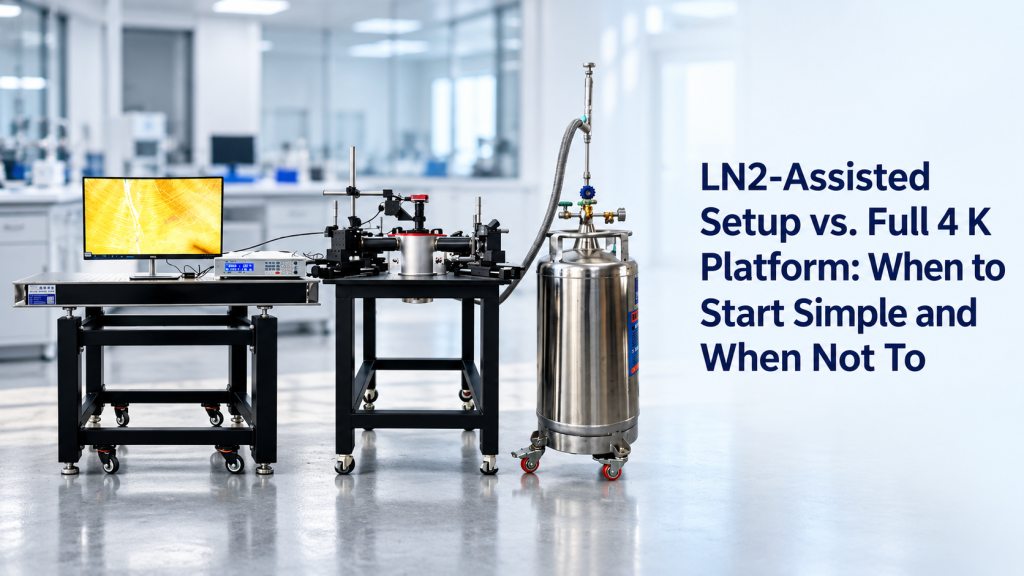
When a laboratory begins planning low-temperature Hall effect, electrical transport, or magnetic measurements, one of the first budget questions is often:
Do we really need a full 4 K cryogenic platform now, or can we start with an LN2-assisted setup and upgrade later?
For budget-sensitive university laboratories and growing R&D groups, starting with liquid nitrogen can be a very sensible strategy.
But not always.
Sometimes a lower-cost LN2 system is a genuine first stage of a long-term research platform. In other cases, it becomes equipment that must eventually be replaced when the laboratory discovers that its real science happens below 77 K.
The right decision is therefore not simply:
“How low can the system go?”
A better question is:
“What temperature range does our science actually require—and can today’s hardware become part of tomorrow’s system?”
This article compares an LN2 vs 4 K cryogenic platform from the perspective of research capability, Hall measurements, operating complexity, upgrade strategy, and total cost of ownership.
1. First Understand What “LN2” and “4 K” Really Mean
Liquid nitrogen and 4 K systems represent very different cryogenic environments.
At atmospheric pressure, liquid nitrogen boils at approximately 77.3 K, while liquid helium boils at approximately 4.2 K, according to NIST cryogenic property data. NIST
That temperature difference is not incremental.
It opens completely different experimental regimes.
An LN2-Assisted Setup May Mean
Depending on the system design:
- A simple 77 K immersion or cold-stage measurement
- A liquid-nitrogen cryostat
- Variable-temperature operation approximately from 80 K upward
- A Hall or resistivity platform using LN2 as the cooling source
- A low-cost first step into temperature-dependent characterization
A Full 4 K Platform May Mean
- A liquid-helium cryostat
- A closed-cycle refrigerator
- A pulse-tube cryocooler
- A cryogen-free 4 K measurement platform
- An integrated low-temperature Hall or electrical transport system
This distinction matters because “4 K” does not automatically mean a laboratory must continuously consume liquid helium.
Modern closed-cycle cryocoolers can provide approximately 4 K operation without routine liquid-helium filling.
2. Why LN2 Is Such an Attractive Starting Point
LN2 systems remain popular for a simple reason:
They can provide a major increase in experimental capability without immediately requiring a complete ultra-low-temperature infrastructure.
Practical Advantages of LN2
An LN2-assisted setup can offer:
- Lower initial capital cost
- Simpler cryostat architecture
- Easier laboratory installation
- Relatively straightforward operation
- Faster training for new users
- Lower system complexity
- Suitable temperature range for many semiconductor and materials experiments
For laboratories moving from room-temperature measurements into low-temperature characterization for the first time, this can be a very rational first investment.
77 K Is Already Scientifically Important
Liquid-nitrogen temperature is not simply a demonstration temperature.
It can be relevant for:
- Semiconductor carrier transport
- Resistivity versus temperature
- Mobility studies
- Magnetoresistance
- Sensor characterization
- Thermoelectric materials
- High-temperature superconductors
- Temperature-dependent magnetic and electronic properties
The historical development of high-temperature superconductors demonstrates why the 77 K boundary is important. Nature Materials notes that YBCO reached a critical temperature around 90 K, making liquid-nitrogen cooling practical compared with much more expensive helium-based cooling. Nature
For some research programs, therefore, an LN2 platform is not a compromise.
It may cover the entire scientifically relevant temperature range.
3. But “Low Temperature” Is Not One Research Category
This is where procurement discussions often go wrong.
A researcher may request:
“We need a low-temperature Hall measurement system.”
That requirement is incomplete.
Does “low temperature” mean:
- 200 K?
- 100 K?
- 77 K?
- 50 K?
- 20 K?
- 4 K?
- Below 4 K?
Those are very different system specifications.
The Important Question Is the Lowest Scientifically Meaningful Temperature
Suppose your current project studies carrier mobility between:
300 K and 100 K
A full 4 K cryogenic platform may provide capability that is not currently being used.
But suppose the research program involves:
- Superconducting transitions around 20–40 K
- Quantum transport below 10 K
- Low-temperature magnetoresistance
- Weak localization
- Shubnikov–de Haas oscillations
- Low-temperature semiconductor freeze-out
- Strongly temperature-dependent magnetic transitions below 77 K
Then an LN2 platform may stop before the most important physics begins.
In that case, “starting simple” can become false economy.
4. LN2 vs 4 K Cryogenic Platform: The Real Comparison
The comparison should extend beyond purchase price.
LN2-Assisted Platform
Best suited to laboratories prioritizing:
- Lower entry cost
- Approximately 77–300 K characterization
- Relatively simple operation
- Routine temperature-dependent Hall measurements
- Early-stage material screening
- Teaching or shared laboratory access
Potential limitations:
- Cannot access phenomena occurring far below 77 K
- May require manual cryogen handling
- Cooling duration can depend on cryostat design
- Long automated temperature sweeps require proper control architecture
- Some components may not transfer directly to a future 4 K system
Full 4 K Platform
Best suited to laboratories requiring:
- Deep cryogenic transport measurements
- Approximately 4–300 K characterization
- Advanced semiconductor physics
- Superconductivity research
- Quantum materials research
- Automated multi-temperature measurements
- Long-term expansion into advanced low-temperature experiments
Potential trade-offs:
- Higher initial investment
- Greater system complexity
- More demanding thermal engineering
- Longer cooldown cycles in some configurations
- Higher maintenance and integration requirements
The correct platform is the one that matches the research roadmap, not simply the current budget.
5. When Starting With LN2 Makes Good Engineering Sense
Starting simple is reasonable when the first-stage platform has a clearly defined scientific role.
Scenario 1: Your Research Questions Are Above Approximately 80 K
If the laboratory primarily measures:
- Room-temperature Hall parameters
- Mobility from 300 K down to approximately 80 K
- Semiconductor resistivity
- Moderate-temperature magnetoresistance
- Temperature coefficients
then purchasing a complete 4 K system simply because it offers a lower number may not improve the research.
Scenario 2: You Are Still Validating the Research Direction
A new laboratory may not yet know:
- Which materials will become the main research focus
- Whether low-temperature transport will become a core capability
- What magnetic field will ultimately be needed
- Whether a superconducting magnet will eventually be required
Committing immediately to an expensive integrated cryogenic platform can lock the laboratory into assumptions made too early.
A modular LN2 system can allow the research program to develop before the larger capital decision is made.
Scenario 3: Budget Is Available in Stages
Many university laboratories do not receive one large equipment budget.
Funding may arrive through:
- Initial laboratory setup
- Department funding
- Later research grants
- Shared-platform funding
- Project-specific equipment budgets
A staged procurement strategy can be sensible—but only if the equipment architecture is deliberately planned for it.
6. “Upgrade Later” Is Only Valuable If the Upgrade Path Is Real
This is the most important procurement warning in this article.
Many systems are described as:
“Upgradeable to 4 K later.”
That statement needs to be examined carefully.
Ask Exactly What Can Be Reused
Can the future 4 K configuration reuse:
- Temperature controller?
- Temperature monitor?
- Temperature sensors?
- Measurement electronics?
- Current source?
- Nanovoltmeter?
- Hall switching matrix?
- Electromagnet?
- Magnet power supply?
- Software?
- Sample holder?
- Vacuum hardware?
- Control computer?
If the answer is yes for most of the expensive electronics, then staged procurement may be genuinely economical.
If the upgrade requires replacing almost everything except the computer, it is not really an upgrade.
It is a second system purchase.
7. The Cryostat Is Often the Main Architectural Divide
The electronics around a cryogenic system can often be modular.
The cryostat usually creates a much harder boundary.
An LN2 cryostat and a 4 K closed-cycle refrigerator may differ substantially in:
- Mechanical structure
- Vacuum requirements
- Radiation shielding
- Thermal anchoring
- Sample-space geometry
- Sensor selection
- Heater design
- Wiring
- Heat-load management
- Vibration behavior
This means laboratories should distinguish between:
Reusable instrumentation
and
temperature-specific cryogenic hardware.
A good staged strategy assumes that some components may be replaced while deliberately maximizing reuse of the expensive measurement and control instruments.
8. Temperature Controller Capability Is Not the Same as Cooling Capability
This misunderstanding is surprisingly common.
A temperature controller may be capable of reading a sensor at 4 K—or even much lower.
That does not mean the laboratory possesses a 4 K system.
The controller does not create the cryogenic environment by itself.
A Complete Low-Temperature System Requires
- Cooling source
- Cryostat
- Vacuum environment
- Temperature sensors
- Thermal links
- Heater
- Temperature controller
- Sample stage
- Wiring
- Measurement electronics
Cryomagtech, for example, offers cryogenic temperature controllers designed for low-temperature sensor measurement and closed-loop temperature regulation, including the CMT-290 platform. But the achievable sample temperature in a real experiment still depends on the complete cryogenic system surrounding the controller. Cryomagtech
This distinction is essential when planning an upgrade path.
9. Hall Measurements Make Temperature Planning More Complicated
For Hall effect characterization, temperature is only one part of the system.
The experiment may need simultaneous control of:
- Sample temperature
- Excitation current
- Hall voltage
- Magnetic field
- Field polarity
- Sample switching
- Data acquisition
A typical temperature-dependent Hall sequence might look like:
- Stabilize at 300 K
- Measure resistivity
- Apply positive magnetic field
- Measure Hall voltage
- Reverse field
- Repeat measurement
- Calculate carrier concentration and mobility
- Move to the next temperature
- Repeat the sequence
Once dozens of temperature points are involved, automation becomes increasingly important.
LN2 Hall Measurement
An LN2 platform may be entirely appropriate for:
- 300–80 K R-T curves
- Temperature-dependent mobility
- Carrier concentration versus temperature
- Hall coefficient versus temperature
- Magnetoresistance above approximately 80 K
4 K Hall Measurement
A 4 K platform becomes important when the experiment needs to continue into:
- Cryogenic semiconductor transport
- Superconducting transitions
- Quantum transport regimes
- Very low-temperature magnetoresistance
- Electronic phenomena below the LN2 range
Cryomagtech Hall and electrical transport platforms currently support different temperature architectures, including liquid-nitrogen configurations and closed-cycle cryogenic options extending toward approximately 4 K, depending on system configuration. Cryomagtech
10. Do Not Buy 4 K Capability Just Because It Sounds More Advanced
There is also an opposite procurement mistake:
Over-specification.
A 4 K system may look more future-proof in a grant proposal.
But unused capability still has a cost.
That cost may include:
- Larger capital investment
- Longer installation
- More complex maintenance
- Additional vacuum hardware
- Cryocooler servicing
- More complicated user training
- Longer measurement turnaround
If 95% of your experiments will remain between 100 K and 300 K, allocating budget toward better electrical measurement performance, magnetic field capability, automation, or additional sample channels may generate more scientific value than extending the temperature range to 4 K.
The lowest achievable temperature should not become a prestige specification.
11. When You Should NOT Start With LN2
There are several cases where beginning with LN2 may create more problems than it solves.
Your Core Physics Happens Below 77 K
This is the clearest case.
If the scientific question fundamentally requires 4 K, then 77 K is not an intermediate solution.
It is simply the wrong temperature range.
Your Grant Already Covers the Complete Platform
If funding is available now and the research roadmap clearly requires 4 K operation, splitting the project into two purchases may increase:
- Integration work
- Procurement effort
- Installation cost
- Training
- Duplicate hardware
The Future 4 K System Uses a Completely Different Geometry
This is particularly important when magnets are involved.
A future cryostat may require a larger magnet pole gap than the current LN2 insert.
That larger gap may reduce the magnetic field available from the existing electromagnet.
Suddenly the future upgrade requires:
- New cryostat
- New sample holder
- New magnet
- New power supply
At that point, the original “modular upgrade” has largely disappeared.
Your Experiment Requires Long Unattended Runs
If the future research program needs automated measurements across dozens of temperature points over many hours, a fully integrated closed-cycle platform may justify its higher initial cost through operational simplicity.
12. Magnet Geometry Should Be Planned Before the Cryostat
For Hall and magnetotransport systems, low-temperature upgrades can affect the magnetic system itself.
This is easy to underestimate.
Consider:
Room-temperature sample holder → small pole gap → higher achievable field
But after adding:
- Vacuum chamber
- Radiation shield
- Cryostat wall
- Thermal shield
- Sample insert
the required pole gap becomes larger.
For an electromagnet, increasing the pole gap generally reduces the achievable magnetic field for a given magnet design and excitation.
Therefore, laboratories expecting future 4 K operation should not select an electromagnet based only on today’s room-temperature or LN2 geometry.
Ask in Advance
- What will the future cryostat outer diameter be?
- What pole gap will it require?
- What magnetic field is required at that gap?
- Can the existing electromagnet accommodate it?
- Will the field remain uniform over the sample region?
This one design decision can determine whether staged procurement saves money or creates a future system replacement.
13. Sample Wiring Also Changes Below 77 K
Deep cryogenic measurements introduce additional constraints that may be insignificant at higher temperatures.
Examples include:
- Thermal conduction through measurement wires
- Sensor wiring
- Heater wiring
- Contact reliability during thermal cycling
- Sample mounting
- Thermal anchoring
- Electrical noise
- Thermoelectric voltages
Going from room temperature to 77 K is already a meaningful engineering step.
Going from 77 K toward 4 K requires another level of thermal management.
This is why a full 4 K platform should be treated as a system architecture, not simply a stronger refrigerator attached to an existing measurement setup.
14. The Three-Level Strategy Often Makes More Sense Than “LN2 or 4 K”
For many buyers, the decision should not be binary.
A better framework is to think in three levels.
Level 1 — Single-Point LN2 Measurement
Approximately:
77 K + room temperature
Useful for:
- Basic material comparison
- Screening
- Teaching
- Checking whether properties change strongly with temperature
This is the lowest-complexity entry point.
Level 2 — Variable-Temperature LN2 Platform
Approximately:
80 K to 300 K or higher, depending on cryostat design.
Useful for:
- R-T curves
- Temperature-dependent Hall mobility
- Semiconductor transport
- Controlled material characterization
This provides much more scientific information than a simple 77 K measurement.
Level 3 — Full 4 K Variable-Temperature Platform
Approximately:
4 K to 300 K or higher, depending on system architecture.
Useful for:
- Advanced electrical transport
- Superconductivity
- Quantum materials
- Low-temperature magnetoresistance
- Broad temperature-dependent studies
Cryomagtech’s Hall system configurations illustrate this layered architecture: available temperature options include single-point liquid-nitrogen operation, LN2 cryostats around 80 K and above, and closed-cycle cryogenic configurations extending toward 4 K. CryoMagTech Blog
This is often a much more useful procurement framework than simply asking for “a low-temperature system.”
15. A Better Way to Think About Budget
Instead of comparing only:
LN2 system price vs. 4 K system price
compare three numbers:
1. Cost of the System You Need Today
What is necessary to answer the current scientific question?
2. Cost of the Final System You Expect to Need
What is the likely research platform three years from now?
3. Cost of Getting From Stage 1 to Stage 2
Which components will survive the transition?
This produces a much better procurement metric:
Total cost to reach the final research capability
rather than:
Lowest initial purchase price
A cheaper first system can be financially worse if most of it must later be replaced.
16. How Cryomagtech Approaches Staged Cryogenic System Planning
Cryomagtech supplies cryogenic temperature instruments together with Hall effect, electrical transport, magnetic field, and low-temperature measurement solutions.
Depending on the research stage, a laboratory can evaluate combinations of:
- Cryogenic temperature controllers
- Multi-channel temperature monitors
- Cryogenic temperature sensors
- LN2 sample environments
- Variable-temperature cryostats
- 4 K closed-cycle cryogenic systems
- Hall effect measurement electronics
- Electrical transport measurement platforms
- Electromagnets
- Magnetic field power supplies
- Automated measurement software
The goal of staged procurement should not be to buy the cheapest possible first system.
It should be to create a first stage that produces useful research immediately without blocking the second stage later.
17. Questions to Answer Before Requesting a Quotation
Before deciding between an LN2 vs 4 K cryogenic platform, provide the supplier with more than a minimum temperature number.
Scientific Requirements
- What materials will be measured?
- What physical properties are being investigated?
- What transitions or phenomena are expected?
- What is the lowest scientifically meaningful temperature?
Measurement Requirements
- Hall effect?
- Resistivity?
- Magnetoresistance?
- I-V?
- R-T?
- Magnetic measurements?
Magnetic Field Requirements
- Maximum field
- Field direction
- Required pole gap
- Field sweep requirements
Temperature Requirements
- Single-point 77 K or continuously variable temperature?
- Current minimum temperature
- Future minimum temperature
- Required stability
- Required temperature sweep automation
Procurement Strategy
- Is this a complete project or Phase 1?
- Is 4 K expansion realistically expected?
- What hardware must remain reusable?
- Is future funding likely to purchase modules or an entirely new system?
These answers make it much easier to determine whether staged procurement is technically sound.
18. A Simple Decision Rule
A practical decision can be reduced to two questions.
Start With LN2 If:
- Your current science is genuinely above approximately 77–80 K
- Your budget is staged
- Your future research direction is still uncertain
- Important electronics can be reused
- The LN2 system will remain useful even after a future 4 K purchase
Start With 4 K If:
- Your core experiments already require temperatures below 77 K
- The future research roadmap clearly depends on 4 K operation
- Funding is available now
- The future cryostat changes the entire magnet and sample geometry
- Buying LN2 first would create substantial duplicate hardware
The decision should come from the research roadmap—not from the lowest quotation.
19. Key Takeaways
- LN2 and 4 K platforms serve fundamentally different temperature regimes.
- Liquid nitrogen operates near 77 K, while atmospheric-pressure liquid helium boils near 4.2 K. NIST
- An LN2-assisted platform can be an excellent cost-effective solution for semiconductor transport, Hall measurements, and materials research above approximately 80 K.
- A 4 K system becomes necessary when the important physics lies below the liquid-nitrogen range.
- “4 K” does not necessarily mean continuous liquid-helium consumption; closed-cycle and cryogen-free architectures are also available.
- A temperature controller’s minimum readable temperature does not determine the cooling capability of the complete system.
- Staged procurement only works when there is a genuine hardware reuse path.
- Cryostat geometry can affect magnet pole gap and achievable magnetic field.
- The cheapest first purchase is not necessarily the lowest-cost route to the final laboratory capability.
- Laboratories should design around the lowest scientifically meaningful temperature, not the lowest temperature that looks impressive on a specification sheet.
The best procurement question is therefore not:
“Can we afford 4 K today?”
It is:
“Will starting at LN2 move our research forward without forcing us to buy the same capability twice?”
For some laboratories, the answer is clearly yes.
For others, starting simple is exactly what makes the final system more expensive.
References
NIST – Cryogen Properties and Cryogenic Safety
NIST lists the normal boiling points of nitrogen at approximately 77.3 K and helium at approximately 4.2 K, providing a useful physical reference for understanding the very different temperature regimes represented by LN2 and 4 K platforms. NIST
NIST – Cryogen Safety and Cryogen Properties
Nature Materials – Hot Superconductors, 20 Years On
This Nature Materials article discusses the development of high-temperature superconductors and explains why superconducting transition temperatures above liquid nitrogen’s boiling point made LN2 cooling especially significant for practical applications. Nature