
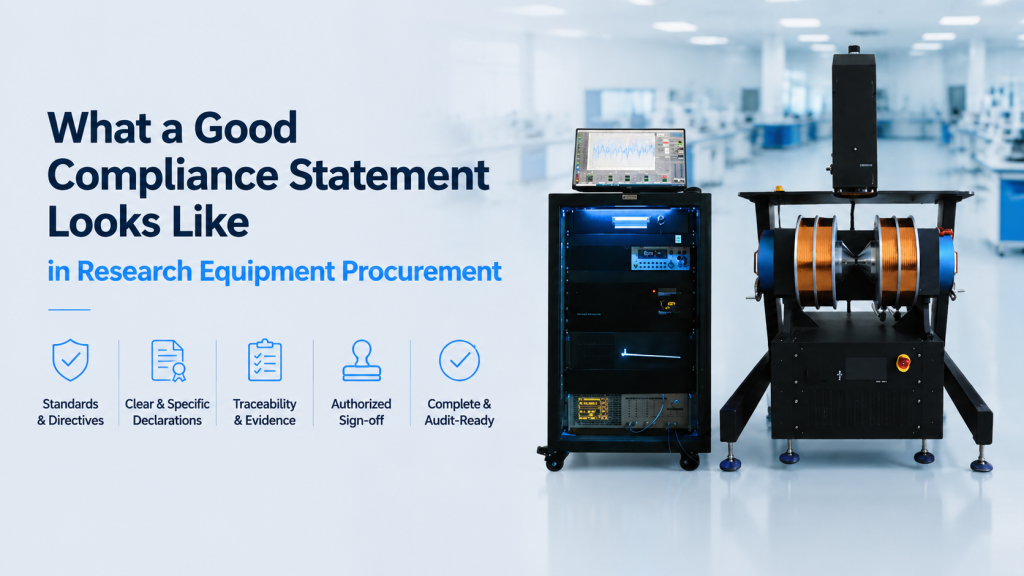
A tender asks a supplier to submit a compliance statement for a scientific instrument.
The response says:
“We fully comply with all specifications.”
It sounds confident.
It is also one of the least useful answers a serious procurement team can receive.
For complex research equipment, a good research equipment compliance statement should allow the buyer, technical evaluator, integrator, and supplier to answer four questions quickly:
- What exactly is being offered?
- Which requirements are fully met?
- Where are there deviations or conditions?
- What evidence supports each important claim?
This matters particularly for systems such as:
- Electromagnets and Helmholtz coil systems
- Hall Effect Measurement Systems
- VSM systems
- MOKE systems
- Cryogenic temperature systems
- Probe stations
- Customized magnetic measurement platforms
A compliance statement is also not automatically the same thing as a regulatory Declaration of Conformity.
ISO/IEC 17050-1 defines general requirements for a supplier’s declaration of conformity, while ISO/IEC 17050-2 addresses supporting documentation used to substantiate such a declaration.
In procurement, however, buyers often use the phrase compliance statement more broadly to mean a structured response to their technical, documentary, commercial, and regulatory requirements.
Understanding that distinction is the first step toward writing a useful one.
1. A Compliance Statement Is Not a Marketing Brochure
A brochure answers:
“What can this product do?”
A compliance statement answers:
“Does the exact configuration being offered meet this exact requirement?”
Those are different documents.
Brochure Language
A product brochure may say:
- High magnetic field
- Excellent stability
- Flexible sample stage
- Multiple temperature options
- Advanced software
- Easy system integration
These statements are useful for product introduction.
They are not sufficient for formal technical evaluation.
Compliance Language
A compliance response should instead say something like:
Requirement: Magnetic field ≥0.8 T at 20 mm pole gap.
Supplier response: Comply.
Offered performance: ≥0.85 T at 20 mm gap under continuous water-cooled operation.
Evidence: Technical Specification, Section 3.2.
Now the evaluator can compare the offer with the requirement.
That is the purpose of a compliance statement.
2. Do Not Confuse Procurement Compliance With Regulatory Conformity
This distinction is important.
Procurement Compliance
A buyer may ask whether a system complies with requirements such as:
- Magnetic field
- Temperature range
- Sample dimensions
- Software functions
- Delivery time
- Training
- Warranty
- Documentation
This is primarily a contractual and technical comparison between the tender specification and the supplier’s offer.
Regulatory Conformity
This concerns whether a product satisfies applicable legal or regulatory requirements.
For products placed on the EU market, for example, CE marking applies only where relevant EU harmonization legislation requires it. The manufacturer must identify the applicable requirements, perform the appropriate conformity assessment, prepare technical documentation, and issue an EU Declaration of Conformity where required.
The European Commission also makes clear that CE marking is tied to applicable EU requirements rather than being a general-purpose quality certificate.
Therefore, a supplier should not use:
“CE compliant”
as a vague substitute for explaining the actual technical offer.
And a tender compliance matrix should not be mistaken for an EU Declaration of Conformity.
3. “Fully Compliant” Should Never Be the Only Response
Imagine a 12-page technical specification containing 80 requirements.
The supplier responds:
“Our system fully complies with the specification.”
That creates several problems.
The evaluator cannot easily determine:
- Which offered model is being referenced
- Whether accessories are included
- Whether performance is standard or customized
- Whether a requirement applies only under certain conditions
- Whether an optional item has been assumed
- Which document proves the claim
A stronger response is clause-by-clause.
Example
Buyer requirement: Temperature range 4–300 K.
Supplier response: Partially compliant.
Offered configuration: Standard cryogenic module provides approximately 10–300 K. A 4 K closed-cycle configuration is available as an optional upgrade and is not included in the base quotation.
That response may look less impressive than “fully compliant.”
It is far more useful—and far safer commercially.
4. A Good Compliance Statement Uses Defined Response Categories
Do not improvise a different phrase for every clause.
Use a controlled vocabulary.
A practical structure may include:
- Comply
- Partially Comply
- Deviation
- Not Applicable
- Optional
- To Be Confirmed
The exact terminology can follow the buyer’s tender format when one is provided.
Comply
Use when the offered configuration meets the requirement without a material qualification.
Partially Comply
Use when part of the requirement is satisfied but another part is not.
Deviation
Use when the proposed system differs from the stated requirement.
Not Applicable
Use only when the clause genuinely does not apply to the offered configuration.
Optional
Use when the capability is available but is not included in the quoted base system.
To Be Confirmed
Use sparingly when a final answer depends on information not yet supplied or on engineering work not yet completed.
These categories make the document easier to audit.
5. “Comply” Should Refer to the Quoted Configuration
This is one of the most important rules.
A manufacturer may be capable of producing many configurations.
The tender is evaluating one offer.
Suppose the buyer requires:
±1 T magnetic field.
Your company may manufacture a 1 T electromagnet.
But the quotation currently includes a lower-cost 0.5 T system.
You cannot reasonably mark:
Comply
because another product in the catalogue can meet the requirement.
Compliance should refer to:
the configuration, accessories, options, and services included in the submitted offer.
If an upgrade can satisfy the clause, say:
Optional – compliant configuration available at additional cost.
That is transparent and commercially useful.
6. Every Important Number Should Include Its Operating Condition
Research equipment specifications are full of numbers that become meaningless when their conditions disappear.
Examples include:
- Magnetic field
- Field uniformity
- Temperature stability
- Measurement sensitivity
- Maximum current
- Noise
- Vacuum level
- Optical resolution
Weak Compliance Statement
Magnetic field: 1 T — Comply.
Better Statement
Maximum magnetic field: ≥1 T at a 10 mm pole gap with the specified pole faces and water-cooled continuous operation.
The second version tells the buyer what will actually be delivered.
Cryogenic Example
Weak:
Temperature stability: ±0.01 K — Comply.
Better:
At the specified operating point of 20 K, after thermal stabilization, the control sensor can be maintained within the agreed stability band under the defined system load; final acceptance conditions to follow the technical specification.
The more demanding the specification, the more important the test condition becomes.
7. Separate Standard Capability From Custom Engineering
A compliance statement should help the buyer see which features are proven standard functions and which require development.
Use language such as:
Standard
“Comply — included in standard configuration.”
Standard Option
“Comply — requires listed optional module.”
Customized
“Comply by customization — included in the quoted configuration.”
Engineering Review Required
“Conditional compliance — final dimensions/performance subject to confirmation after receipt of customer interface drawing.”
These distinctions reduce project risk.
They are especially important for:
- Custom electromagnets
- Non-standard coil geometries
- Cryogenic integration
- Custom MOKE optical access
- Special VSM sample environments
- Third-party equipment integration
A buyer evaluating a custom scientific system should know where engineering uncertainty remains.
8. Never Turn an Estimate Into a Guaranteed Specification
During early discussion, suppliers often use engineering estimates.
For example:
- Expected field: approximately 0.9 T
- Estimated stability: around 20 mK
- Preliminary dimensions: approximately 800 mm
- Estimated delivery: 12–16 weeks
Those numbers can be useful for feasibility.
They should not silently become guaranteed acceptance specifications.
Compliance Statement Language Should Distinguish
- Guaranteed
- Nominal
- Typical
- Expected
- Estimated
- Target
- Subject to final design
This is not legalistic wording for its own sake.
It tells the buyer how much engineering confidence exists behind the number.
9. Technical Compliance Should Be Traceable to Evidence
ISO/IEC 17050-2 specifically addresses supporting documentation used to substantiate a supplier’s declaration of conformity, reflecting a broader conformity-assessment principle: a declaration is more credible when evidence exists behind it.
The same principle is useful in tender responses.
A compliance matrix can include an evidence column.
Possible evidence includes:
- Technical datasheet
- Drawing
- Test report
- User manual
- Calibration certificate
- Factory acceptance test
- Product photograph
- Previous configuration reference
- Engineering calculation
Example
Requirement: Pole gap adjustable from 10–50 mm.
Status: Comply.
Offered specification: Manual continuously adjustable gap, 10–50 mm.
Evidence: Mechanical Drawing CMT-EM-202, Rev. B.
This is much stronger than:
“Comply.”
10. Do Not Cite Irrelevant Evidence
A common tender mistake is attaching 200 pages of brochures and certificates.
Volume is not traceability.
If the requirement concerns:
maximum field at a 30 mm gap,
then an ISO management-system certificate does not prove the magnetic-field specification.
Likewise:
- CE documentation does not prove measurement sensitivity.
- A calibration certificate does not prove delivery time.
- A product brochure may not prove a custom interface dimension.
Evidence should match the claim.
11. Standards Should Be Named Precisely
Avoid statements such as:
“Complies with all international standards.”
That is almost impossible to interpret.
Instead specify the actual applicable standard or regulatory framework where confirmed.
For example:
- Standard number
- Edition or year when relevant
- Product or subsystem covered
- Evidence available
ISO/IEC 17050-1 exists precisely to provide general requirements for supplier declarations of conformity to specified requirements; the key idea is that the requirements being claimed should actually be identifiable.
Better Language
“Compliance with the following applicable requirements will be documented for the supplied configuration: [specific standards / regulations].”
That is better than promising compliance with an undefined universe of standards.
12. CE Marking Should Be Used Carefully in Research Equipment Quotes
For European projects, buyers commonly ask:
“CE required.”
The supplier should first determine whether the offered product falls within legislation that requires CE marking and which rules apply.
Official EU guidance places responsibility on manufacturers to determine applicable requirements, complete the required conformity assessment, prepare technical documentation, and sign the Declaration of Conformity before affixing CE marking where required.
Good Response
“CE marking: applicable to the offered final product configuration; EU Declaration of Conformity will be supplied with delivery.”
Conditional Response
“CE requirements for the final customized integrated system are under review and will be confirmed after final system configuration is frozen.”
Poor Response
“CE certified.”
unless a specific certification process and document actually justify that terminology.
In many CE frameworks, manufacturer self-declaration is part of the applicable conformity route; therefore the exact legal mechanism matters more than using the word “certificate.”
13. Component Compliance Does Not Automatically Prove System Compliance
Imagine an integrated research system containing:
- Power supply
- Electromagnet
- Chiller
- Control cabinet
- Computer
- Motion stage
Several components may carry individual CE markings.
That does not automatically answer the regulatory status of the final integrated product.
EU guidance states that where a manufacturer places a final product on the EU market, the Declaration of Conformity must cover the final product even when individual components are already CE marked, where the applicable rules require such a declaration.
This has an important implication for scientific system integrators:
Do not simply collect component certificates and assume the integrated system question is finished.
The final configuration matters.
14. A Compliance Statement Should Separate Technical and Regulatory Claims
A useful tender response may have separate sections.
Technical Compliance
Examples:
- Magnetic field
- Pole gap
- Uniformity
- Temperature range
- Sample size
- Measurement resolution
- Software functions
Regulatory / Safety Compliance
Examples:
- Applicable product safety requirements
- CE-related documentation where required
- Electrical safety documentation
- Laser-related documentation where applicable
Documentation Compliance
Examples:
- Manuals
- Drawings
- Test reports
- Calibration records
Commercial Compliance
Examples:
- Delivery
- Warranty
- Training
- Payment terms
This prevents unrelated topics from being mixed into one “compliant/not compliant” answer.
15. Commercial Clauses Need Compliance Responses Too
Technical teams often focus entirely on the instrument specifications.
Procurement teams may care equally about:
- Delivery schedule
- Warranty
- Installation
- Training
- Payment terms
- Packaging
- Shipping terms
- Documentation
- Spare parts
- After-sales support
A supplier can be technically compliant and commercially non-compliant.
Example
Buyer requires:
36-month warranty.
Supplier offers:
12 months.
Do not mark the overall tender:
“Fully compliant.”
Write:
Deviation — standard warranty is 12 months. Extension to 36 months can be quoted separately.
This gives the buyer a choice.
16. Training Requirements Should Be Treated as Real Requirements
If the tender says:
“On-site training for five operators included,”
the compliance response should not simply say:
“Training available.”
Those sentences do not mean the same thing.
Better Response
“Comply — one day of on-site operator training for up to five users is included after successful commissioning. Training language: English. International travel costs are included/excluded as stated in the commercial quotation.”
Now the scope is measurable.
The same principle applies to:
- Installation
- Commissioning
- Acceptance testing
- Remote support
17. Delivery Compliance Needs a Starting Point
“Delivery within 12 weeks” is incomplete unless both parties understand when the clock starts.
Possible starting points include:
- Purchase order date
- Receipt of advance payment
- Final technical approval
- Approval of drawings
- Receipt of customer interface information
For customized research equipment, the safest response may be:
“Comply — estimated delivery 12 weeks from final technical confirmation and receipt of the agreed advance payment.”
If the buyer’s tender defines another starting point, respond directly to it.
18. Acceptance Criteria Deserve Their Own Column
For major systems, the strongest compliance matrices connect requirements with verification.
For example:
| Requirement | Response | Offered Value | Verification |
|---|---|---|---|
| Field ≥0.8 T at 20 mm | Comply | ≥0.85 T | Factory magnetic-field test |
| Gap 10–50 mm | Comply | 10–50 mm | Mechanical inspection |
| Bipolar operation | Comply | ±B | Functional test |
| USB control | Comply | Included | Communication test |
This makes later Factory Acceptance Testing much easier.
The specification, quotation, compliance statement, and acceptance procedure now speak the same language.
19. If a Requirement Cannot Be Verified, Say How It Will Be Evaluated
Some requirements cannot easily be tested during ordinary factory acceptance.
Examples might include:
- Long-term lifetime
- Special compatibility with customer equipment
- Performance under a facility-specific environment
The response can state:
- Manufacturer specification
- Design analysis
- Customer-site verification
- Joint integration test
The important point is to avoid pretending that every clause has already been physically proven.
20. “Equivalent” Needs an Explanation
Tenders sometimes specify a particular architecture.
The supplier may have a technically equivalent solution.
Simply writing:
Equivalent
is not enough.
Explain why.
Example
Buyer requires:
“Mechanical field reversal.”
Supplier proposes:
“Electronic bipolar current reversal using a four-quadrant power supply.”
The compliance response might state:
Deviation / Equivalent solution proposed: Magnetic-field polarity is reversed electronically without mechanical rotation. This preserves sample position and provides programmable ±B operation.
Now the evaluator can decide whether the alternative satisfies the scientific objective.
21. Do Not Hide Deviations in Footnotes
A major deviation should appear directly beside the requirement.
Poor practice:
Status: Comply*
and four pages later:
“*Maximum field available only for 60 seconds.”
Better:
Partial compliance — 1 T is available for up to 60 seconds; continuous field rating is 0.8 T under the stated cooling condition.
A technical evaluator should not need detective work to understand the proposal.
22. A Transparent Deviation Can Strengthen a Bid
Suppliers sometimes fear that any word other than “Comply” will weaken the offer.
That is not always true.
For sophisticated scientific procurement, a technically reasoned deviation may demonstrate that the supplier understands the requirement.
Example
Buyer asks for:
“1 T at 50 mm pole gap with an electromagnet weighing less than 30 kg.”
If those requirements conflict physically, a professional supplier should explain the trade-off rather than mark everything “Comply.”
A credible alternative might be:
- 0.6 T at 50 mm
- 1 T at 25 mm
- Larger magnet required for 1 T at 50 mm
That conversation is much more useful than an unrealistic promise.
23. “To Be Confirmed” Should Not Become a Hiding Place
Some uncertainty is normal during custom engineering.
But a compliance statement containing:
- TBD
- TBC
- TBD
- TBC
on every difficult clause is not a completed proposal.
Use “To Be Confirmed” only when:
- Buyer information is missing
- Final drawing approval is pending
- A legitimate engineering calculation remains open
Then identify what is needed.
Better Response
“To be confirmed after receipt of the customer cryostat outer-dimension drawing and optical-axis position.”
Now the open dependency is clear.
24. Buyer Dependencies Should Be Stated Explicitly
Some compliance depends on the buyer.
Examples include:
- Facility power
- Cooling water
- Compressed air
- Vacuum connection
- Customer-supplied computer
- Customer-supplied cryostat
- Sample contact quality
- Optical access
Example
“Comply, provided the customer-supplied cooling water meets the specified flow, pressure, and inlet-temperature requirements.”
That is not avoiding responsibility.
It is defining the system boundary.
25. Third-Party Equipment Should Have a Clear Responsibility Boundary
Research platforms frequently integrate third-party equipment such as:
- Keithley instruments
- Lock-in amplifiers
- Cryostats
- Chillers
- Vacuum pumps
- Customer computers
The compliance document should identify whether the third-party component is:
- Supplied by vendor
- Supplied by buyer
- Integrated by vendor
- Only mechanically compatible
- Only electrically compatible
Example
“Software communication with the specified third-party source meter is included using the documented interface. Calibration and warranty of the source meter remain the responsibility of its original manufacturer.”
Clear boundaries reduce after-sales disputes.
26. Customized Interfaces Need Drawings
Text alone is often insufficient for:
- Sample space
- Pole gap
- Optical access
- Cryostat integration
- Mounting holes
- Probe clearance
The compliance response should reference an interface drawing where appropriate.
Good Practice
“Comply according to Interface Drawing CMT-MOKE-017 Rev. A.”
The final approved drawing can then become part of the contractual technical package.
27. Document Revision Control Matters
For complicated tenders, documents evolve.
You may have:
- Quotation Rev. A
- Specification Rev. B
- Compliance Matrix Rev. C
- Drawing Rev. D
If documents contradict each other, problems follow.
A Strong Compliance Statement Should Identify
- Tender/reference number
- Buyer specification revision
- Supplier quotation number
- Supplier quotation revision
- Date
For example:
This compliance statement responds to Technical Specification ABC-2026, Rev. 3, dated 15 July 2026, and forms part of Quotation CMT-Q-2026-088 Rev. B.
Now everyone knows which documents belong together.
28. Do Not Copy the Buyer’s Requirement Incorrectly
When creating a compliance matrix, preserve the buyer’s original requirement accurately.
Do not casually shorten:
“Maximum field ≥1 T at 20 mm pole gap”
into:
“Field: 1 T.”
The second statement has lost a critical condition.
If necessary, use:
- Clause number
- Exact requirement
- Supplier response
This reduces accidental reinterpretation.
29. One Requirement per Row Is Usually Better
A tender clause sometimes contains four different requirements.
For example:
“The system shall provide ±1 T, 20 mm minimum gap, water cooling, and automatic field reversal.”
If you put the entire sentence into one row and mark:
Partial compliance
the buyer cannot immediately see which part failed.
Break it down:
- Maximum field
- Gap
- Cooling
- Reversal
Each gets its own response.
This improves evaluation and later acceptance testing.
30. Separate Mandatory Requirements From Preferences
Not every tender clause has equal importance.
Buyers may classify requirements as:
- Mandatory
- Preferred
- Optional
Suppliers should preserve those classifications.
A deviation from a preferred requirement may be manageable.
A deviation from a mandatory requirement may disqualify the bid.
The compliance statement should help the procurement team see this immediately.
31. Do Not Claim Certifications You Do Not Hold
This sounds obvious, but formal tenders create pressure.
If the buyer requests:
- ISO certification
- Calibration accreditation
- Specific laboratory accreditation
- Product certification
do not substitute a similar document.
For example:
- An ISO 9001 management-system certificate is not a product-performance certificate.
- A component CE marking is not necessarily the final integrated system’s declaration.
- A calibration report is not automatically an accredited calibration certificate.
A professional response may simply say:
Not available / deviation.
That is better than submitting the wrong document.
32. Supplier Declaration and Third-Party Certification Are Different
ISO describes several forms of conformity attestation. ISO/IEC 17050 specifically addresses supplier declarations of conformity, which are first-party declarations rather than automatically third-party certification.
Therefore, use terminology carefully.
Supplier Declaration
The supplier states that specified requirements are fulfilled.
Third-Party Certification
An independent certification body performs the applicable assessment and issues certification under its scheme.
These are not interchangeable.
If a tender specifically requires independent third-party certification, a supplier declaration may not satisfy it.
33. “Certificate Available” Should Identify the Certificate
Avoid:
“All certificates available.”
Instead list:
- Document name
- Issuing organization
- Scope
- Applicable product/configuration
- Availability stage
For example:
EU Declaration of Conformity — supplied with final product where applicable.
or:
Factory magnetic-field test report — supplied before shipment.
This gives procurement teams something they can actually verify.
34. Technical Documentation Should Support the Final Configuration
Official EU guidance explains that technical documentation used for applicable EU product compliance should describe areas such as product design, manufacture, and operation and provide the information needed to demonstrate conformity with applicable requirements.
A similar discipline is useful even outside regulatory documentation.
For customized scientific systems, final documentation should match:
the machine that was actually built
—not merely the supplier’s generic catalogue.
Potential project documents include:
- Final datasheet
- Electrical diagram
- Mechanical drawing
- User manual
- Test report
- Interface drawing
- Calibration information
35. Compliance Before Engineering Freeze May Need Qualification
During a tender, the final custom design may not exist yet.
That is normal.
The supplier can still provide a meaningful compliance statement by separating:
Confirmed Performance
Based on existing standard design.
Engineered Performance
Calculated or adapted from an existing platform.
Target Performance
Requires detailed engineering after order.
Unconfirmed Requirement
Cannot yet be responsibly guaranteed.
This provides a realistic maturity picture.
36. A Good Statement Should Distinguish Design Target From Acceptance Limit
Suppose engineers design a magnet for:
0.90 T
because the buyer requires:
≥0.80 T.
Then:
- 0.90 T may be the design target.
- 0.80 T is the acceptance requirement.
These should not be confused.
A robust system usually needs engineering margin.
The compliance document should commit to the acceptance value, not accidentally convert every internal design target into a contractual guarantee.
37. Requirements Should Be Quantified Whenever Possible
Weak:
“Low noise.”
Better:
“Noise ≤X under stated measurement conditions.”
Weak:
“High field uniformity.”
Better:
“Field uniformity ≤±X% over the specified volume.”
Weak:
“Stable temperature.”
Better:
“Stability requirement defined at specified temperatures and over an agreed time window.”
Subjective adjectives create disputes.
Measurable criteria create acceptance tests.
38. But Do Not Invent Numbers the Buyer Never Requested
The opposite mistake also occurs.
A supplier may try to make the proposal look more professional by inventing specifications.
For example:
“Field stability: ±0.001%.”
If this has never been measured or guaranteed, do not include it casually.
Every quantitative statement in a formal compliance document can potentially become a contractual expectation.
Only state numbers you can support.
39. Compliance Matrices Are Especially Valuable for Systems With Many Subsystems
Consider a complete cryogenic Hall system.
It may contain:
- Magnet
- Magnet power supply
- Hall electronics
- Temperature controller
- Cryostat
- Vacuum system
- Sample holder
- Computer
- Software
A paragraph saying:
“The system complies with the tender”
hides enormous complexity.
A matrix can identify exactly which subsystem satisfies each requirement.
Example
Requirement: Sample temperature 10–300 K.
Status: Comply.
Subsystem: Cryostat + temperature controller.
Evidence: Technical Specification Section 5.
This is particularly useful for systems integration.
40. Regulatory Scope May Differ Between Countries
A global research-equipment supplier may sell the same basic platform to:
- EU
- United States
- Japan
- Canada
- Australia
- Other markets
Regulatory and documentation requirements may differ.
Therefore, compliance statements should avoid globally universal claims unless they are actually justified.
Better Approach
Identify:
- Destination country
- Final configuration
- Applicable regulatory requirements
- Required project documentation
For CE marking specifically, EU guidance requires the manufacturer to identify the applicable EU requirements before placing products subject to those rules on the market.
Formal procurement works better when destination-market compliance is reviewed early.
41. The Buyer Should Also Identify Its Institutional Requirements
Not every requirement comes from product law.
A university or national laboratory may impose its own:
- Electrical standards
- Facility rules
- Laser rules
- Procurement clauses
- Cybersecurity requirements
- Documentation templates
These may be stricter or simply different from the supplier’s standard package.
The buyer should provide these requirements before final quotation whenever possible.
42. A Good Compliance Statement Should Reveal Open Risks
The best compliance document is not necessarily the one containing the most green “Comply” cells.
It is the one that lets both parties see the project clearly.
Potential open risks might include:
- Customer interface drawing missing
- Sample resistance unknown
- Cryostat dimensions incomplete
- Facility cooling water unconfirmed
- Acceptance method not defined
- Third-party software interface not tested
These should be identified early.
A compliance statement can therefore function as a project-risk document as well as a tender response.
43. Compliance Should Be Frozen Before Production
For customized systems, technical discussion may continue after the initial quotation.
Before production begins, the parties should ideally confirm the final scope.
This may include:
- Final specification
- Final drawing
- Accepted deviations
- Final accessories
- Acceptance criteria
Otherwise, the supplier may build against Revision A while the buyer expects Revision C.
A frozen compliance baseline helps prevent scope creep.
44. Changes After Order Should Be Controlled Separately
Suppose the original tender requires:
0.5 T.
After order, the buyer asks:
“Can you change it to 1 T?”
That is not a compliance correction.
It is a scope change.
It may affect:
- Magnet
- Power supply
- Cooling
- Cost
- Delivery
The original compliance statement should remain traceable, while new requirements should enter a formal revision or change process.
45. A Weak Compliance Statement Example
Requirement
System shall include ±1 T electromagnet, automated Hall measurement, 10–300 K temperature control, software, installation, and training.
Supplier Response
“Fully compliant. Our system can meet all customer requirements.”
This tells the buyer almost nothing.
46. A Better Compliance Statement Example
Requirement 1
Magnetic field ≥±1 T at 20 mm working gap.
Status: Comply.
Offered configuration: Water-cooled bipolar electromagnet, ≥±1 T at 20 mm gap.
Verification: Factory magnetic-field test.
Requirement 2
Automatic carrier concentration and Hall mobility measurement.
Status: Comply.
Offered configuration: Automated Hall measurement software with current/field reversal and van der Pauw calculation.
Verification: Functional acceptance test.
Requirement 3
Temperature range 10–300 K.
Status: Comply.
Offered configuration: Cryogenic sample stage with closed-loop temperature controller.
Verification: Factory temperature-range test.
Requirement 4
On-site training.
Status: Partial compliance.
Offered configuration: Remote operator training included. On-site training is available as an optional service and is quoted separately.
Now the buyer knows exactly what is being offered.
47. A Useful Compliance Matrix Structure
For complex scientific procurement, consider the following columns:
Clause Number
Preserve the buyer’s reference.
Buyer Requirement
Reproduce the requirement accurately.
Compliance Status
- Comply
- Partial
- Deviation
- Optional
- N/A
- TBC
Offered Specification
State the actual capability.
Conditions / Comments
Explain relevant limitations or assumptions.
Evidence
Reference:
- Datasheet
- Drawing
- Test report
- Manual
- Certificate
Verification Method
Where relevant:
- Factory test
- Site test
- Inspection
- Document review
This structure is easy for procurement teams to evaluate.
48. What a Good Compliance Statement Should Not Contain
Avoid:
- “Fully compliant with everything.”
- Unsupported performance claims.
- Unidentified standards.
- Certifications belonging to different products.
- Hidden deviations.
- Ambiguous option status.
- Marketing adjectives without measurable values.
- Copy-pasted requirements with no actual response.
- Unexplained “TBC” entries.
- Numbers that cannot be tested or substantiated.
A compliance statement should reduce uncertainty.
If it creates more ambiguity than the original tender, it has failed.
49. How Cryomagtech Approaches Compliance Documentation
Cryomagtech treats formal compliance responses as part of the technical definition of a research-equipment project.
Depending on the system, the documentation can address:
- Magnetic field and working gap
- Field uniformity
- Power supply requirements
- Sample dimensions
- Measurement configuration
- Temperature capability
- Vacuum or cryogenic interfaces
- Software functions
- Installation
- Training
- Acceptance testing
- Warranty
- Documentation
- Applicable compliance information
This approach is particularly useful for:
- Electromagnet and Helmholtz coil systems
- Hall Effect Measurement Systems
- VSM
- MOKE
- Cryogenic measurement systems
- Customized magnetic characterization platforms
For formal tenders, providing the complete specification and any required compliance-matrix template early helps ensure that the technical proposal, quotation, and final acceptance criteria use consistent language.
50. Research Equipment Compliance Statement Checklist
Before submitting a formal offer, check the following.
Document Control
- Tender/reference number included?
- Buyer specification revision identified?
- Quotation number and revision identified?
- Date included?
Requirement Response
- Every mandatory clause answered?
- One requirement per row where practical?
- Actual offered configuration stated?
- Conditions clearly identified?
Status
- Comply?
- Partial?
- Deviation?
- Optional?
- N/A?
- TBC?
Technical Claims
- Operating conditions stated?
- Standard vs custom capability identified?
- Guaranteed vs estimated performance distinguished?
- Unsupported numbers removed?
Regulatory Claims
- Applicable requirements identified?
- CE wording used correctly where relevant?
- Supplier declarations and third-party certification distinguished?
Evidence
- Datasheets referenced?
- Drawings referenced?
- Test reports identified?
- Relevant certificates identified?
Commercial Scope
- Delivery?
- Warranty?
- Installation?
- Training?
- Support?
Interfaces
- Buyer-supplied equipment identified?
- Third-party responsibilities defined?
- Site utilities defined?
Acceptance
- Verification method identified?
- Factory or site acceptance defined?
- Open criteria resolved before order?
If these questions are answered, the compliance statement becomes much more than tender paperwork.
It becomes a shared technical definition of what the buyer is actually purchasing.
51. Key Takeaways
- A research equipment compliance statement should be clause-specific, traceable, and tied to the exact configuration being quoted.
- Procurement compliance and regulatory conformity are related concepts but are not the same document or process.
- ISO/IEC 17050 distinguishes formal supplier declarations of conformity and supporting documentation.
- “Fully compliant” is not useful unless individual requirements are addressed.
- Important quantitative specifications should include their operating conditions.
- Standard, optional, customized, estimated, and guaranteed capabilities should be clearly distinguished.
- Evidence should support the specific claim being made.
- CE marking should only be claimed according to the applicable EU requirements and conformity process.
- CE marking of individual components does not by itself settle the conformity status of an integrated final product.
- Technical, regulatory, documentation, and commercial compliance are easier to evaluate when separated.
- Deviations should be visible rather than hidden.
- A technically justified alternative can be stronger than an unrealistic “Comply.”
- Acceptance criteria should be connected to the original requirements wherever possible.
- A good compliance matrix helps control project scope after the purchase order as well as before it.
The weakest compliance statement says:
“We confirm full compliance with all specifications.”
A better one says:
“Here is every requirement, our exact response, the offered configuration, any deviation or condition, the supporting evidence, and how compliance will be verified.”
That is what turns a supplier claim into a professional procurement document.
References
- ISO — ISO/IEC 17050-1:2004, Conformity Assessment — Supplier’s Declaration of Conformity — Part 1: General Requirements
ISO states that this standard specifies general requirements for a supplier’s declaration of conformity to specified requirements.
https://www.iso.org/standard/29373.html - European Commission / Your Europe — CE Marking and EU Declaration of Conformity
Official EU guidance explains the manufacturer’s responsibility for identifying applicable requirements, conformity assessment, technical documentation, Declaration of Conformity, and CE marking where required.
https://europa.eu/youreurope/business/product-rules-compliance/general-product-compliance/ce-marking/index_en.htm