
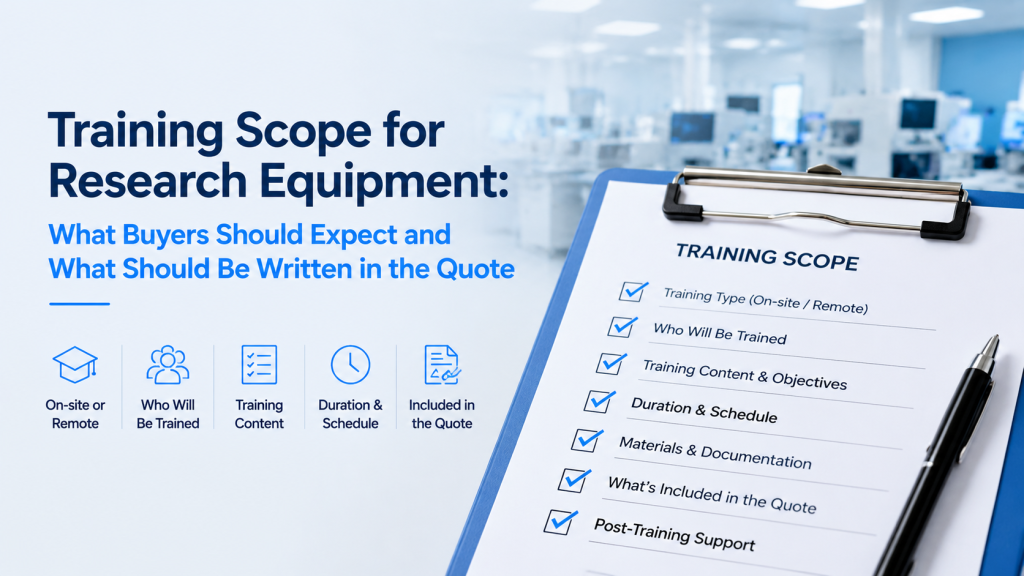
A research-equipment quotation says:
“Training included.”
That sounds reassuring.
But what exactly has been included?
Does it mean:
- A 30-minute online introduction?
- One day of on-site operator training?
- Training for two users or the entire laboratory?
- Basic startup and shutdown only?
- Sample loading and routine measurements?
- Data analysis?
- Troubleshooting?
- Preventive maintenance?
- Application-method development?
- A second training session after new researchers join?
These are completely different levels of support.
For universities, research institutes, national laboratories, and shared facilities, research equipment training should not be treated as a vague after-sales promise. It should be defined as part of the commercial and technical scope before the purchase order is issued.
This is especially important for complex instruments such as:
- Hall Effect Measurement Systems
- MOKE systems
- VSM systems
- Electromagnets and Helmholtz coil systems
- Cryogenic temperature controllers
- Cryogenic measurement systems
- Probe stations
- Integrated magnetic and electrical characterization platforms
ISO/IEC 17025 emphasizes laboratory competence and reliable operation, while NIST laboratory-accreditation guidance similarly treats competence of personnel operating specific equipment as an important part of laboratory quality.
The procurement question should therefore not be:
“Is training included?”
It should be:
“What training is included, for whom, delivered how, to what level, and what remains the buyer’s responsibility afterward?”
This guide explains how buyers should define that scope.
1. Installation, Commissioning, and Training Are Not the Same Service
One of the first procurement mistakes is combining three different activities into one word:
“Installation.”
They should usually be separated.
Installation
Installation may include:
- Unpacking
- Mechanical assembly
- Electrical connection
- Cooling-water connection
- Instrument interconnection
- Software installation
- Basic hardware checks
Commissioning
Commissioning may include:
- Power-on verification
- Functional testing
- Sensor checks
- Magnet-field checks
- Communication checks
- Basic calibration verification
- System acceptance testing
Training
Training is about transferring enough knowledge for the buyer’s personnel to operate the system appropriately after the supplier leaves.
A supplier can install a system correctly without providing comprehensive user training.
Likewise, an instrument can pass commissioning while laboratory staff are still unable to run a real experiment independently.
Large scientific-instrument suppliers often distinguish installation, operating instruction, and additional training or qualification services rather than treating them as one identical service. Thermo Fisher, for example, separately describes installation activities, operating instruction, and additional training programs.
The quotation should make those boundaries explicit.
2. “Basic Operator Training” Should Be Defined
Many quotations include:
Basic operator training included.
That phrase is still too broad.
A reasonable basic operator scope may cover:
- System startup
- System shutdown
- Main user-interface functions
- Sample installation
- Basic measurement setup
- Running a standard measurement
- Saving data
- Basic safety procedures
- Routine checks
- Common warning messages
For a Hall system, basic training might include:
- Installing a standard van der Pauw sample
- Checking electrical contacts
- Setting measurement current
- Applying magnetic field
- Running ±B measurements
- Calculating carrier concentration and mobility
- Exporting data
For a MOKE system, it might include:
- Sample installation
- Optical alignment check
- Magnetic-field setup
- Running a standard hysteresis loop
- Saving data
The quotation should say what “basic” means.
3. Basic Operation Is Not Application Training
This distinction becomes particularly important with research equipment.
Operator Training Answers
“How do I use the instrument?”
Application Training Answers
“How do I use the instrument effectively for this particular research problem?”
Those are different services.
For example, teaching someone how to operate a MOKE system does not necessarily include developing a measurement protocol for:
- Perpendicular magnetic anisotropy
- Spin-orbit torque
- Cryogenic MOKE
- Domain-wall imaging
Likewise, training someone to operate a Hall measurement platform does not automatically mean developing a multi-carrier transport model for their novel material.
Thermo Fisher’s training offerings illustrate this distinction by describing instrument education that can cover operation while more advanced courses extend into applications, maintenance, workflow, and troubleshooting.
Procurement Lesson
If application-specific training is required, write it separately.
Do not assume it is included under:
“User training.”
4. Method Development Is Usually Another Level Again
Research buyers sometimes expect training to include development of the entire experimental method.
For example:
“We bought the system, so please develop a complete method for our new material.”
That may require:
- Sample-preparation optimization
- Measurement-parameter development
- Repeated experiments
- Data interpretation
- Modification of fixtures
- Software customization
- Research collaboration
This is no longer ordinary equipment training.
It is application engineering or method development.
These Should Be Distinguished
Equipment training
How to operate the instrument.
Application training
How to apply standard instrument functions to a defined class of experiments.
Method development
How to create or optimize a new experimental procedure for the buyer’s specific research problem.
If method development is required, it should have its own scope, cost, timeline, and deliverables.
5. Training Should State Who the Audience Is
“Training included” is incomplete without defining the trainees.
A system may be used by:
- One principal investigator
- Two laboratory engineers
- Five PhD students
- Twenty undergraduate students
- A shared university facility
- Industrial production technicians
Those audiences need different training.
Researcher Training
May focus on:
- Measurement flexibility
- Raw data
- Advanced parameters
- Troubleshooting
- Experimental limitations
Facility Manager Training
May also require:
- User management
- Routine inspection
- Calibration checks
- Preventive maintenance
- Fault diagnosis
Student Training
Usually needs:
- Safe operation
- Standardized workflow
- Clear limits
- Simplified sample handling
The quotation should specify the intended audience.
6. Put the Number of Trainees in the Quote
Suppose the supplier expects to train:
2 people
but the university expects:
15 people.
Both parties may genuinely believe that “training included” covers their expectation.
That is avoidable.
Better Wording
For example:
“Remote operator training for up to four participants.”
or:
“On-site training for up to eight laboratory users.”
If the number is unlimited, say so.
If additional attendees require another session, define that too.
7. Define the Training Duration
Training duration should not be left completely open.
Possible scopes include:
- One-hour remote session
- Half-day online training
- One full day on site
- Two days on site
- Several sessions across one week
The correct duration depends on system complexity.
A Compact Electromagnet System
May require relatively short training covering:
- Pole-gap adjustment
- Power supply
- Field measurement
- Safety
- Basic maintenance
An Integrated Cryogenic Hall System
May require significantly more time because users need to understand:
- Vacuum
- Temperature control
- Electrical contacts
- Magnetic field
- Measurement sequence
- Data analysis
- Sample exchange
- Troubleshooting
Training duration should follow the system—not a generic company policy.
8. Define Remote vs. On-Site Training Before Purchase
Both can work.
They solve different problems.
Remote Training
Can be effective for:
- Software operation
- Menu explanation
- Data export
- Basic instrument settings
- Follow-up questions
- Refresher training
Advantages include:
- Lower cost
- Easier scheduling
- No travel
- Easy follow-up
On-Site Training
Is more valuable when users must learn:
- Sample installation
- Optical alignment
- Cryostat operation
- Vacuum procedures
- Probe adjustment
- Cable connections
- Magnet-gap adjustment
- Mechanical reconfiguration
It allows the trainer to see the actual laboratory installation.
Hybrid Training
For many research systems, a strong model is:
- Installation and basic on-site training
- Laboratory begins using the system
- Remote follow-up after users have real questions
This is often more useful than trying to teach every advanced function on installation day.
9. On-Site Training Requires Travel Terms
If on-site training is included, the quotation should state who pays for:
- International airfare
- Domestic transportation
- Hotel
- Meals
- Visa
- Local transport
- Travel insurance
- Travel days
Otherwise, “free training” can become commercially ambiguous.
Possible Structures
Training fee included, travel excluded
or:
Training and reasonable travel expenses included
or:
On-site training quoted separately after destination confirmation
Any of these can work.
The important point is clarity before the purchase order.
10. The Training Location Should Be Explicit
Possible training locations include:
- Buyer’s laboratory
- Supplier’s facility
- Manufacturer’s factory
- Online
- Local distributor’s facility
These are not equivalent.
Supplier-Site Training
May provide:
- Better access to engineers
- More demonstration equipment
- Easier troubleshooting
- Additional reference systems
But the buyer must travel.
Buyer-Site Training
Provides experience on:
- The actual installed system
- Actual utilities
- Actual cryostat
- Actual samples
- Actual room layout
For highly integrated systems, that can be more useful.
11. Training Language Should Be Written Down
International scientific procurement often involves:
- Supplier in one country
- Distributor in another
- End user in a third
Do not assume everyone has the same expectation.
The quote should state something like:
Training language: English.
If local-language training is required, define:
- Language
- Interpreter responsibility
- Whether written materials are translated
This becomes particularly important in public tenders.
12. Manuals and Training Are Not Interchangeable
A user manual is necessary.
It is not a substitute for training on a complex research system.
Likewise, training is not a substitute for documentation.
A complete delivery package may include:
- User manual
- Installation manual
- Software manual
- Safety instructions
- Quick-start guide
- Wiring diagram
- Maintenance instructions
- Calibration information
Thermo Fisher’s instrument-training resources similarly combine user documentation with formal training and other instructional materials rather than treating them as the same thing.
The Buyer Should Ask
Which documents are supplied?
And in what format?
- Printed manual
- Electronic download
- Local computer copy
13. Training Should Use the Actual Delivered Configuration
A generic demonstration can be useful.
But for customized research equipment, training should ideally reflect the delivered system.
Suppose the buyer purchased:
- Electromagnet
- Bipolar power supply
- Hall measurement electronics
- Cryostat
- Temperature controller
- Eight-contact probe stage
Training only on the Hall software does not cover the complete system.
Configuration-Specific Training May Need to Include
- Correct power-on sequence
- Correct shutdown sequence
- Interlocks
- Cooling system
- Magnet operation
- Temperature controller
- Sample fixture
- Measurement electronics
- Integrated software
The more customized the system, the more important this becomes.
14. Sample Loading Should Be Explicitly Included—or Excluded
Many scientific systems become difficult not during measurement, but during sample installation.
Examples include:
- Four-contact van der Pauw samples
- Hall bars
- MOKE thin films
- VSM sample holders
- Cryogenic samples
- Probe-station devices
If sample loading requires skill, training should define whether it includes:
- Sample mounting
- Electrical contact
- Wire connection
- Probe positioning
- Sample orientation
- Sample-height adjustment
This should not be assumed.
15. Sample Preparation Is Usually Different from Sample Loading
A supplier may teach users how to install a prepared sample.
That does not automatically mean the supplier will teach users how to:
- Deposit contacts
- Wire bond
- Apply silver paste
- Fabricate Hall bars
- Polish samples
- Prepare thin films
Those are sample-preparation processes.
Example
A Hall system supplier may reasonably specify:
“Training covers measurement of customer-prepared samples with existing ohmic contacts. Contact fabrication is not included.”
That one sentence can prevent major misunderstanding.
16. Safety Training Should Match the Equipment
Research equipment may contain several different hazards.
Depending on the system, training may need to cover:
- High current
- High voltage
- Strong magnetic fields
- Laser radiation
- Cryogens
- Vacuum
- Hot surfaces
- Cooling water
- Heavy moving components
Training providers commonly include safety as a distinct component of instrument education, alongside applications and maintenance.
But Supplier Training Does Not Replace Institutional Safety Responsibility
The supplier can explain equipment-specific precautions.
The buyer still needs to follow:
- Local electrical rules
- Laser-safety requirements
- Cryogenic safety procedures
- Facility requirements
- Institutional training policies
This boundary should be understood.
17. Basic Troubleshooting Should Usually Be Included
A useful operator-training program should normally cover common faults.
Examples:
- Sensor disconnected
- Communication lost
- Field not reaching setpoint
- Temperature unstable
- Sample contact open
- Software cannot detect instrument
- Cooling-water flow alarm
Users should learn:
- What they can safely check themselves
- When they should stop
- When they should contact the supplier
This can reduce unnecessary service requests.
18. Advanced Repair Training Is Different
Basic troubleshooting is not the same as repair training.
Research laboratories should not assume that ordinary operator training includes:
- Opening power electronics
- Component-level repair
- Laser replacement
- Magnet-coil repair
- Cryostat disassembly
- Internal calibration adjustment
These activities may:
- Require specialist tools
- Affect calibration
- Create safety risks
- Affect warranty conditions
Quotation Language Should Distinguish
- User-maintainable items
- Supplier-service items
- Factory-service items
That boundary becomes important after warranty expiration.
19. Preventive Maintenance Training Should Be Defined Separately
Some systems benefit from periodic user maintenance.
Examples can include:
- Checking water level or coolant
- Cleaning optical windows
- Inspecting vacuum seals
- Inspecting connectors
- Checking filters
- Backing up software configuration
- Inspecting cables
If users are expected to perform these tasks, training should cover them.
The Quote Can State
“Training includes routine operator maintenance described in the user manual.”
That is much clearer than leaving maintenance undefined.
20. Calibration Training Requires Careful Boundaries
A buyer may ask:
“Will you teach us calibration?”
But “calibration” can mean several things.
User Verification
Checking against a reference.
Routine Adjustment
Updating a sensor factor or offset.
Formal Calibration
A controlled calibration process with traceability and defined uncertainty.
ISO/IEC 17025 is specifically concerned with laboratory competence and consistent generation of valid testing and calibration results.
Therefore, a supplier should not casually imply that a short training session makes the buyer an accredited calibration laboratory.
Quote More Precisely
For example:
“Training includes routine field-verification procedures but not accredited calibration services.”
That is much safer and clearer.
21. Data Analysis Scope Must Be Defined
Research instruments produce data.
How far should training go?
Basic Data Training May Include
- Opening data files
- Plotting standard curves
- Exporting CSV
- Calculating standard outputs
- Saving reports
Advanced Scientific Interpretation May Include
- Fitting complex models
- Multi-carrier transport analysis
- Magnetic-domain interpretation
- Phase-transition analysis
- Publication-level statistics
These are not necessarily part of standard equipment training.
Hall Example
Training may reasonably include:
- Sheet resistance
- Carrier type
- Carrier concentration
- Hall mobility
It may not include developing a multi-band conduction model for a novel quantum material.
Write the boundary.
22. Software Training Should Include More Than “Click Start”
For automated research equipment, software may control:
- Magnetic field
- Temperature
- Measurement current
- Sample position
- Data acquisition
Basic software training should typically cover:
- Creating a measurement
- Changing parameters
- Starting/stopping safely
- Saving configuration
- Exporting data
- Recovering from common errors
For advanced systems, buyers may also need:
- Script control
- API commands
- LabVIEW integration
- Python integration
- Network configuration
If automation programming is required, specify it separately.
23. API Support Is Not the Same as Programming Training
A supplier may provide:
- Communication protocol
- Command manual
- Drivers
- Example code
That means the equipment can be integrated.
It does not necessarily mean the supplier will write the buyer’s entire laboratory automation software.
A Good Quote Distinguishes
Included
- Remote-command documentation
- Example commands
- Basic communication demonstration
Not included unless quoted
- Custom Python software
- Complete LabVIEW application
- Integration with third-party instruments
This distinction is critical for automated research platforms.
24. Third-Party Equipment Creates Another Boundary
A research system may need to work with:
- Keithley instruments
- Lock-in amplifiers
- External cryostats
- Existing magnets
- Customer computers
- Third-party vacuum pumps
Training on the supplier’s system does not automatically include comprehensive training on every third-party component.
Before Purchase, Define
Who is responsible for:
- Connection
- Communication
- Configuration
- Training
- Troubleshooting
of each third-party device?
Integrated-system responsibility should not be left implicit.
25. Training Should Define Customer Prerequisites
On-site training can fail if the laboratory is not ready.
Before the trainer arrives, the buyer may need:
- Electrical power ready
- Cooling water ready
- Compressed air ready
- Computer network ready
- Laboratory access approved
- Samples prepared
- Vacuum accessories installed
- Required gases available
Major instrument suppliers use formal site-preparation checklists precisely because installation and training depend on utilities, space, supplies, and readiness being completed beforehand.
The Quote Should State
Training may be postponed or limited if the required site conditions are not ready.
That protects both parties.
26. Training Should Ideally Follow Successful Commissioning
Training users on an unstable or incomplete system is inefficient.
A better sequence is:
- Installation
- Functional verification
- Acceptance test
- Operator training
- Initial independent use
- Follow-up support
This allows training to focus on operation rather than unresolved hardware problems.
27. But Training Should Not Always Happen Only Once
Users often understand very little on installation day.
They are simultaneously seeing:
- New hardware
- New software
- New terminology
- New measurement workflow
A follow-up session can be much more productive after the laboratory has actually used the system.
A Strong Training Package Might Include
- Initial training during commissioning
- One remote follow-up session within an agreed period
For more complex research systems, this can add more value than extending the initial training by another few hours.
28. Define the Post-Training Support Window
What happens after training?
This should be clear.
Possible support models include:
- Email support during warranty
- Remote technical support
- Scheduled video call
- Ticket system
- Paid application support
- Annual service contract
Avoid Unlimited Language
Phrases such as:
“Lifetime technical support.”
sound attractive but are difficult to define operationally.
A better statement is:
“Remote technical support for standard operation and fault diagnosis is included during the warranty period.”
Then define what happens afterward.
29. Technical Support Is Not Unlimited Research Consulting
This boundary matters particularly with university customers.
Technical Support
May reasonably cover:
- Instrument error
- Software problem
- Configuration question
- Standard measurement procedure
- Hardware diagnosis
Research Consulting
May include:
- Designing experiments
- Interpreting novel physics
- Optimizing unpublished research methods
- Repeated analysis of customer data
The second category can consume substantial engineering time.
If extensive application support is expected, it should be quoted or agreed separately.
30. Define Whether Training Can Be Recorded
Remote training is easy to record technically.
But recording rights should not simply be assumed.
Questions include:
- May the buyer record the session?
- Is the recording for internal use only?
- Can it be shared with future students?
- Does it contain proprietary material?
If training recordings are part of the deliverables, state this.
Otherwise, provide manuals or presentation files as the formal reference.
31. Training Materials Should Be Listed as Deliverables
Possible deliverables include:
- User manual
- Training slides
- Quick-start guide
- Sample measurement file
- Example dataset
- Troubleshooting guide
- Maintenance checklist
- Training attendance record
Not every project requires all of these.
But buyers should know what they will receive.
32. Training Completion Should Be Documented When Necessary
For routine research equipment, an informal session may be sufficient.
For shared facilities, regulated environments, or formal procurement, documentation may matter.
Possible evidence includes:
- Attendance sheet
- Training certificate
- Training report
- Commissioning report
- Signed completion form
ISO/IEC 17025 centers laboratory quality around technical competence and reliable results, while NIST accreditation material explicitly addresses personnel competence and training records in laboratory environments.
Therefore, buyers operating under formal quality systems should decide whether training records are required before the purchase.
33. A Training Certificate Is Not a Competency Guarantee
Another distinction matters.
A supplier can certify that:
Person A attended training.
That does not necessarily certify that:
Person A is fully competent to perform every future experiment independently.
Competence develops through:
- Training
- Practice
- Experience
- Internal supervision
- Procedures
- Periodic review
Better Language
“Certificate of training completion.”
rather than:
“Certification as expert operator.”
unless a formal competency assessment really exists.
34. Should Training Include an Operator Competency Test?
For many research labs, this is unnecessary.
For shared laboratories, it can be useful.
A practical competency check may ask the trainee to:
- Start the system
- Load a sample
- Run a standard measurement
- Save the data
- Shut down correctly
This demonstrates that the trainee can perform a standard workflow.
But Be Clear
This is an operational competency check.
It does not prove expertise in all applications.
35. Shared Facilities Need a “Train-the-Trainer” Model
A supplier cannot reasonably train every PhD student who joins a university for the next ten years.
For shared laboratories, the better strategy is often to train:
- Facility manager
- Laboratory engineer
- Senior technical user
to a deeper level.
These users then train routine future users internally.
Train-the-Trainer Scope May Include
- Complete routine operation
- Configuration management
- Troubleshooting
- Sample fixture changes
- User-level maintenance
- Safety limits
This can dramatically improve long-term sustainability.
36. New Students Joining Later Should Be Planned For
University staff turnover is predictable.
Students graduate.
Postdocs leave.
New users arrive.
The quotation should therefore clarify whether future training is:
- Included
- Available remotely
- Available at additional cost
- Handled internally by the buyer
Do not discover three years later that nobody in the laboratory remembers how the equipment works.
37. Training Should Cover What Users Must Not Do
Good training is not only about functions.
It should also define prohibited actions.
Examples:
- Do not operate magnet without cooling
- Do not exceed specified current
- Do not change internal calibration constants
- Do not open high-voltage enclosure
- Do not move optical components unless required
- Do not disconnect cryogenic sensor under certain operating conditions
Knowing system limits can prevent more failures than learning another advanced software feature.
38. Training Scope Can Affect Warranty Disputes
Consider a failure after delivery.
Supplier says:
“The system was operated incorrectly.”
Buyer says:
“Nobody told us that.”
A clearly documented training scope helps reduce this problem.
The quotation and manual should establish:
- Required operation
- Required maintenance
- Prohibited operation
- Buyer responsibilities
This is good procurement practice even when both parties trust each other.
39. Acceptance Testing and Training Should Not Be Confused
Acceptance testing proves the system meets agreed specifications.
Training teaches users how to operate it.
They may happen on the same day.
They are still different.
Acceptance Test May Verify
- Maximum magnetic field
- Temperature range
- Measurement functionality
- Software communication
- System stability
Training May Cover
- How to reproduce those tests
- How to run normal experiments
- How to respond to errors
The buyer should not be asked to accept an instrument merely because training was completed.
Likewise, passing acceptance does not prove all users have been trained.
40. Advanced Application Training May Require Real Samples
Generic samples are useful for teaching the basic workflow.
But application training becomes much more valuable when it uses the buyer’s real samples.
Buyer Should Provide in Advance
- Sample type
- Dimensions
- Contact configuration
- Expected signal
- Special handling requirements
This allows the supplier to prepare.
But Add a Boundary
Training with buyer samples should not automatically constitute a guarantee that every unknown sample will produce a successful measurement.
Sample quality still matters.
41. Consumables Used During Training Should Be Defined
Some systems consume:
- Cryogens
- Vacuum seals
- Sample holders
- Probe tips
- Calibration samples
- Specialty gases
Who supplies these during training?
This matters especially when installation is international.
The quote or site-preparation document should clarify buyer-supplied consumables.
42. Training for Standard Equipment and Custom Systems Should Not Be Priced the Same Way
A standard instrument usually has:
- Established manual
- Standard workflow
- Known training program
A heavily customized research system may require:
- Custom documentation
- New operating procedures
- Special acceptance tests
- Application-specific engineering explanation
The training burden is different.
For custom systems, training should be part of engineering scope planning rather than added casually at the end.
43. Remote Support Can Be More Important Than a Long Initial Training Session
Buyers sometimes focus heavily on:
“Two days of training included.”
But what happens six months later?
A research laboratory may gain more value from:
- One day of good initial training
- Good documentation
- Reliable remote support
than from:
- Three days of training
- No usable support afterward
Evaluate the Full Support Lifecycle
Before purchase, ask:
- Who do we contact?
- By email or ticket?
- What is included?
- During what period?
- What becomes chargeable?
The after-sales model matters as much as the training event.
44. A Weak Training Statement in a Quote
Consider:
Training: Included.
Almost nothing has actually been defined.
The buyer does not know:
- Mode
- Duration
- Participants
- Content
- Language
- Location
- Travel
- Follow-up
- Application scope
This is precisely the kind of wording that creates disagreement later.
45. A Better Training Statement
A more useful quotation might say:
Training Scope
- One remote pre-installation orientation session
- One day of on-site operator training after successful commissioning
- Training for up to five users
- Training language: English
- Scope: startup/shutdown, sample installation, routine measurement, software operation, data export, safety, routine user maintenance, and basic troubleshooting
- User manual and quick-start documentation included
- One remote follow-up training session within 60 days of installation
- Advanced application development, custom software development, component-level repair training, and training on third-party equipment are excluded unless separately quoted
- International travel and accommodation: [included / excluded / quoted separately]
Now both sides know what was purchased.
46. What Should Be Written in the Quote?
For formal scientific procurement, the training section should ideally define the following.
Training Type
- On-site
- Remote
- Supplier-site
- Hybrid
Timing
- During installation
- After acceptance
- Separate follow-up session
Duration
- Hours
- Days
- Number of sessions
Participants
- Maximum number
- Intended user level
Language
- Training language
- Documentation language
Included Content
For example:
- Safety
- Startup/shutdown
- Sample mounting
- Standard measurements
- Software
- Data export
- Routine maintenance
- Basic troubleshooting
Excluded Content
For example:
- Research-method development
- Custom programming
- Advanced repair
- Third-party equipment training
- Sample fabrication
Deliverables
- Manual
- Training slides
- Completion record
- Example data
Travel
- Included
- Excluded
- Reimbursable
Post-Training Support
- Duration
- Communication method
- Included scope
This is far better than one sentence saying “free training.”
47. A Practical Training Scope for a Simple Magnet System
For an electromagnet or Helmholtz coil system, training may reasonably cover:
- System components
- Electrical connections
- Cooling requirements
- Safe startup
- Magnetic-field setting
- Bipolar operation
- Gaussmeter use
- Pole-gap adjustment
- Shutdown
- Routine checks
- Common alarms
Extensive application training may not be necessary.
This training could often be handled remotely when mechanical installation is straightforward.
48. A Practical Training Scope for a Hall Effect Measurement System
A Hall platform may require more detailed training.
Possible topics include:
- Sample requirements
- Van der Pauw fixture
- Hall bar fixture
- Contact verification
- Measurement current
- Magnetic-field control
- ±B reversal
- Sheet resistance
- Carrier concentration
- Hall mobility
- Data export
- Basic troubleshooting
If variable temperature is included:
- Cryostat operation
- Temperature control
- Vacuum
- Sensor configuration
should also be addressed.
49. A Practical Training Scope for a MOKE System
A MOKE system combines optics, magnetics, and sample handling.
Training may need to cover:
- Laser safety
- Sample positioning
- Optical alignment check
- Longitudinal or polar geometry
- Electromagnet operation
- Hysteresis measurement
- Detector adjustment
- Data acquisition
- Common optical artifacts
- Routine optical inspection
Advanced application interpretation should be defined separately.
50. A Practical Training Scope for Cryogenic Equipment
Cryogenic systems may need training on:
- Temperature sensors
- Calibration curves
- Heater configuration
- PID control
- Vacuum
- Cooldown
- Warm-up
- Sample exchange
- Condensation prevention
- Cryogenic safety
- Troubleshooting
For these systems, training quality can directly affect both measurement performance and hardware safety.
51. A Buyer Training Checklist Before Issuing the PO
Before approving a research-equipment quotation, ask:
Scope
- Is training explicitly included?
- What topics are covered?
- What is excluded?
People
- How many users?
- What experience level?
- Train-the-trainer required?
Format
- On-site?
- Remote?
- Hybrid?
Time
- How many hours or days?
- One session or multiple sessions?
Language
- What language is used?
- What language are the manuals?
Application
- Standard operation only?
- Application-specific training?
- Method development?
Maintenance
- Routine maintenance?
- Troubleshooting?
- Advanced repair excluded?
Software
- Basic software?
- API?
- Custom programming?
Documentation
- Manuals?
- Training material?
- Completion record?
Travel
- Flights?
- Hotel?
- Local transportation?
- Visa?
Support
- What happens after training?
- For how long?
- Is follow-up training available?
If these questions are answered, the word “training” finally becomes commercially meaningful.
52. How Cryomagtech Approaches Training for Research Equipment
Cryomagtech evaluates training according to the complexity of the delivered system rather than treating every product as requiring the same support model.
For a standard magnet or temperature instrument, training may focus on:
- Installation check
- Basic operation
- Safety
- Standard measurement
- Data handling
- Basic troubleshooting
For an integrated Hall, MOKE, VSM, cryogenic, or customized magnetic measurement system, the scope may additionally require:
- Sample installation
- Field-control workflow
- Temperature-control workflow
- Optical or electrical setup
- System synchronization
- Acceptance-test reproduction
- Configuration-specific troubleshooting
Before a formal quotation is finalized, buyers should tell us whether they require:
- Remote training
- On-site training
- A defined number of users
- Application-specific training
- Follow-up sessions
- Formal training documentation
The goal is to make the support scope clear before the purchase—not negotiate its meaning after installation.
53. Key Takeaways
- Research equipment training should be a defined technical and commercial scope, not simply the phrase “training included.”
- Installation, commissioning, acceptance testing, and user training are separate activities.
- Basic operator training, application training, and method development are different service levels.
- The quotation should specify training format, duration, location, participant count, language, and content.
- On-site training should clarify travel and accommodation costs.
- Sample loading and sample preparation should be treated separately.
- Basic troubleshooting and routine maintenance may reasonably be included, while component-level repair often requires separate service training.
- Data analysis training should distinguish standard instrument outputs from advanced scientific interpretation.
- API documentation does not automatically include custom software development.
- Training on third-party instruments should not be assumed.
- Formal laboratories may require training records or completion certificates as part of their quality system.
- A follow-up session after users gain practical experience can be more valuable than extending installation-day training indefinitely.
- Post-training technical support should have a clearly defined scope.
- Shared facilities should consider training one or more internal expert users using a train-the-trainer model.
- The training section of a quotation should state both what is included and what is excluded.
The weak procurement question is:
“Is training included?”
The better question is:
“Who will be trained, for how long, on which functions, by what method, with what deliverables—and what support remains after training is complete?”
References
- ISO — ISO/IEC 17025: Testing and Calibration Laboratories
ISO/IEC 17025 establishes requirements around laboratory competence and consistent generation of valid results, providing useful context for why operator competence and controlled laboratory processes matter in scientific measurement.
https://www.iso.org/ISO-IEC-17025-testing-and-calibration-laboratories.html - Thermo Fisher Scientific — Training Services / Instrument Education
Thermo Fisher’s official training programs illustrate how research-equipment education may be delivered through different formats and can cover instrument operation, applications, maintenance, and safety rather than being one undefined service.
https://www.thermofisher.com/jp/en/home/products-and-services/services/training-services.html