
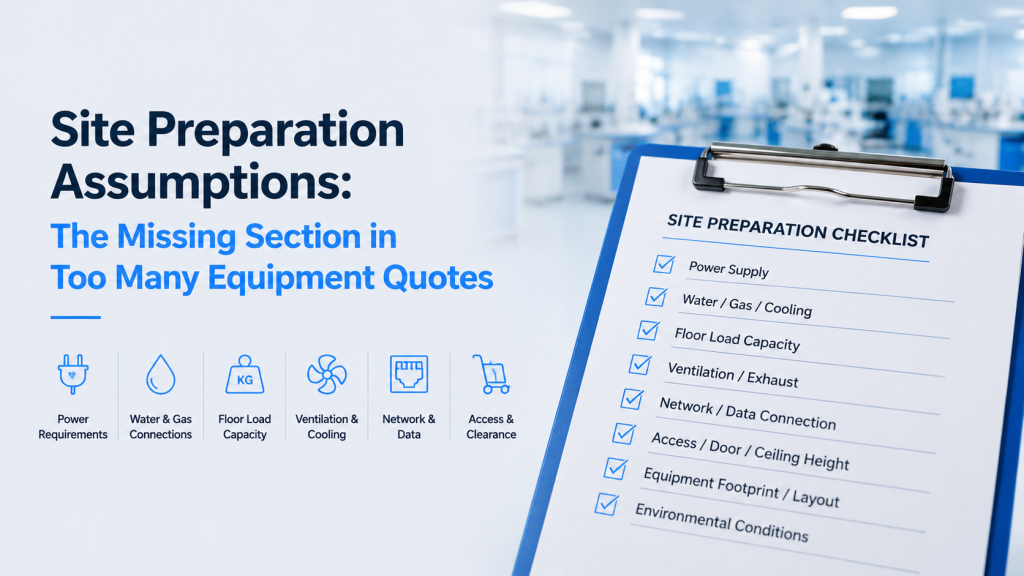
A quotation for a research system may carefully define:
- Magnetic field
- Temperature range
- Measurement sensitivity
- Sample size
- Software
- Delivery time
- Warranty
Yet one of the most important sections is often missing:
Site Preparation Assumptions.
The equipment is technically suitable. The purchase order is issued. Production is completed.
Then the system arrives—and the laboratory discovers:
- The available electrical circuit cannot support the power supply.
- The cooling-water pressure is wrong.
- There is no suitable drain.
- The chiller releases more heat than the room HVAC can remove.
- The floor or optical table has not been checked for the equipment load.
- The crate cannot fit through the final laboratory door.
- The cryogenic compressor is too noisy to sit beside the measurement platform.
- The IT department will not allow the control software onto the laboratory network.
- The customer expected the supplier to provide lifting equipment.
- The supplier expected those items to be prepared by the customer.
None of these problems necessarily means the equipment is defective.
They mean the project boundary was never defined.
That is why research equipment site preparation should appear in the quotation before an order is placed—not emerge as a checklist a week before installation.
Major scientific-instrument manufacturers already treat site preparation as a formal pre-installation activity. Agilent describes site-preparation documentation as covering the supplies, space, utilities, computing environment, and other conditions required before equipment setup.
For cryogenic equipment, the requirements can become even more substantial. Bruker’s cryogenic site-planning documentation explicitly addresses equipment dimensions and weights, floor loading, service clearance, electrical supply, air-conditioning load, cooling water, compressor placement, acoustic noise, and utility requirements.
The purchasing question should therefore not be:
“What does the equipment require after it arrives?”
It should be:
“What site conditions have been assumed in this quotation, who must provide them, and what happens if the actual site is different?”
1. Site Preparation Is Part of the Equipment Specification
Site preparation is sometimes treated as an administrative issue for the facilities department.
That is too late.
For system-level research equipment, the laboratory environment can affect:
- Whether the equipment can be installed
- Whether it can reach its rated performance
- Whether continuous operation is possible
- Whether maintenance can be performed
- Whether commissioning can be completed on schedule
This is particularly important for:
- Large electromagnets
- High-current Helmholtz coil systems
- VSM systems
- MOKE systems
- Hall Effect Measurement Systems
- Cryogenic measurement platforms
- Superconducting magnet systems
- Probe stations
- Vacuum-integrated systems
A useful quotation therefore defines both:
What the supplier will deliver
and
What the site must provide.
2. A Site Preparation Guide and a Quote Assumption Section Are Different
A detailed site preparation guide may be supplied after order.
That is useful.
But it should not be the first time the buyer learns that the system needs:
- Three-phase power
- Dedicated cooling water
- 500 kg floor capacity
- A particular room-temperature range
- Network access
- A wide installation route
Site Preparation Guide
Usually provides detailed installation instructions.
Site Preparation Assumptions in the Quote
Identify the major conditions that affect:
- Configuration
- Price
- Performance
- Installation
- Buyer responsibility
The quote does not need to contain a 30-page facility manual.
It does need to disclose the assumptions that could change the commercial or technical scope.
3. Start With a Responsibility Matrix
The cleanest approach is to divide site requirements into responsibilities.
For each item, specify:
- Supplier provided
- Buyer provided
- Included in quotation
- Optional
- To be confirmed
- Not required
Example
Electromagnet: Supplier
Magnet power supply: Supplier
Dedicated AC electrical circuit: Buyer
Water chiller: Supplier
Chiller electrical supply: Buyer
Cooling hoses between chiller and magnet: Supplier
Laboratory drain: Buyer, if required
Control computer: Supplier
Ethernet connection: Buyer
Forklift for unloading: Buyer
This simple structure prevents a surprising amount of confusion.
4. Electrical Power: Voltage Alone Is Not Enough
A buyer often says:
“We have 230 V power.”
That is not a complete site specification.
The supplier may also need to know:
- Frequency
- Single-phase or three-phase supply
- Maximum available current
- Breaker rating
- Grounding arrangement
- Socket or hardwired connection
- Dedicated-circuit availability
- Starting current
- Continuous power consumption
For cryogenic systems, these distinctions can be substantial. One Bruker cryogenic compressor configuration, for example, specifies three-phase electrical supply together with defined current, starting current, and power requirements—illustrating why voltage alone does not define electrical compatibility.
Quote Assumption Example
Site electrical supply: Buyer to provide 380–415 VAC, 50 Hz, three-phase supply with suitable breaker, protective earth, and local disconnect in accordance with local electrical regulations.
That is much clearer than:
Power: 400 V.
5. Dedicated Circuit or Shared Laboratory Power?
A small temperature controller may run comfortably from an ordinary laboratory outlet.
A high-current magnet power supply may not.
Large systems can contain several loads:
- Magnet power supply
- Chiller
- Cryogenic compressor
- Vacuum pump
- Computer
- Control cabinet
- Auxiliary electronics
The buyer should know whether these require:
- One shared supply
- Several dedicated circuits
- Different voltages
- Separate breakers
The quotation should identify major loads separately rather than presenting one mysterious “system power” number.
6. Power Quality and Power Interruptions Can Matter
Some laboratory equipment can tolerate a brief power interruption.
Other systems may require a lengthy recovery process.
Bruker’s cryogenic site-planning documentation, for example, notes that a short mains interruption can trigger an automatic warm-up cycle in the referenced CryoProbe system and discusses UPS use where short interruptions should be bridged.
That does not mean every cryogenic instrument requires a UPS.
It means the quote should identify whether power continuity is relevant.
Ask
- Does a power loss create only a restart?
- Does it cause sample warming?
- Does it interrupt vacuum?
- Does it require controlled shutdown?
- Is UPS support recommended?
- Which components should or should not be placed on a UPS?
These questions matter before the facility electrical design is finalized.
7. Grounding Should Be Defined Early
Research equipment frequently combines:
- High-current magnet power
- Low-level voltage measurement
- Temperature sensors
- Motors
- Computers
- Communication interfaces
Poor grounding can complicate sensitive measurements.
For Hall, MOKE, transport, and other low-signal experiments, the site design should consider:
- Protective earth
- Instrument grounding
- Ground loops
- Shared noisy equipment
- High-current cable routing
- Signal-cable separation
The supplier should provide equipment grounding requirements.
The buyer’s electrician or facilities team should confirm that the building installation can meet them.
8. Cooling Water: “Water Available” Is Not Enough
Water-cooled equipment should never be quoted on the assumption that any laboratory tap is suitable.
The required cooling specification may include:
- Flow rate
- Inlet temperature
- Maximum temperature rise
- Inlet pressure
- Pressure drop
- Maximum pressure
- Water quality
- Hose diameter
- Connector type
Bruker’s cryogenic site guide demonstrates how detailed these requirements can become, specifying flow, pressure, inlet-water temperature, connector dimensions, and water-quality limits for a water-cooled compressor configuration.
Quote Assumption Example
Cooling: Performance ratings assume continuous cooling water within the specified flow, temperature, pressure, and quality limits. Final cooling specification to be provided before site installation.
That protects both sides from assuming that “water cooling” is self-explanatory.
9. Facility Water or Dedicated Chiller?
These are different installation strategies.
Facility Cooling Water
Potential advantages:
- No separate chiller footprint
- Lower local heat rejection
- Simpler equipment package
But it depends on facility availability and water quality.
Dedicated Chiller
Can make the system more self-contained.
But now the laboratory must consider:
- Chiller footprint
- Chiller power
- Heat rejection
- Noise
- Ventilation
- Hose routing
The quote should state clearly whether a chiller is:
- Included
- Optional
- Buyer supplied
- Not required
10. Do Not Forget Water Quality
Cooling-water requirements can exist because poor water chemistry may contribute to:
- Corrosion
- Deposits
- Blockages
- Reduced heat-transfer performance
Bruker’s cryogenic site-planning manual, for example, specifies limits for pH, hardness, silica, and suspended matter in the applicable cooling loop.
A supplier of water-cooled research equipment should therefore avoid saying only:
“Cooling water required.”
The actual acceptable water specification should be available before installation.
11. Drainage and Leak Management Should Be Clarified
Some closed-loop chillers require no permanent drain during normal operation.
Other installations may need:
- Drain connection
- Overflow provision
- Service drain
- Condensate handling
Water-cooled systems may also justify:
- Leak tray
- Leak detector
- Shutoff valve
- Flow alarm
Whether these are required depends on the system and facility.
They should be identified during site planning rather than improvised after the hoses are connected.
12. Heat Rejection Is a Room Requirement
Electrical power consumed by equipment ultimately appears largely as heat somewhere.
For an air-cooled device, much of that heat may be released directly into the laboratory.
For a water-cooled system, some heat may be carried away through the cooling loop instead.
Bruker’s CryoProbe planning documentation illustrates the scale this can reach: the referenced air-cooled helium compressor can release approximately 7.5 kW of heat into its environment, creating a significant HVAC consideration.
The lesson is broader than that specific instrument.
Quote Should State, Where Relevant
- Approximate room heat load
- Whether heat is air-cooled or water-removed
- Required ventilation
- Whether a compressor/chiller is recommended in another room
A room can have enough physical space for the system and still lack enough cooling capacity.
13. Ambient Temperature and Humidity Should Not Be Assumed
Many scientific instruments have defined operating-environment limits.
These may include:
- Room temperature
- Maximum temperature variation
- Relative humidity
- Dust conditions
- Condensation limits
Bruker’s site-planning example specifies room-temperature and humidity conditions for its cryogenic installation and explicitly links environmental conditions to proper operation.
The exact acceptable range is equipment-specific.
Do not copy another manufacturer’s limits into an unrelated system.
Instead, the supplier should provide the actual operating environment for the quoted equipment.
14. Floor Load Is More Than Total Weight
A quote may list:
System weight: 500 kg.
That is useful—but incomplete.
Facilities may need to consider:
- Total weight
- Footprint
- Point loading
- Load concentration
- Support-leg locations
- Dynamic load during movement
Bruker’s cryogenic site documentation explicitly warns that the installation floor must support the listed equipment weights.
Large Magnet Systems May Include
- Magnet yoke
- Support structure
- Optical table
- Chiller
- Power cabinet
- Cryostat
The weight may be distributed across several locations.
The buyer’s facilities or structural team—not the equipment salesperson—should make the final building-capacity determination.
15. Bench Load and Optical Table Load Are Separate Questions
Some systems sit on the laboratory floor.
Others sit on:
- Optical table
- Workbench
- Granite platform
- Custom support frame
The support must accommodate:
- Static equipment weight
- Load distribution
- Sample-stage movement
- Maintenance loads
A magnet that physically fits on an optical table may still exceed the table’s recommended loading condition.
The quotation should state the equipment weight and footprint clearly enough for the buyer to verify the support structure.
16. Vibration Can Become a Site Assumption
For some equipment, vibration barely matters.
For others, it can directly affect measurement quality.
Sensitive systems may include:
- MOKE microscopy
- Optical measurement systems
- Probe stations
- Low-noise transport systems
- Cryogenic optical experiments
Potential vibration sources include:
- Pumps
- Chillers
- Compressors
- HVAC equipment
- Elevators
- Nearby machinery
In Bruker’s cryogenic site planning, compressor placement is explicitly discussed in relation to floor vibration and acoustic noise, and remote placement or acoustic isolation is recommended where appropriate.
A supplier should therefore state when:
- A normal laboratory floor is acceptable
- An optical table is recommended
- Pump or compressor separation is required
17. Acoustic Noise and Measurement Noise Are Different—but Both Matter
A compressor may create two problems:
Human Environment
The laboratory becomes unpleasant to work in.
Experimental Environment
Mechanical vibration may couple into the measurement.
Bruker’s site-planning guidance recommends locating the referenced helium compressor away from the magnet where practical and notes the advantages of a separate room or acoustic isolation.
For MOKE, optical, and cryogenic systems, the quote should state whether pumps or compressors are expected to sit:
- Beside the instrument
- Under the table
- On the floor
- In another room
That decision affects hose length, cable length, and room layout.
18. Magnetic Stray Field Requires Its Own Site Planning
Large magnet systems create another site condition:
the magnetic environment.
Depending on field strength and magnet geometry, buyers may need to consider proximity to:
- Other sensitive instruments
- Magnetic storage
- Ferromagnetic structures
- Computers
- Precision sensors
- Access routes
For strong magnetic installations, the supplier should provide available stray-field information or a defined exclusion-zone basis where relevant.
The buyer should then review the room layout and institutional safety requirements.
19. Do Not Assume Every Magnet Needs the Same Safety Zone
A compact electromagnet with a closed magnetic circuit behaves differently from:
- Large Helmholtz coils
- Open coil systems
- Superconducting magnets
Therefore, statements such as:
“Keep everything three meters away”
should not be invented generically.
The exclusion area should follow:
- Actual field map
- Magnet geometry
- Maximum operating condition
- Local safety policy
Site assumptions should be specific, not theatrical.
20. Compressed Air and Process Gas Can Be Hidden Requirements
Cryogenic and vacuum systems may need more than electricity.
Depending on architecture, utilities can include:
- Dry compressed air
- Nitrogen
- Helium
- Purge gas
- Pneumatic supply
Bruker’s cryogenic planning manual, for example, identifies pneumatic-gas and helium requirements in addition to electrical and cooling utilities.
If the quoted system requires any gas supply, the quotation should state:
- Gas type
- Purity
- Pressure
- Flow
- Connection
- Buyer/supplier responsibility
before order.
21. Cryogenic Systems Need More Than a “Cryostat Included” Line
A low-temperature system may also involve:
- Compressor
- Vacuum pump
- Chiller
- Gas lines
- Transfer lines
- Temperature controller
- Vacuum gauges
- Exhaust
- Cryogen storage
These components occupy space and require utilities.
Site planning for cryogenic equipment should therefore address the complete installation—not only the cold sample stage.
The Bruker example is instructive because its site guide separately addresses cryogenic unit footprint, compressor footprint, service space, utilities, cooling, and environmental requirements.
22. Vacuum Pumps Need a Location Before Shipment
For vacuum-integrated systems, ask where the pump will actually sit.
Possible considerations include:
- Floor space
- Pump vibration
- Noise
- Exhaust
- Hose length
- Service access
- Electrical supply
A pump placed farther away may reduce local vibration and noise.
But excessively long or restrictive vacuum lines may affect pumping performance.
The correct layout should be considered as a system.
23. Network Access Is Now a Site Utility
Modern laboratory instruments may require:
- Ethernet
- USB
- Local network
- Internet access
- Remote support
- Software activation
- Data storage
- Network license
A laboratory may physically have an Ethernet socket but still not permit:
- Unknown devices
- Remote desktop
- Administrator access
- External service connections
Major instrument manufacturers include computing and networking requirements in formal site-preparation processes; Agilent’s site-preparation documentation explicitly includes computing environment and utility planning as part of readiness.
The IT department may therefore need to join the project before installation day.
24. Software Permissions Should Be Treated as Site Preparation
A control computer may need:
- Administrator privileges
- Driver installation
- USB access
- Firewall exceptions
- Static IP configuration
- Specific operating-system version
These are not traditional “facilities” topics.
They can still stop commissioning.
Quote Assumption Example
Customer shall provide required institutional IT approval, network access, and administrator permissions for installation of the supplied control software unless the control PC is included and delivered preconfigured.
Now the responsibility is visible.
25. Remote Support Depends on the Customer’s IT Policy
A supplier may promise:
Remote technical support included.
But remote support may be impossible if the institution prohibits:
- TeamViewer
- AnyDesk
- VPN access
- Screen sharing
- External software installation
The quote should not promise a specific remote method before confirming what the customer allows.
A safer formulation is:
Remote technical support will be provided using a communication method permitted by the customer’s institutional IT policy.
26. Delivery Route Should Be Checked Before Manufacturing Is Finished
A system can fit perfectly inside the laboratory and still be impossible to bring into it.
The delivery route may include:
- Loading dock
- Building entrance
- Corridor
- Elevator
- Stairwell
- Final laboratory door
The buyer should check:
- Crate dimensions
- Equipment dimensions after unpacking
- Door width and height
- Elevator internal dimensions
- Elevator load capacity
- Turning radius
- Ceiling clearance
This is especially important for:
- Large C-frame magnets
- Optical tables
- Cryogenic compressors
- Heavy frames
- Large Helmholtz coil assemblies
27. Crated Dimensions Matter, Not Only Equipment Dimensions
Suppose the assembled system is:
900 mm wide.
The laboratory door is:
1000 mm wide.
It appears acceptable.
But the transport crate may be:
1200 mm wide.
Now the crate cannot enter the room.
Possible solutions include:
- Uncrate elsewhere
- Use removable panels
- Deliver in subassemblies
Those decisions should be planned before shipment.
28. Unloading and Rigging Responsibilities Must Be Written Down
Who provides:
- Forklift
- Pallet jack
- Crane
- Gantry
- Rigging company
- Loading-dock personnel
?
This is a classic responsibility gap in international equipment delivery.
Supplier May Reasonably Provide
- Equipment weight
- Center-of-gravity information where needed
- Lifting points
- Unpacking instructions
Buyer May Reasonably Provide
- Site-specific lifting equipment
- Qualified rigging personnel
- Building access
But the exact split should be stated in the quote.
29. “Installation Included” Does Not Automatically Mean “Rigging Included”
A supplier engineer may be qualified to:
- Assemble
- Connect
- Configure
- Commission
the system.
That does not mean the engineer arrives with a 2-ton forklift.
If heavy handling is required, define separately:
- Delivery
- Unloading
- Internal transport
- Positioning
- Installation
- Commissioning
Each is a different activity.
30. Maintenance Clearance Is Part of the Footprint
Equipment footprint is not just:
width × depth.
It may also require space for:
- Opening panels
- Removing filters
- Servicing pumps
- Accessing connectors
- Replacing cooling hoses
- Moving a compressor
- Loading samples
Bruker’s site-planning document explicitly allocates additional space around equipment for connectors, air intake, and maintenance, showing why service clearance belongs in site planning rather than being added afterward.
Quote Should Distinguish
- Equipment footprint
- Recommended operating footprint
- Required service clearance
They are not always the same.
31. Cable and Hose Lengths Create Layout Constraints
The laboratory may want:
- Chiller in another room
- Magnet power supply outside the optical area
- Cryogenic compressor behind a wall
That may be possible.
But cable and hose lengths have limits.
Longer runs can affect:
- Voltage drop
- Cooling pressure
- Vacuum conductance
- Signal noise
- Flex-line routing
Bruker’s cryogenic planning guide, for example, specifies minimum bending considerations for flexible lines and discusses remote compressor placement as part of the site layout.
The equipment quote should state standard included lengths when layout is critical.
32. A Floor Plan Is Often Worth More Than Ten Emails
For large systems, the buyer should provide a simple layout showing:
- Room dimensions
- Door location
- Power outlets
- Cooling-water points
- Drain
- Network connection
- Existing optical table
- Nearby equipment
- Proposed system location
It does not need to be a sophisticated CAD drawing during early quotation.
A simple dimensioned plan can immediately expose layout conflicts.
33. Site Preparation Should Include Maintenance, Not Just Day-One Installation
Imagine the equipment fits perfectly between two walls.
Installation succeeds.
Six months later, a pump needs replacement.
There is no space to remove it.
That is a site-planning failure.
The correct question is:
Can the equipment be installed, operated, sampled, and serviced in this location?
Bruker’s site documentation explicitly plans extra access for maintenance of the cryogenic compressor rather than considering only its operating footprint.
34. Environment Around Sensitive Measurements Also Matters
Hall, MOKE, VSM, low-temperature transport, and other measurement systems may be sensitive to:
- Vibration
- Electrical interference
- Strong nearby magnetic equipment
- Air movement
- Temperature changes
Site preparation therefore includes more than utilities.
The measurement environment should be appropriate for the experiment.
That does not mean every laboratory needs:
- Shielded room
- Active vibration isolation
- Precision HVAC
Those requirements should only be specified when justified by the actual system and measurement objective.
35. The Quote Should Identify Buyer-Supplied Items
A professional quote can include a simple section:
Buyer-Supplied Site Items
- Electrical supply
- Protective earth
- Cooling water or chiller utilities
- Drain where required
- Laboratory bench/floor support
- Network connection
- Unloading equipment
- Local rigging
- Facility safety approvals
The list will change with the equipment.
Its value is that nothing remains implicit.
36. The Quote Should Also Identify Supplier-Supplied Items
For example:
Included in Supplier Scope
- Main instrument
- Magnet
- Power supply
- Water chiller
- Standard power cables
- Standard cooling hoses
- Control computer
- Control software
- Installation documentation
- Remote commissioning
Now the buyer can see where the equipment ends and the building begins.
37. Assumptions and Exclusions Are Not the Same Thing
Assumption
Something the quotation has been based on.
Example:
Quotation assumes the customer has 400 V three-phase power available within 3 m of the proposed equipment location.
Exclusion
Something not included in supplier scope.
Example:
Electrical building work and installation of additional power circuits are excluded.
Both belong in a complete proposal.
One explains the technical basis.
The other explains the commercial boundary.
38. Good Assumptions Should Be Measurable
Weak:
Customer should provide a suitable laboratory.
Better:
Customer shall provide sufficient floor area and load capacity for the system dimensions and weights shown in the technical drawing, together with the stated service clearances.
Weak:
Cooling water should be adequate.
Better:
Customer facility water shall meet the specified inlet temperature, flow, pressure, and quality requirements.
The purpose is not to make the quote bureaucratic.
It is to eliminate interpretations.
39. Do Not Hide Critical Site Conditions in the User Manual
If failure to provide a site condition would prevent installation or rated performance, the buyer should know before ordering.
Critical items may include:
- Three-phase power
- Large cooling load
- Minimum door width
- High floor load
- Required compressed gas
- Significant exhaust heat
- Mandatory network access
A post-order manual is too late for commercially important assumptions.
40. Factory Acceptance and Site Acceptance Need Different Boundaries
A system may pass Factory Acceptance Testing under supplier-controlled conditions.
Site Acceptance Testing happens in the buyer’s environment.
If the site does not meet agreed requirements, the same performance may not be reproducible.
Example
Factory test:
Magnet reaches rated continuous field with cooling water at specified temperature and flow.
Customer site:
Cooling-water flow is much lower.
That is not automatically a magnet-performance failure.
The quotation and acceptance documents should connect performance guarantees to defined site conditions.
41. Site Conditions Should Be Frozen Before Shipment
Before shipping a major system, confirm:
- Final installation room
- Power
- Cooling
- Space
- Floor capacity
- Delivery route
- Network
- Rigging
- Utilities
This can be done using a formal:
Site Readiness Checklist
signed or confirmed by the buyer.
Agilent’s site-preparation process similarly treats customer readiness as something to verify before installation rather than after the service engineer arrives.
42. A Site Survey Can Be Worth the Cost
For standard benchtop instruments, a site survey may be unnecessary.
For large or customized systems, one may reduce risk.
Possible survey methods include:
- Customer-completed questionnaire
- Photographs
- Video call
- Floor plan
- Remote site review
- On-site survey
The level should match project complexity.
Do not send an engineer across the world to inspect a standard temperature controller.
But do not design a multi-ton integrated system from one sentence saying:
“We have enough space.”
43. Site Changes Can Change the Equipment Configuration
Suppose the quote assumes:
20 mm magnet gap.
Later, the customer decides to insert a large cryostat requiring:
60 mm gap.
That can change:
- Maximum magnetic field
- Magnet size
- Power
- Cooling
- Cost
Or suppose the customer says:
“The compressor must be 15 m away in another room.”
That may affect:
- Flex lines
- Cables
- Pumping
- Layout
Site preparation is therefore not merely an installation issue.
It can change the equipment itself.
44. Large Magnet Systems Need an Explicit Utility Section
For electromagnets and large Helmholtz coil systems, the quotation should consider:
- Magnet weight
- Support structure
- Input power
- Magnet power-supply location
- Cooling water
- Chiller
- Heat rejection
- High-current cable length
- Magnetic stray field
- Emergency access
These items should be reviewed together with:
- Target field
- Working gap
- Uniformity
- Duty cycle
because site utilities can determine whether the rated operating condition is sustainable.
45. Cryogenic Systems Need an Even Broader Site Scope
For cryogenic systems, add questions about:
- Compressor
- Vacuum pump
- Cooling water
- Helium or other gas
- Cryogen handling
- Heat rejection
- Vibration
- Noise
- Emergency response
- Warm-up behavior after power loss
The Bruker site-planning example demonstrates how cryogenic infrastructure can span electrical power, HVAC, floor loading, compressor placement, cooling water, gas supplies, and maintenance access.
A quote saying only:
“Cryogenic option included”
does not describe this installation reality.
46. MOKE Systems Add Optical-Site Requirements
For a MOKE system, site assumptions may also include:
- Optical table
- Vibration conditions
- Ambient-light control
- Airflow
- Laser safety
- Magnet placement
- Optical access
- Computer location
A laboratory that is suitable for a simple electromagnet is not automatically suitable for a sensitive optical measurement platform.
The quoted installation concept should reflect the actual measurement architecture.
47. Hall and Transport Systems Add Electrical-Noise Requirements
For Hall Effect Measurement Systems and transport platforms, site planning may need to consider:
- Grounding
- Low-noise power
- Separation of current and signal cables
- Probe-station placement
- Cryostat interfaces
- Computer and network control
If the experiment includes microvolt-level signals, the physical laboratory environment becomes part of measurement quality.
Again, the requirement should be proportional to the actual measurement—not over-specified generically.
48. VSM Systems Have Their Own Mechanical Conditions
Depending on the VSM architecture, buyers may need to consider:
- Equipment footprint
- Magnet cooling
- Mechanical vibration
- Sample motion
- Power supply
- Cryogenic or furnace options
- Service clearance
A general site-assumption framework works across product families, but the actual numbers should always belong to the quoted configuration.
49. A Weak Site Preparation Section
A quotation says:
Site Requirements
Customer to prepare suitable utilities.
This is almost useless.
What utilities?
Which parameters?
Who determines suitability?
When must they be ready?
No one knows.
50. A Better Site Preparation Assumptions Section
A more useful quotation could say:
Site Preparation Assumptions
Electrical Power
Quotation assumes customer-provided 380–415 VAC, 50 Hz, three-phase electrical service with appropriate current capacity, breaker protection, protective earth, and local disconnect.
Cooling
Quoted continuous performance assumes cooling water/chiller operation within the flow, inlet-temperature, pressure, and water-quality limits stated in the final technical specification.
Room Environment
Customer shall provide an indoor laboratory environment within the specified operating temperature and humidity range with sufficient HVAC capacity for the stated equipment heat load.
Mechanical Support
Customer shall confirm that the floor/table can safely support the equipment weight and load distribution shown in the final layout drawing.
Installation Space
Customer shall provide the required equipment footprint plus specified operating and maintenance clearances.
Delivery Access
Customer shall confirm that loading dock, corridors, elevators, doors, and turning clearances are sufficient for the shipping crates and unpacked equipment.
Rigging
Local unloading, forklift/crane services, and building-internal rigging are excluded unless specifically listed in the quotation.
Network / IT
Customer shall provide the network connection and institutional permissions required for supplied control software and remote support.
Site Readiness
Installation scheduling is subject to confirmation that the required site conditions are available.
Now both parties understand the commercial basis of the quotation.
51. What Should Be Written in the Quote?
For system-level research equipment, a site preparation section should consider the following categories.
Electrical
- Voltage
- Frequency
- Phase
- Current
- Breaker
- Ground
- UPS requirements
Cooling
- Facility water or chiller
- Flow
- Temperature
- Pressure
- Water quality
- Drain
Environment
- Room temperature
- Humidity
- HVAC load
- Dust
- Condensation
Mechanical
- Equipment weight
- Footprint
- Point load
- Floor/table capacity
- Service clearance
Delivery
- Crate dimensions
- Doorways
- Elevator
- Turning radius
- Unloading
- Rigging
Measurement Environment
- Vibration
- Noise
- Magnetic-field exclusion
- Electrical interference
- Optical conditions
Utilities
- Vacuum
- Compressed air
- Helium
- Nitrogen
- Other gases
IT
- Computer
- Operating system
- Ethernet
- Network policy
- Administrator access
- Remote support
Responsibilities
- Buyer supplied
- Supplier supplied
- Included
- Optional
- Excluded
This is enough to expose most major assumptions before order.
52. Research Equipment Site Preparation Checklist for Buyers
Before approving a quotation, ask:
Power
- What voltage is required?
- Single phase or three phase?
- Maximum current?
- Dedicated breaker?
- Grounding?
- UPS?
Cooling
- Water cooling?
- Chiller?
- Required flow?
- Pressure?
- Water temperature?
- Water quality?
- Drain?
Room
- Equipment footprint?
- Maintenance clearance?
- HVAC load?
- Temperature/humidity range?
Structure
- Equipment weight?
- Point load?
- Bench/table capacity?
- Floor capacity?
Delivery
- Crate size?
- Door width?
- Elevator size and rating?
- Forklift?
- Crane?
- Rigging?
Measurement Environment
- Vibration restriction?
- Acoustic noise?
- Optical table?
- Magnetic exclusion area?
- EMI concerns?
Cryogenic / Vacuum
- Compressor?
- Pump?
- Gas supply?
- Exhaust?
- Cryogen handling?
IT
- Computer supplied by whom?
- Network required?
- Administrator rights?
- Remote support allowed?
Responsibility
- What does supplier provide?
- What does buyer provide?
- What is excluded?
If these answers are clear, installation becomes much more predictable.
53. How Cryomagtech Approaches Site Preparation
Cryomagtech evaluates system-level equipment not only around the main measurement specification but also around the conditions required to install and operate it.
Depending on the project, site preparation may include review of:
- Electrical supply
- Magnet power requirements
- Cooling water and chillers
- Heat rejection
- Equipment footprint
- Weight and support
- Optical-table requirements
- Cryogenic compressors
- Vacuum pumps
- Utility gases
- Cable and hose routing
- Network access
- Installation path
- Maintenance clearance
- Buyer/supplier responsibility boundaries
For larger customized projects, providing a room layout, site photographs, utility information, and delivery-route dimensions before the final quotation can help prevent configuration changes later.
The goal is not to make procurement more complicated.
It is to move predictable installation problems forward—while they are still inexpensive to solve.
54. Key Takeaways
- Research equipment site preparation should be considered before the purchase order, not only before installation.
- The quote should disclose major site assumptions that affect configuration, price, performance, or installation.
- Voltage alone does not define electrical compatibility; phase, current, breaker, grounding, and power continuity may also matter.
- Water-cooled equipment should specify required flow, temperature, pressure, connection, and where necessary water quality.
- Air-cooled compressors, chillers, power supplies, and other equipment can create significant room heat loads that must be considered by the laboratory HVAC system.
- Floor load, equipment weight, maintenance access, and compressor placement are standard site-planning considerations for complex scientific equipment.
- The delivery route must be checked against both equipment and shipping-crate dimensions.
- Installation, unloading, rigging, and commissioning should be treated as separate scopes.
- Network permissions and software access can delay installation just as effectively as missing electrical power.
- Large magnet systems need site planning for cooling, electrical power, mechanical support, cable routing, and stray-field considerations.
- Cryogenic systems can require additional compressor, vacuum, gas, cooling, ventilation, and vibration planning.
- A responsibility matrix prevents the supplier and buyer from assuming the other party will provide the same item.
- Factory performance guarantees should be connected to the agreed operating-site conditions.
- Critical site assumptions belong in the quotation even if a more detailed site-preparation manual will follow later.
The weak quotation says:
“Customer shall provide suitable site conditions.”
The better quotation says:
“These are the exact conditions assumed in our offer, these items are provided by us, these are provided by you, and these conditions must be ready before installation.”
That small section can prevent some of the most expensive misunderstandings in research-equipment procurement.
References
- Agilent Technologies — Site Preparation Checklist
Agilent’s formal site-preparation documentation illustrates the use of pre-installation checklists covering laboratory space, utilities, computing environment, and customer responsibilities before equipment installation.
https://www.agilent.com/cs/library/sitepreparationchecklists/agilent-xf-pro-site-preparation-checklist-d0015048-agilent.pdf - Bruker — CryoProbe System Site Planning Guide
The site-planning guide demonstrates the depth of infrastructure planning that can be required for cryogenic scientific equipment, including dimensions, weight, floor support, maintenance space, compressor placement, electrical supply, HVAC, cooling water, and gas utilities.
https://2210pc.chem.uic.edu/nmr/downloads/bruker/en-US/pdf/z31524.pdf